Download
1 / 18
180 likes | 289 Vues
This study presents a comprehensive exploration of the spectral trace formula relevant to counting nodal domains in quantum systems, specifically for surfaces of revolution. We investigate nodal counts through various historical perspectives, referencing key contributions from Sturm and Courant. The paper delves into the implications of the trace formula, examining both smooth and oscillatory components, as well as numerical simulations of the cumulative nodal counts. Special attention is given to the geometric aspects of the spectrum and the behavior of nodal sequences in separable systems.

E N D
A trace formula for nodal counts: Surfaces of revolution Sven Gnutzmann Panos Karageorgi U. S. Rehovot, April 2006
Reminder: The spectral trace formula or how to count the spectrum
The spectral counting function: Trace formula : Smooth Oscillatory A periodic orbit The geometrical contents of the spectrum
The sequenceofnodal counts n =20 n=8 Sturm (1836) : For d=1 : n = n Courant (1923) : For d>1 : n n
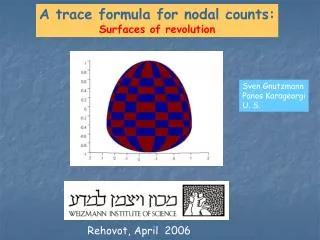
Counting Nodal Domains: Separable systems Rectangle, Disc “billiards” in R2 Surfaces of revolution Liouville surfaces Main Feature – Checkerboard structure
Simple Surfaces of Revolution (SSR) for a few ellipsoids n(m) simple surfaces: n’’(m) 0 m
Bohr Sommerfeld (EBK) quantization
Nodal counting Order the spectrum using the spectral counting function: The nodal count sequence : The cumulative nodal count:
Cmod(k) C(k)
A trace formula for the nodal sequence Cumulative nodal counting
Numerical simulation: the smooth term Ellipsoid of revolution (c(k) – a k2)/k2 c(k)~a k2 k k k
The fluctuating part = c(k) - smooth (k) Correct power-law
The scaled fluctuating part: Its Fourier transform = the spectrum of periodic orbits lengths
The main steps in the derivation Poisson summation Semi-classical (EBK) n+1/2 ! n
Change of variables: Approximate: Integration limit: Another change of variables
The oscillatory term Saddle point integration: Picks up periodic tori with action: Collecting the terms one gets the trace formula
Closing remarks : What is the secret behind nodal counts for separable systems? Consider the rectangular billiard: E(n,m)= n2 + m2 ; (n,m)= n m ~ (Lx / Ly)2 Follow the nodal sequence as a function of : At every rational value of there will be pairs of integers (n1,m1) and (n2,m2) for which the eigen-values cross: -+ E (n1,m1) < E (n2,m2) ; E (n1,m1) = E (n2,m2) ; E (n1,m1) > E (n2,m2) ! at this the nodal sequence will be swapped ! Thus: The swaps in the nodal sequence reflect the the value of ! Geometry of the boundary
Gnutzmann films presents Nodal domains are created or merged by fission or fusion