The Rich History and Dynamic Landscape of Hawaii: A Journey Through Time
Hawaii, a breathtaking chain of volcanic islands, began as mere bumps on the sea floor and has erupted into a paradise over the last five million years. Native Hawaiians, descendants of Polynesians, settled the islands over 2,000 years ago, cultivating crops like taro, essential for traditional dishes. European discovery occurred in 1778 with Captain James Cook. The islands feature diverse topography, thriving wildlife, and a unique economy that has evolved from sugar plantations to a modern tourism and service industry, solidifying Honolulu as a key trade hub.

The Rich History and Dynamic Landscape of Hawaii: A Journey Through Time
E N D
Presentation Transcript
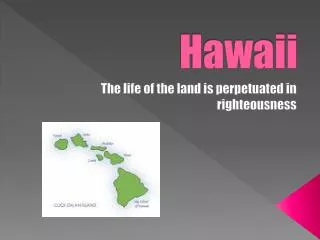
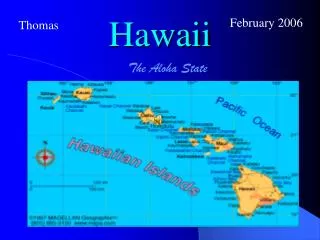
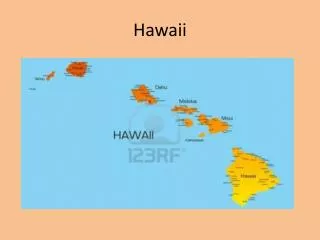
Hawaiian Islands began as bumps on the sea floor • Erupted to become a chain of volcanic islands within the past 5 million years
History • Native Hawaiians are descended from Polynesian Islanders who took sea voyages into the South Pacific more than 2,000 years ago • Native Hawaiians settled in favorable valleys near the coast where they raised taro. A root crop, used for making poi, a traditional staple food.
History • Europeans recorded discovery of Hawaii came in 1778. • Capt. James Cook happened upon the shores of the island while on a voyage seeking a route from the Pacific to the Atlantic. • Capt. Cook killed on return trip. • Venereal disease
Topography • Hawaii’s rocks are volcanic • Which means no metallic minerals, coal, oil or natural gas • Developed on the sloping sides of volcanic cones. • Counting beneath sea-level, largest mountains on earth.
Lies within the tropical northeasterly trade-wind zone • Wet conditions on the islands windward slopes • Leeward rain shadows on the southwest Large portions of the island of Hawaii and sections of central Oahu and Maui have grassy or shrubby vegetation.
Wildlife • Home to many thousands of species of plants, birds, insects, and small mammals • Some 8800 of which are found exclusively in Hawaii
Economy • By the late 1880’s the Hawaiian economy depended almost entirely on the sugar industry. • Plus a few other tropical crops like pineapples • Americans gain control of large blocks of land through intermarriage with Hawaiian royalty • Asian laborers for sugar plantations
Modern • Between 1950-1970 Hawaii transforms from agricultural to a diversified economy. • Construction, service industries, tourism • Honolulu today is a western city by design and construction. • Most important banking center, specializing in East-West transactions. • Leading center for all types of trade between Southeast Asia and United States