Download
1 / 6
60 likes | 198 Vues
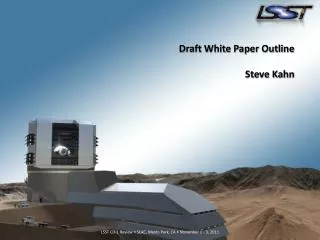
This white paper outlines the LSST (Large Synoptic Survey Telescope) as a significant experiment for dark energy research. It includes a detailed description of the LSST system, planned survey strategies, and the data products anticipated. The paper examines the current understanding and outstanding questions regarding dark energy, reviews precursor projects, and discusses how LSST's key probes will advance scientific knowledge. It further elaborates on the need for a dedicated dark energy collaboration, governance structure, analysis frameworks, and the tools required for investigations over the next three years.

E N D
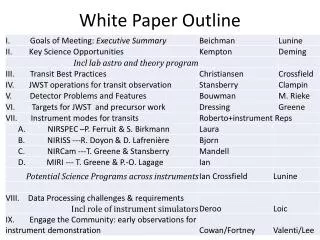
I. LSST as a dark energy experiment. • Overall description of the LSST system. • Planned survey strategy and delivered data products. • Overview of dark energy science – what is known, what are we still trying to learn, what are the ideas to test? • Review of precursor projects – where will this field be at the time LSST starts taking data? • How will LSST extend our science reach? What are the key dark energy probes that LSST will enable, and roughly how far beyond Stage III can we potentially get.
II. The LSST dark energy science collaboration • Need for the collaboration – clarification of the relation to the project and the community. Feedback to telescope, camera, and DM development. • Overall governance and organization. • Policies and procedures (to the extent they are defined). • Initial org chart and definition of roles. • General structure of work plan for next three years.
III. The analysis framework and key systematics for investigation. • Common issues across multiple probes. • Weak lensing: description of major analyses with primary systematics concerns for each. • Large-scale structure: description of major analyses with primary systematics concerns for each. • Clusters of galaxies: description of major analyses with primary systematics concerns for each. • Supernovae: description of major analyses with primary systematics concerns for each. • Strong Lensing: description of major analyses with primary systematics concerns for each. • Photometric redshifts: description of major approaches with primary systematics concerns.
IV. Tools for investigation – simulations, precursor and corollary datasets, etc. • Cosmological simulations – current state, areas for improvement. • Sky catalogues – how are they generated, areas for improvement. • OpSim – current state, areas for improvement that are DE specific. • PhoSim – current state, areas for improvement that are DE specific. • What existing datasets are available, and how are they useful? • What upcoming datasets are available, how will we get access to them, and how will they be useful? • Use of datasets in other wavebands, spectroscopy, etc. Do we need to acquire new observations? If so, how will we get them?
V. Detailed work plan for next three years. • Simulations improvements and development. • Analysis subtasks for each of the probes. • Algorithmic investigations, development. • New observations with existing facilities. • Development of a software framework. • Development of a computational model. VI. Cross-matrix by institution and task element.