
Chapter 4
E N D
Presentation Transcript
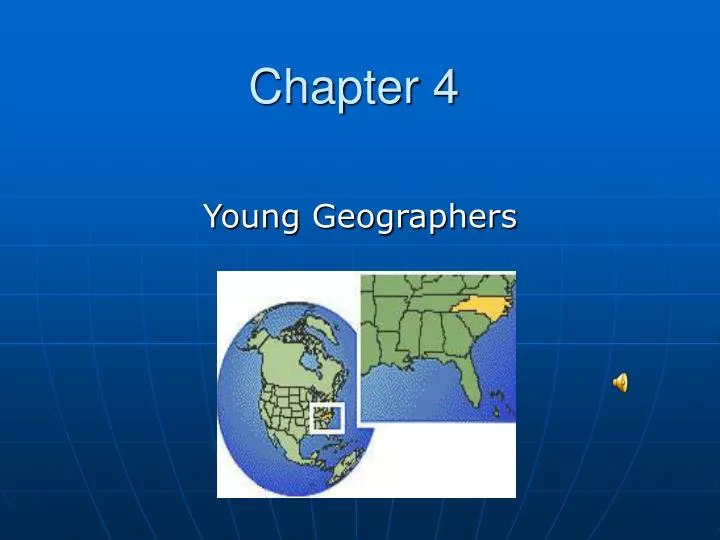
Chapter 4 Young Geographers
What does Geography look like? • Sample lessons— • Flat Stanley • The Erie Canal • Sending exchange packages • Making adobe houses • The World Wide Travel Agency • Making classroom maps • School wide Geography immersion
1. What is Geography? • Geography is the study of the connections between people and places on Earth. • It is the science of space and place. • It brings together the physical and human dimensions of the world in the study of people, places, and environments.
What Is Geography? Geography- The study of: WHEREplaces are located, WHYplaces are located where they are, HOWthose places affect the lives of people, and HOWpeople interact with their environment.
2. Why is Geography important? • Global Society/interconnected world • Illiteracy of students in US • Four reasons • Existential: understand where you are • Ethical: understand interdependency and basis for cooperating • Intellectual: become better informed; therefore make better decisions • Practical: better equipped to solve problems
The Power of Geography Outsourcing Imports Exports Globalization Economic Reason
The Power of Geography Global Warming http://www.oftheworld.tv/0405/amazon1.htm Energy and the Environment http://www.msnbc.msn.com/id/6407196/ Environmental Reason
The Power of Geography Diplomacy Terrorism U. S. Military Geo-Political Reason
The Power of Geography As our world becomes ever more interconnected, a practical knowledge of geography becomes more critical. Citizens need to understand people and cultures in order to make informed decisions about our role in world affairs. Geo-Political Reason
The Power of Geography World Heritage Sites National Parks Aesthetic Reason
The Power of Geography Geography is visual. It captures the imagination and stimulates curiosity about the world; its diverse inhabitants and places, as well as about local and regional diversity. Often the classroom is a student’s first “window on the world.” Aesthetic Reason
3. What is the content of Geography? • National Geography Standards Six Essential Elements • The World in Spatial Terms • Places and Regions • Physical Systems • Human Systems • Environment and Society • Uses of Geography • NC Standard Course of Study
3. What should young geographers know and be able to do? • Five Themes of Geography (a way of organizing the content) • Location • Place • Relationships within Places (Human-Environmental Interaction) • Movement • Regions
4. How should Geography be taught? • Teacher Guided Discovery • Observation • Speculation • Investigation • Extension • Reinforcement • Evaluation
Independent Projects • Opening • Investigating or producing • Culminating activity
5. Maps: the Tools of Geographers • A map is a graphic representation of the Earth’s surface drawn to scale, as seen from above. • Students need the basic skills to construct maps and to interpret maps. • Map skills and understandings are developmental—children must build and play before formal map reading can begin.
Basic map skills for early grades • Locating places • Recognizing and expressing relative location • Interpreting map symbols • Developing a basic idea of relative size and scale • Reading directions • Understanding the globe is the most accurate representation of the earth’s surface
Some types of maps for early elementary • Three dimensional classroom maps • Flat maps • Model communities • Story maps • Mental maps
Refining map skills – primary grades • Map Symbols • Direction • Scale • The Globe • Understand the basic roundness of the Earth • Understand the differences between land (continents) and water areas • Begin to locate the poles, major cities and the US
Basic map skills for upper elementary • Place location and direction • Latitude and longitude • Relative location • Map symbols • Scale • Reading a globe
Some types of maps for upper elementary • Political maps • Physical maps • Topographical maps • Raised relief maps • Weather maps • Special purpose maps • Historical maps • Road maps • Globes
Teacher Reference Websites for Geography • National Council for Geography Education http://www.ncge.org • National Geographic Society http://www.ngsednet.org • North Carolina Geography Alliance http://www.ngsednet.org/ncga • Google Earth http://www.Earth.google.com