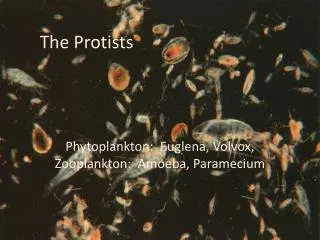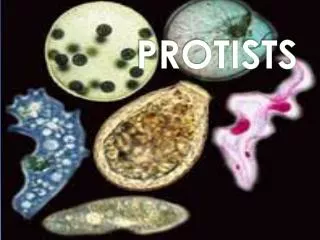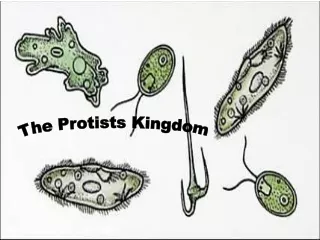
The Protists
The Protists. Eukaryotes. Most unicellular. Most aerobic. Moist environments Can be photoheterotrophs, photoautotrophs, chemoheterotrophs or mixotrophs. Flagella or cilia. All protists can reproduce asexually, some sexually. Endosymbiosis.

The Protists
E N D
Presentation Transcript
The Protists • Eukaryotes. • Most unicellular. • Most aerobic. • Moist environments • Can be photoheterotrophs, photoautotrophs, chemoheterotrophs or mixotrophs. • Flagella or cilia. • All protists can reproduce asexually, some sexually
Endosymbiosis • Eukaryotic cells evolved from symbiotic combinations of prokaryotic cells. • Mitochondria aerobic heterotrophic prokaryotic cells • Chloroplasts photosynthetic prokaryotes
Evidence for Endosymbiosis Similarities between modern bacteria and the chloroplasts/mitochondria of eukaryotes: *size *enzymes *circular DNA molecules *process of division *ribosomes similar
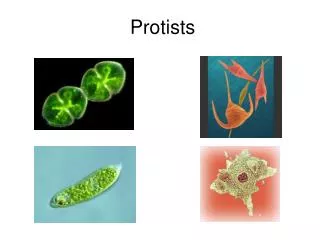
The Candidate Kingdoms • Archaezoa • Euglenozoa • Alveolata • Stramenopila • Rhodophyta • Green Algae
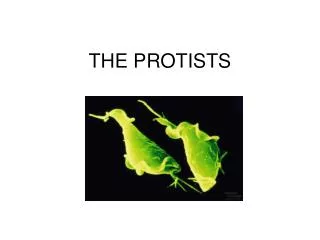
Candidate Kingdom Archaezoa • Giardia • have two nuclei, flagella, and no mitochondria (…parasites)
Candidate Kingdom Euglenozoa Autotrophic and/or heterotrophic flagellates • Euglena • 1 or 2 flagella • Kinetoplasts parasitic, e.g. African Sleeping Sickness (bite of tsetse fly) Trypanosoma
Candidate Kingdom Alveolata • Dinoflagellates, phytoplankton, cause red tides, color from xanthophyll. • Apicomplexans, plasmodium, causes malaria. • Ciliates, paramecium Next Group
Dinoflagellates http://www.microscopy-uk.org.uk/mag/artsep01/dinof.html http://www.microscopy-uk.org.uk/mag/indexmag.html
Apicomplexans Leishmania Parasite infected erythrocyte
Ciliates Stentor Paramecium Vorticella
Pseudopod “Protists”Taxonomic lineage unclear, so no clear kingdom found… i.e. “misfits” • Rhizopods, amoebas • Actinopods, radiolarians and heliozoans (delicate silica shells). • Foraminiferans, marine with porous calcium shells. Used as index fossils. • Slime Molds, cytoplasmic streaming
Rhizopod Amoeba
Actinopods Radiolarians
Slime Molds • Plasmodial Slime Mold – Myxomycota. Heterotrophic,brightly colored, multinucleated ameboid mass.
Candidate Kingdom Stramenopila • Diatoms (bacillariophyta)– unicellular plankton with box-like silica walls. Diatomaceous earth. • Golden Algae(chrysophyta) – yellow and brown carotene and xanthophyll pigments • Brown Algae(phaeophyta)- largests and most complex. Seaweeds and kelps, may be as long as 60m. • Water Molds(oomycota) – white rusts and downy mildews Next Group
Brown Algae - Phaeophyta Kelp Harvesting
Kelp Structures • Analogous plant-like structures • Body = thallus • Root-like structure – holdfast • Stem-like structure – stipe • Leaf-like structure - blades
Water molds, white rusts and downy mildews Water mold White rust on spinach
Candidate Kingdom Rhodophyta • Red color from pigment • Marine • Multicellular • Carrageenan thickener
Candidate Kingdom Green Algae *Many scientists advocate inclusion of green algae into the plant kingdom. *More than 7000 species, mostly freshwater. *Unicellular – Chlamydomonas *Colonial – Volvox *Multicellular – Ulva Ulva
Green Algae - Chlorophyta Volvox Chlamydomonas Spirogyra