Download
1 / 26
260 likes | 416 Vues
Explore the geologic history of Earth through various cultural, philosophical, and scientific lenses. Part 1 discusses common traditions and the elements of nature, while Parts 2 and 3 delve into scientific theories on energy cycles, matter, and the geologic timeline of Earth’s formation through diverse eons and eras. Learn about the significant events that shaped life on Earth, from oceans to land, and the interplay of natural elements. This comprehensive overview highlights the patterns of evolution and the intricate systems that sustain our planet.

E N D
Geologic History Making of a Planet Part 1 Common Traditions
Common TraditionsCulture, Philosophy, and Religion • Elements of Nature Fire Earth Wind Water Spirit – a.k.a. Aether or “breath of life”
Common TraditionsCulture, Philosophy, and Religion • Order of Creative Events 1. Formation of the Earth 2. Life in the Oceans 3. Life on Land 4. Humankind * life in the air varies by tradition (birds)
Geologic History Making of a Planet Part 2 Scientific Theories
Scientific TheoriesFossils, Geology, and Astronomy – Empirical Evidence • Ingredients for a Living Planet Stable Source of Energy Active Geosphere Active Hydrosphere Active Atmosphere Balanced Biosphere
Scientific TheoriesCycling of Matter and Energy • Stable Source of Energy 1. Sun-Earth-Moon System 2. Radiant Solar Energy 3. Tidal Forces of Gravity 4. Seasons
Scientific TheoriesCycling of Matter and Energy • Geosphere 1. Volcanic Activity 2. Plate Tectonics 3. Rock Cycle
Scientific TheoriesCycling of Matter and Energy • Hydrosphere 1. Ocean Currents 2. Ocean Tides 3. Water Cycle a. Evaporation, Condensation, Precipitation b. Surface Water c. Ground Water d. Polar Ice Caps
Scientific TheoriesCycling of Matter and Energy • Atmosphere 1. Air Currents 2. Weather 3. Climate 4. Greenhouse Effect 5. Ozone Layer
Scientific TheoriesCycling of Matter and Energy • Biosphere 1. Biogeochemical Cycles ( O2 , CO2 , N2 ) 2. Cycles of Environmental Change, Evolution, Adaptation, and Extinctions 3. Balanced Ecosystems 4. Population Dynamics 5. Trophic Levels, Food Webs, and Energy Pyramids
Geologic History Making of a Planet Part 3 Geologic Timeline
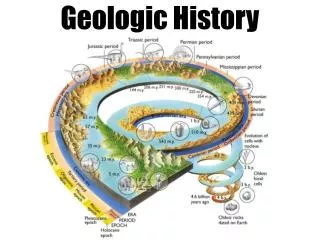
Geologic TimelineDivisions and Units of Measure • Eons 1,000’s of Millions of Years • Eras 100’s of Millions of Years • Periods 10’s of Millions of Years • Epochs Millions of Years
Geologic TimelineEons of Earth’s History • Hadean 1 Billion Years • Archean 1 Billion Years • Proterozoic 2 Billion Years • Phanerozoic ½ Billion Years
Geologic TimelineEons of Earth’s History • Hadean Eon • Archean • Proterozoic • Phanerozoic · Meaning: “Hell on Earth” ·Began: ~ 5 Billion Years Ago ·Length: ~ 1 Billion Years ·Birth of Solar System & Accretion of Planets ·Theia Event – Formation of the Moon ·1st Atmosphere, Cooling Temperatures, Crust Forms, Oceans Fill, Continents Drift
Geologic TimelineEons of Earth’s History • Hadean Eon • Archean • Proterozoic • Phanerozoic · Meaning: “Beginning or Origin” of Life ·Began: ~ 3.8 Billion Years Ago ·Length: ~ 1 Billion Years ·Natural Development of Organic Molecules in Deep Water and Shallow Pools ·First Single Cell Prokaryotes ·Chemosynthesis vs. Photosynthesis
Geologic TimelineEons of Earth’s History • Hadean Eon • Archean • Proterozoic • Phanerozoic · Meaning: “Earlier Life” ·Began: ~ 2.5 Billion Years Ago ·Length: ~ 2 Billion Years · Snowball Earth Event ·Oxygenation Event ·Early Multicellular Forms of Life
Geologic TimelineEons of Earth’s History • Hadean Eon • Archean • Proterozoic • Phanerozoic · Meaning: “Visible Life” ·Began: ~ ½ Billion Years Ago (Ongoing) ·Cambrian Explosion – Diversity of Species · Advanced Plants and Animals in Oceans ·Migration of Life to Land
Geologic TimelineEons of Earth’s History • Hadean Eon • Archean • Proterozoic • Phanerozoic Video: Earth – Making of a Planet
Geologic History Making of a Planet Part 4 Phanerozoic Eon Hadean, Archean, Proterozoic, PHANEROZOIC
PHANEROZOIC EON • Paleozoic Era • Mesozoic Era • Cenozoic Era • Means “old life” • Began about 541 Mya • Major Evolutionary Events Include: Central Nervous System + Eyes Skeletons in Fish Spinal Cord + Vertebral Column Wings in Insects Plant Life Migrates to Land (Vascular Tissue, Spores in Ferns) Amniotic Eggs in Reptiles Reptiles Migrate to Land Insects Migrate to Land Mammal-Like Reptiles Appear Jaw Structures in Fish Seeds in Plants Amphibians Migrate to Land (Tetrapods) Paleozoic Era Ended in Mass Extinction – 95% of All Species
PHANEROZOIC EON • Paleozoic Era • Mesozoic Era • Cenozoic Era • Means “middle life” • Began about 251 Mya • Major Evolutionary Events Include: Conifer Forests Spread Birds Appear First Mammals & Dinosaurs Appear Flying Reptiles Flowers and Fruit in Plants Turtles, Frogs, Lizards, and Salamanders Appear Wings in Insects Dinosaurs Dominate Mesozoic Era Ended in Mass Extinction – Asteroid Strike – 50%
PHANEROZOIC EON • Paleozoic Era • Mesozoic Era • Cenozoic Era • Means “new life” • Began about 66 Mya • Major Evolutionary Events Include: Mammals Survive and Dominate Flowering Plants Dominate Grasses Appear and Spread Four Major Glaciation Periods · Extinction of Large Mammals · Rapid Changes in Marine Species Several Species of Humans Appear and Go Extinct
Geologic History Making of a Planet Part 5 Patterns of Evolution
Patterns of EvolutionGeological • Continental Drift and Supercontinents Ur (Vaalbara) ~ 3.6 Gya (Archean) ~ 2.7 Gya (Archean) Kenorland ~ 1.8 Gya (Proterozoic) Columbia (Nuna) ~ 1.3 Gya (Proterozoic) Rodinia ~ 600 Mya (Proterozoic) Pannotia ~ 300 Mya (Phanerozoic) Pangaea
Patterns of EvolutionGeological • Global Warming/Cooling • Glaciers and Polar Ice Caps • Changes in Sea Level • Ice Ages
Patterns of EvolutionBiological • Environmental Changes & Mass Extinctions • Genetic Mutations 1. Random and Require Many Generations 2. Most Mutations are Deadly – Lead to Extinction 3. Diversification in Anatomy and Physiology 4. Diversification in Size 5. Best Adaptations Passed On to Posterity