Download
1 / 15
150 likes | 278 Vues
The AMY detector, a compact device from the 1980s, played a significant role at CERN's LEP and LHC facilities. These experiments examined collision processes involving electrons, protons, and anti-particles, revealing crucial insights into particle interactions and new physics. By measuring cross sections and branching ratios, researchers evaluate the probability of events like Higgs decays. Harnessing high-speed networking and computing power, the HEP Data Grid enables massive data sharing and complex analysis of up to 108 events per year, paving the way for future explorations in high-energy physics.

E N D
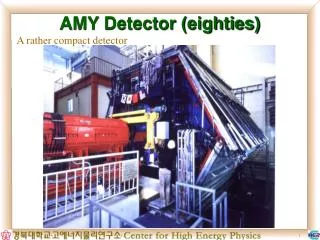
AMY Detector (eighties) A rather compact detector
LEP/LHC at CERN- Geneva Particle Accelerators • usual types • electron vs anti-electron • proton vs proton • proton vs anti-proton • electron vs proton
e+e- Cross Sections(for example, LEP experiments in 1989~2000) • They represents the probability of producing specific scattering events • Finding new physics largely depends on how well we distinguish signals from background processes
Branching Ratios of Higgs (e.g.) • Branching Ratios mf2 • Decays to bb dominant
4 jets Missing Energy Higgs Signature (Expected) ν Z→ νν Z→ qq H→ bb H→ bb ν 2 leptons(e,μ) +2 jets 2 taus(τ) +2 jets τ Z(H)→τ τ Z→ l+l- H(Z)→bb(qq) H→bb τ
Event Display
One of the four LHC detectors: Experiments from 2007 online system multi-level trigger filter out background reduce data volume 40 MHz (40 TB/sec) level 1 - special hardware 75 KHz (75 GB/sec) Particle collisions in nanoseconds level 2 - embedded processors 5 KHz (5 GB/sec) level 3 - PCs 100 Hz (100 MB/sec) data recording & offline analysis
Why HEP Data Grid and e-Science? • The Grid is rapidly being recognized as one of the most promising application of information technology. • High Energy Physics (HEP), as one of the most immediate applications, needs, in its nature, - A new next-generation information technology in very high-speed networking, - massive data distribution and processing, - and intensive computing power and data storage. • To meet these needs, "HEP Data Grid“ and we do e-Science
CERN Experiments: Example The LHC Detectors CMS ATLAS ~6-8 PetaBytes / year ~108 events / year LHCb
CMS at LHC Courtesy P. Sphicas/ICHEP2002 and CMS
Concepts of Linear Collider in 2010’s another option
In the future • Production of data ( > tens of PB/year) • Processing of data and sharing with thousands of people for analysis • Transferring data ( ~ Tera bit seconds ) • Analysis becomes very complex but should be made easy for users • GRID / High BW Networks/ Supercomputing • In fact, related technologies and economic factors are in favor of us to make this scenario real