
SlideServe
Menu
Préférences
© SlideServe · v2026

Open Education Resources

brant avatar
26 diapositives · 1.2K Views · Jul 21, 2014

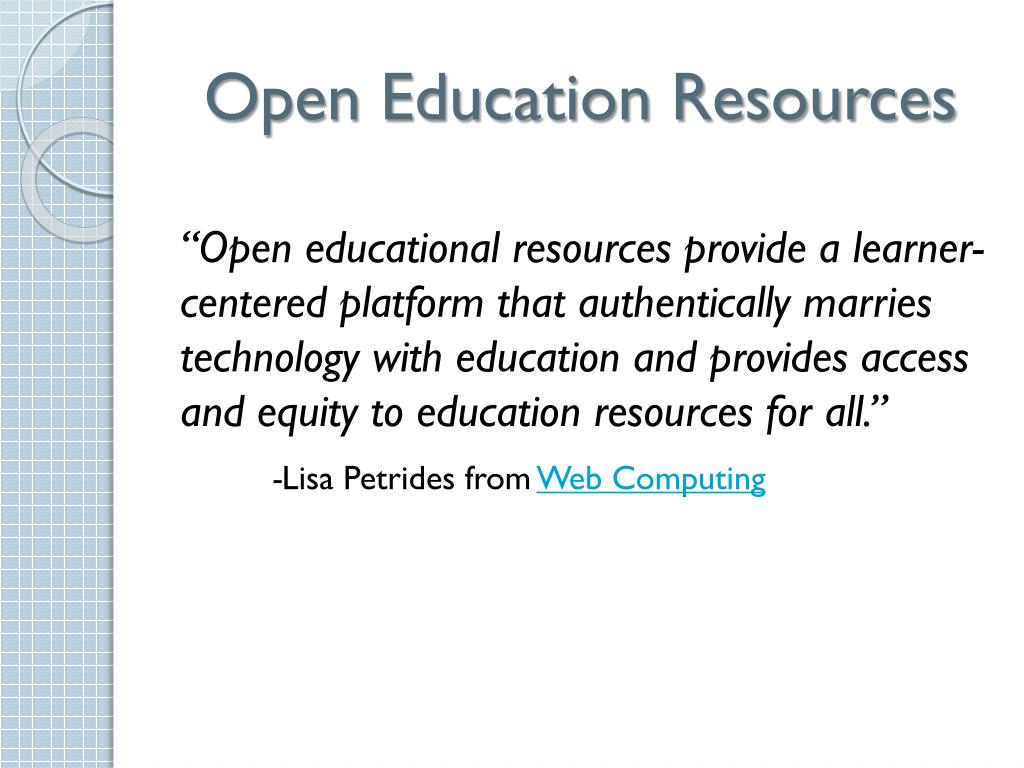
Open Education Resources. “Open educational resources provide a learner-centered platform that authentically marries technology with education and provides access and equity to education resources for all.” - Lisa Petrides from Web Computing. What is OER?.
Open Education Resources - slide 1
01 / 26Open Education Resources
1 / 17

Télécharger la présentation

Open Education Resources
Une image / un lien ci-dessous est fourni (tel quel) pour télécharger la présentation

Politique de téléchargement : le contenu du site vous est fourni TEL QUEL pour votre information et votre usage personnel ; il ne peut être vendu, concédé sous licence ni partagé sur d’autres sites sans l’accord de son auteur.Le contenu vous est fourni TEL QUEL, pour votre information et votre usage personnel uniquement. Téléchargez la présentation en cliquant sur ce lien. Lors du téléchargement, si vous ne parvenez pas à télécharger une présentation, l’éditeur a peut-être supprimé le fichier de son serveur.Pendant le téléchargement, si vous ne parvenez pas à obtenir une présentation, le fichier a peut-être été supprimé par l’éditeur.

F I N

Plus de contenu associé

Transcription de la présentation
  1. Open Education Resources “Open educational resources provide a learner-centered platform that authentically marries technology with education and provides access and equity to education resources for all.” -LisaPetrides from Web Computing

  2. What is OER? Open Educational Resources (OERs) • Are free • Openly licensed • Educational materials that can be used for teaching, learning, research, and other purposes

  3. What does OER’s Include? • Courses • Course materials • Content modules • Learning objects • Collections • Journals

  4. OERs and Tools • OERs includes tools for delivering educational content • Software that supports the creation, delivery, use and improvement of open learning content • Searching and organization of content • Content and learning management systems • Content development tools • On-line learning communities

  5. History of OERs • The term “learning object” was coined in 1994 by Wayne Hodgins • Shared the idea that digital materials can be designed to allow easy reuse in a wide range of teaching and learning situations • Term was adopted by educators and instructional designers

  6. History of OERs • Movement originated from developments in open and distance learning (ODL) • Culture of open knowledge and open source • Believes in free sharing and peer collaboration

  7. Creative Commons • Creative Commons licensing provides a framework to provide guidelines for the “4 Rs” of sharing resources: • Reuse: copying verbatim with attribution • Redistribution: sharing with others • Revision: adapting and reusing • Remixing: combining with other resources

  8. Creative Commons

  9. Today’s Session • Resources and links for today’s session can be found on- • Pinterest • Learni.st • Ed Shelf • OCIP Resource Wiki

  10. Susie’s and Sandy’s Top Picks • OER Commons • Merlot • Physics Education Technology (PhET) • Khan Academy • Open Culture (OC) • Open Learning Initiative (OLI) • Open Course Ware (OCW)

  11. OER Commons http://www.oercommons.org/

  12. OER Commons Details • Across all subject areas • Lots of different resource types • Flexible search features • Quality rating system • Clearly labeled “Conditions of Use” • Short abstract • Review resource • Easy to curate resources in account

  13. Merlothttp://www.merlot.org

  14. Merlot Details • Online learning materials in different disciplines • Peer review opportunities – can review and add to the content collection • Awards – submitted content is review and can be recognized by consortium • Guest Speakers – content specialists are available for guest speaking to your students

  15. PhEThttp://phet.colorado.edu/

  16. PhET Details • Interactive labs- manipulations, cause and effect opportunity, and collection of data • Researched-based simulations – continually being revised and improved • Connections- real-life phenomena focusing on the underlying science • Quantitative exploration - measurement instruments including rulers, stop-watches, voltmeters and thermometers

  17. Khan Academy http://www.khanacademy.org/

  18. Khan Academy Details • Instruction – math, science, some humanities, test prep • Practice - materials provided for student practice with feedback • Teacher/Coach - teachers can be associated with their students to monitor progress or completion • Assessment – quizzes and tests provided • Collaborative opportunities- teachers are invited to add and improve the collection

  19. Open Culture http://www.openculture.com/

  20. OC Details • Use resources to enhance your courses • Materials are vetted and added to regularly • You can mail@openculture.com & suggest content to add • Easy to search & integrated content • Mobile friendly • No registration! Subscribe or Follow • Ads a Con but funds resource

  21. Open Learning Initiative http://oli.cmu.edu/

  22. OLI Details • Students use independently, choose level of access – register or not • Textbook independent, embedded practice questions, hands on practice, virtual labs, videos • Faculty create custom courses using OLI materials • “Learning Dashboard” tracks student progress

  23. Open Course Ware(OCW) Search http://www.ocwsearch.com

  24. OCW Details • Search in a variety of ways • Helpful example searches • Advanced Search customize search with operators • Link to web-based course OR zip file • Download – full course load access via index.html • Do you want all materials on your desktop/laptop?

  25. Where you should start! • Academic Earth http://academicearth.org • Connexionshttp://cnx.org • Courserahttps://www.coursera.org/ • Creative Commons http://creativecommons.org/ • iTunesUhttp://www.apple.com/education/itunes-u • Khan http://www.khanacademy.org • Merlot http://www.merlot.org http://www.merlot.org • MIT http://ocw.mit.edu/index.htm • National Academy Press http://www.nap.edu • OCW Search http://www.ocwsearch.com/

  26. Where you should start! • OER Commons http://www.oercommons.org/ • Open Courseware Consortium http://www.ocwconsortium.org • Open Culture http://www.openculture.com/ • Open Learning Initiative http://oli.cmu.edu/ (Carnegie Mellon) • Peer to Peer University https://p2pu.org/en/ • PHET http://phet.colorado.edu • Udacityhttp://www.udacity.com/ • Wiki Books http://en.wikibooks.org