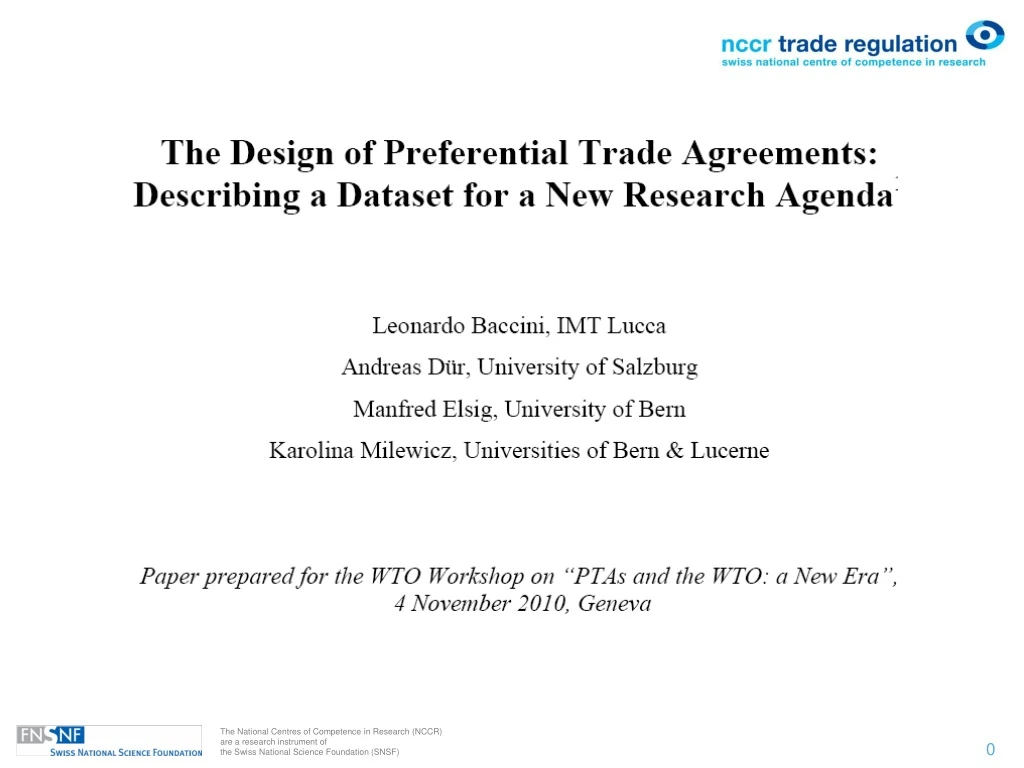

Global Preferential Trade Agreements: Understanding Design Dynamics
E N D
Presentation Transcript
Starting point • Many coding projects on sub-areas or selected number of treaties • Little systematic coding on PTAs • Lots of explanations on why states sign PTAs and what explains design • Joining forces
The theoretical backdrop to the project • The signing of preferential trade agreements • Legalization through international agreements • The rational design of international institutions/agreements • Diffusion • Political and economic effects of trade agreements • Power • Forum-shopping/Overlapping Regimes
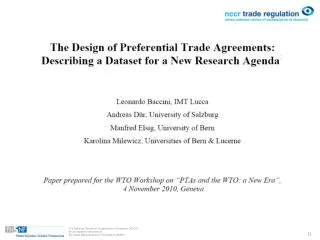
The population of PTAs • 494 PTAs between 1945-2009 • Criteria: negotiated, concrete and preferential • Sources: WTO, Tuck Trade Agreements (Dartmouth), McGill Faculty of Law Preferential Trade Agreements database, bilaterals.org, cuts-citee.org • Full text and appendices (70 full texts missing)
Design of PTAs • Market Access (tariff schedules) • degree of concessions (tariffs and TRQ), speed and depth • tariff peaks • exemptions • export taxes • Trade facilitation • To be finalized March 2011
Design of PTAs • Services • substantive provisions • 11 broad services sectors • presence or absence of MFN • national treatment • non-establishment • movement of natural persons clauses
Design of PTAs • Investment • sectoral coverage • scope of non-discrimination provisions • most-favored nation • national treatment • standards of treatment • transfer of payments • dispute settlement mechanism • temporary movement of business and natural people
Design of PTAs • Intellectual Property Rights • general statement on IPRs • IPRs Conventions • scope of IPRs protection
Design of PTAs • Government Procurement • general objective/substantive rules • national treatment clause • transparency clause • reference to the GATT/WTO rules • scope in terms of entities (government, sub-national governments, state-owned enterprises) and type of purchase (goods and/or services)
Design of PTAs • Competition • chapter or single articles • provisions related to subsidies (allowed, out-ruled, specific references to the GATT/WTO) • scope (monopolies and cartels, mergers and acquisitions, state trading enterprises, state aid, structural adjustment provisions) • degree of cooperation measured (from general obligation not to distort competition to creation of common competition authority).
Design of PTAs • Trade Defence Instruments • anti-dumping, countervailing duties, and safeguards provisions(allowed, out-ruled, specific references to the GATT/WTO) • balance of payment provisions
Design of PTAs • TBT and SPS Measures • general provisions • references to GATT/WTO provisions • cooperation and information exchange • TBT: provisions stipulating the harmonization of rules (reference to standards)
Design of PTAs • Dispute Settlement • existence of provisions • degree of delegation • choice of dispute settlement forum • implementation (bindingness and sanctions) • exemptions.
Design of PTAs • Non-trade issues (“political” issues) • pre-amble or text • areas: 1) corruption, 2) labour standards, 3) environmental protection, 4) human rights, 5) democracy, 6) security and 7) social development, 8) open category • To be finalized by December 2010.
Coding work organization and reliability tests • 11 coders in Bern, Geneva, Lucca, and Salzburg • preparation and coaching • first reliability test encouraging • to be followed by: second round of coding (random sub-samples) • other topics (energy, transport) • next steps: finalizing first round, find missing treaties,