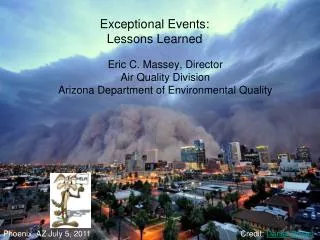
Exceptional Events: Lessons Learned
80 likes | 215 Vues
This presentation by Eric C. Massey, Director of the Air Quality Division at the Arizona Department of Environmental Quality, discusses the critical lessons learned from Arizona's management of exceptional events affecting air quality. It highlights the journey from 2007 to 2012, detailing the submissions to the EPA, the revisions made, and the challenges faced. The presentation underscores the importance of collaboration, strategic planning, and effective communication in improving air quality management. Additionally, it outlines future submissions and the expected completion timelines.


Exceptional Events: Lessons Learned
E N D
Presentation Transcript
Exceptional Events:Lessons Learned Eric C. Massey, Director Air Quality Division Arizona Department of Environmental Quality Phoenix, AZ July 5, 2011 Credit: Daniel Bryant
Exceptional Events Timeline • Phoenix Area = NAA since 1990 amendments • 5% Plan submitted in 2007 • Calendar Year 2010 • Resubmitted 4 EE demonstrations for 2008 • Each > 400 pages of highly technical information • Unsuccessful, withdrew 5% Plan • Calendar Year 2011 - EPA Guidance • Calendar Year 2012 • New 5% Plan submitted • ADEQ submitted July 2-8, 2011 Events • Total package < 250 pages in length • Approved on September 6, 2012 • EPA revised guidance, worked with ADEQ • Further streamlining • 40-60 pages of new material per event
Upcoming Submissions • 22 additional packages • 25 exceedance days • Some easier – regional events • Some harder – single monitor • Schedule • First set to public notice on 12/1 • Anticipating 6 demonstrations (1 rural) • Second set to public notice on 1/1/13 • Anticipating 50-70% completion • Final set to public notice on 4/1/13 Credit: Mike Maxham
Who and How Much? • ADEQ staff lead the project • Local help • MAG, Maricopa County • Contractors engaged • Sierra Research • Sonoma Technology • Cost • Staff time • $400,000 in contract charges • Only includes Maricopa County
Repeated Events • Set the stage in the first submission: • Introduction and background done once • Most of conceptual model • Historical fluctuations updated periodically • Not reasonably controllable or preventable • Event specific information: • Some conceptual model elements • Clear causal relationship • “But for” analysis • Supporting forecasts/data/analyses
Other Helpful Tools • Strategic planning performance measures • Focus on improving Air Quality • Submit EE’s within 180 days • EPA concurrence on 95% of submissions • Develop a screening tool
Recommendations • Get really smart people • Involve the customer • Tell the story in words, not just data • Use photos/video evidence of the event wherever possible • Go fast