
The Periodic Table
E N D
Presentation Transcript
The Periodic Table Unit II—Part 4
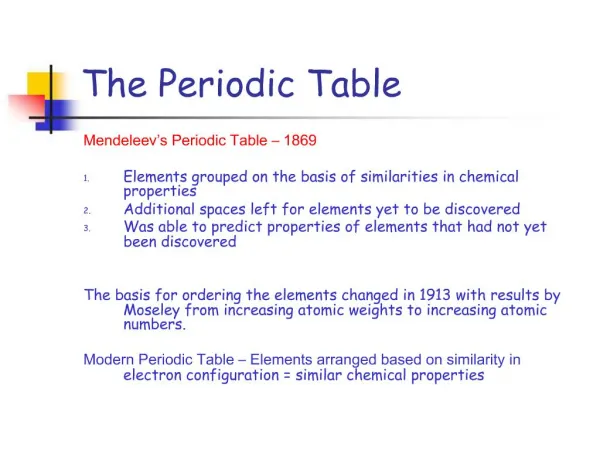
The Father of the Periodic Table—Dmitri Mendeleev • Mendeleev (1834-1907) was the first scientist to notice a relationship between the elements • Around 1865 he arranged his periodic table by atomic mass • Said properties of unknown elements could be predicted by the properties of elements around the missing element
The Periodic Table • Henry Moseley (1887-1915) later discovered that the periodic nature of the elements was associated with atomic number, not atomic mass.
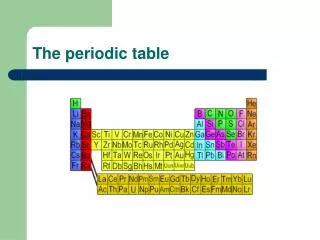
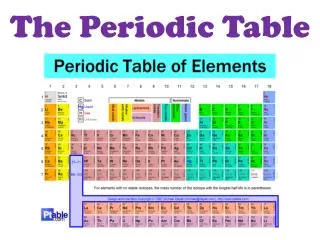
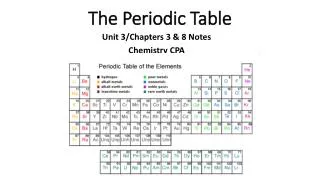
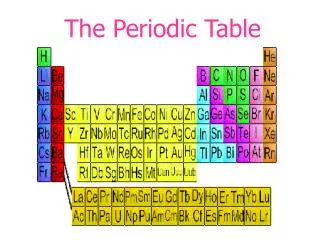
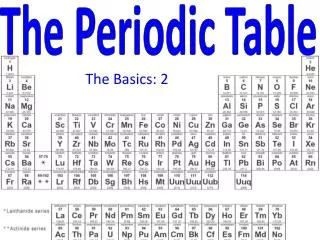
The Periodic Table Column = Group or Family 18 columns on the Periodic Table Row = Period 7 rows on the Periodic Table
What does the information in the box tell me? 1 H 1.008 Atomic Number = # of protons and # of electrons Elemental Symbol Atomic Mass = # of protons plus neutrons
Metals, Nonmetals, and Metalloids Hydrogen (H) the only nonmetal on the metal side Nonmetals are on the right of the stair-step Metals are to the left of the stair- step Semi-metals, “metalloids,” touch the stair-step
VALANCE ELECTRONS • The electrons that are in the outermost energy level of any atom. Examples: Hydrogen has 1 valance electron Boron has 3 valance electrons Oxygen has 6 valance electrons Argon has 8 valance electrons
8 VALANCE ELECTRONS • In order to feel and be stable, all atoms would like to have 8 valance electrons. If they don’t already have 8 they will react very well and bond with others that can add up to 8. Example: Oxygen has 6 valance electrons and reacts very easily with 2 Hydrogen atoms to form H2O, water.
The Groups of the Periodic Table • Group 1 or 1a: The Alkali Metals • Most reactive metals on the PT • Rarely found free in nature • Charge of +1, 1 valence electron
Group 2 or 2a: The Alkaline Earth Metals • Still quite reactive • Charge of +2, 2 valence electrons
T he Groups of the Periodic Table • Groups 3-12 or 3-12b: Transition Metals • Found freely and in compounds in nature • Charge is usually +2 but can vary—usually 2 valence electrons
Group 13 or 3a: Boron Family • Charge is +3, 3 valence electrons
The Groups of the Periodic Table • Group 14 or 4a: The Carbon Family • Contains elements that can form unusual bonds (carbon and silicon) • Charge is +4 or -4, contains 4 valence electrons
Group 15 or 5a: The Nitrogen Family • Charge is -3, contains 5 valence electrons
The Groups of the Periodic Table • Group 16 or 6a: The Oxygen Family • Also known as the chalcogens • Charge is -2, 6 valence electrons
Group 17 or 7a: The Halogens • Most reactive nonmetals • charge is -1, 7 valence electrons
Group 18 or 8a: The Noble Gases (The Inert Gases) • Inert means Nonreactive, don’t normally react with other elements • Charge is 0, 2 or 8 valence electrons
Special Rows on the PT Lanthanides We call these rare earth metals because they are rarely found on earth. Actinides