ENZYMES
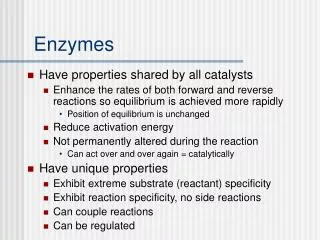
Enzymes are specialized proteins that act as catalysts in biological processes, facilitating chemical reactions without being consumed in the process. They usually have a tertiary or quaternary structure and their names typically end in 'ase.' Enzymes function by binding to substrates at specific active sites, lowering the activation energy required for reactions. The rate of enzyme activity can be influenced by factors such as temperature, pH, and substrate concentration. Understanding enzyme behavior is crucial for many fields, including biochemistry and medicine.

ENZYMES
E N D
Presentation Transcript
ENZYMES 1.4
Enzyme are _________________ catalysts. • Either tertiary or quaternary. • Names ususually end in ‘ase.’ • CATALYST: substance that _____________ a chemical reaction without being consumed in the process. • Reactants products. Enzyme can be used again. • For chemical reaction to occur: bonds between reactant molecules break, rearrangement of atoms, new bonds form. • Reactants need to _______________ with enough _______________ and in the correct geometric ________________ for bond breaking to occur transition state.
Activation Energies • All reactions possess an activation energy, EA. • Activation energy can be provided by: • Heat • Examples: • spark at a gas station. • Collision theory • Problem with heat as EA source? ___________________________________________. • Catalysts allow reactions to proceed at suitable rates at moderate temperatures by reducing the a ACTIVATION ENERGY EA barrier.
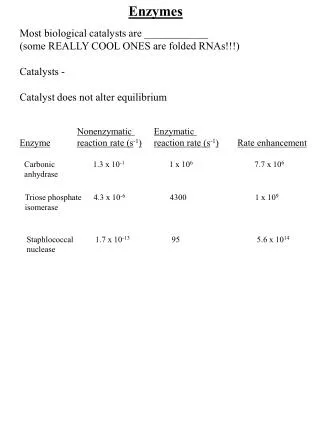
Catalysts do not affect the free energy change, ∆G • Does not change endergonic exergonic. • Only decreases the potential energy level of the transition state more colliding reactants reach the transition state and become products. • Does not affect the position of equilibrium • Forward and reversed reactions are catalyzed at the same rate • Rate at which equilibrium is reached is increased.
SUBSTRATES • A substrate is the reactant that an enzyme acts on when it catalyzes a chemical reaction. • Substrate binds to particular site on enzyme to which it is attracted. • Very specific for substrate will not even bind isomers.
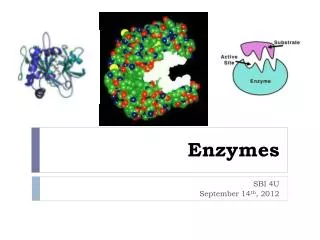
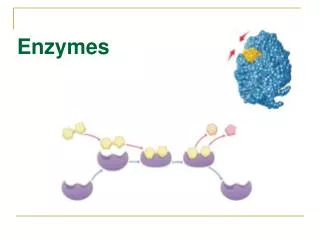
MODEL OF ENZYME ACTIVITY • Active site: region where substrate binds. • Usually a pocket or groove. • As substrate comes close to active sites, ____________________ of substrate interact with _________________ of _____________ on enzyme. • Enzyme-substrate complex: substrate + enzyme • Interactions between substrate and enzyme causes a ___________________ change of the enzyme. • Induced-fit model enzyme ‘accomodates’ • Substrates’ chemical bonds are stretched and bent lowers the amount of energy needed to bring substrate to ‘transitional state.’ LOWERS THE ACTIVATION ENERGY!
Folded Paper & Paper Clip Analogy NOTE: ONE PAPER CLIP = ONE MONOMER TEAM 1: Make 3 polymers of 3 monomers each. No paper TEAM 2: Make 3 polymers of 3 monomers each. With paper WINNER: _________ How does the action of the paper enzyme relate to a real enzyme-catalyzed condensation reaction?
Factors Affecting the Rate of Enzyme Activity Temperature pH Concentration of substrate
Temperature • Reactions increase in speed with an increase in temperature (collision theory). • As temperature increases beyond a critical point, protein ______________ and loss of enzyme ____________ would occur. • Every enzyme has an optimal temperature at which it works best. • Human enzymes: around _____. • Some thermophiles: _____.
pH • Enzymes have pH at which they work best. • If environment is too acidic or basic, it may ___________________________ the enzyme. • Pepsin • Catalyzes hydrolysis of proteins in the stomach • There is HCl in the stomach pH = 2 • Trypsin • Also hydrolyses proteins, but in the small intestine • Basic substance is secreted into small intestine pH=8
Substrate Concentration As substrate concentration increases, more reactions can occur. However, as active sites become occupied, rate of reaction slows. A point called the ‘saturation’ (asymptote)is reached, in which all enzyme active sites are occupied. Reaction rate virtually constant: reaction can only occur when enzymes are vacant.
Cofactors and Coenzymes • Cofactors: nonprotein components, such as dissolved ions, that are needed for some enzymes to function. • Zinc and manganese ions. • Coenzymes: organic nonprotein cofactors that are needed for some enzymes to function. • Derivatives of many vitamins • May bind to active site with covalent bonds, or weakly to the substrate
Enzyme Inhibition • A variety of substances inhibit enzyme activity. • Some are poisons, some are used by cell to control enzyme activity. • Competitive Inhibitors • Similar to enzyme’s substrate • Bind to active site • Block normal substrate from binding • Reversible • Solution: increase concentration of enzyme’s substrate compete. • Noncompetitive Inhibitors • Do not compete with substrate • Bind to another part of the enzyme conformation change change in shape of active site enzyme loses affinity for substrate. • DDT: poison that inhibits enzymes of the nervous system
Allosteric Regulation • Cells control enzyme activity to coordinate cellular activities. • Restrict production of enzyme • Inhibiting the action of enzyme • Allosteric Sites • Receptor sites • Substances bound to it may inhibit or stimulate enzyme’s activity. • Usually in proteins in quaternary structure with several subunits and several active sites. • ALLOSTERIC REGULATORS: • Attach to allosteric sites using weak bonds. • ACTIVATORS: stabilizes protein conformation to keep active sites available. • ALLOSTERIC INHIBITOR: Stabilizes inactive form of enzyme • Noncompetitive inhibitors
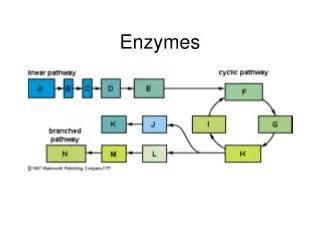
FEEDBACK INHIBITION • Method used by cells to control metabolic pathways involving a series of sequential reactions. • Each reaction catalyzed by a specific enzyme. • A product formed later in the sequence of reaction steps ALLOSTERICALLY INHIBITS an enzyme that catalyzes a reaction occurring earlier in the process. • Reduces the production of the inhibitor a product of the process. • As product used up, less inhibition. • Enzyme in active form again, but cycle continues. • RESULT: AMOUNT OF PRODUCT KEPT TIGHTLY CONTROLLED BY FEEDBACK INHIBITION PROCESS.
METABOLIC PROCESSES are also controlled by controlling where certain enzymes are in the cell. • Some in mitochondria ______________________ • Some are in chloroplasts _____________________ • Some in the golgi bodies: _____________________ • Some in lysosomes: __________________________ ETC.
Classwork/Homework Read pages 75-76 (Commercial and Industrial Uses of Enzyems) PPs 1-9