Understanding Carbohydrates: Structure, Isomerism, and Classification of Monosaccharides
This article explores the chemical structure and classification of carbohydrates, focusing on monosaccharides, particularly the significance of stereoisomers and their optical activity. It defines essential terms such as aldo and keto sugars and discusses the degrees of unsaturation. Further, it examines the properties of important sugars like D-glucose, D-galactose, and D-fructose, including the formation of hemiacetals and the concept of anomeric carbons. The classification based on the number of carbons and functional groups is also emphasized, demonstrating the vast variety of possible isomers.

Understanding Carbohydrates: Structure, Isomerism, and Classification of Monosaccharides
E N D
Presentation Transcript
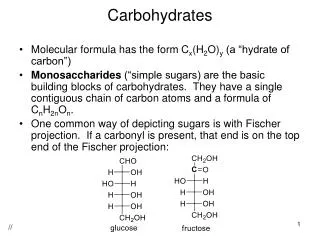
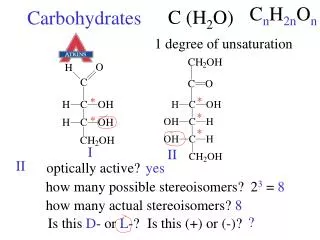
CnH2nOn C (H2O) Carbohydrates 1 degree of unsaturation * * * * * I II II optically active? yes I optically active? yes how many possible stereoisomers? 23 = 8 how many possible stereoisomers? 4 how many actual stereoisomers? 8 how many actual stereoisomers? 4 ? Is this D- or L-? Is this (+) or (-)? Is this D- or L-? Is this (+) or (-)? ?
I II Carbohydrates can be: simple monosaccharides can’t be hydrolyzed complex disaccharides hydrolyzed to 2 monosaccharides polysaccharides hydrolyzed to 3 - 1000’s
I II Classifying monosaccharides 1. carbonyl group “aldo” or “keto” C=O “pent”, “hex” 2.number of carbon atoms “tri”, “tetr”, 3.suffix “ose” I II hex aldo tetr ose keto ose 23 isomers 22 isomers
Physical properties pentose Classify: aldo 2-deoxyribose * * DNA What are IMF ? H-bond donors and acceptors high b.p. solids at room T soluble in H2O chiral 2-deoxyribose has ______ isomers 4 Is this L- or D- isomer
CHO HO H H OH HO H HO H CH2OH CHO * H OH * HO H * H OH * H OH CH2OH L-glucose aldo hexose ____stereocenters 4 natural monosaccharides = D 24=16 ______stereoisomers D- glucose
monosaccharides to know: D-galactose D-fructose D-glucose keto hexose aldohexose diastereomers
OH H OR’ hemi-acetal formation .. H+ .. H+ .. R’-OH + .. + H+ aldehyde alcohol cyclic hemi-acetal
Fischer Haworth _ H O = C O O = = _ _ C C H H H+ 6 5 C C HOH2C CH2OH OH .. OH OH CH2OH OH C OH C .. HO C C OH + OH C C OH 6 1 2 1 4 2 OH 3 5 3 HO 4 OH 5 OH 6 + CH2OH H+ aldehyde + alcohol left = up right = down
_ H O = C OH HO OH OH CH2OH created a new C* at C1 6 5 * 25 isomers 4 * * 1 1 * * differ only at C1 * 2 2 3 * 3 OH up = * 4 -D-glucose 5 * OH down = 6 racemic mixture anomers C1 = anomeric C hemi-acetal unstable -D-glucose
6 6 CH2OH CH2OH 5 5 O H O OH 4 1 4 1 OH OH 3 2 3 2 OH H OH OH OH OH CH2OH OH HO OH more stable 6 CH2OH 4 5 OH OH HO 2 b.p. = 150o 1 3 OH anomers diastereomers different physical properties -D-glucose b.p. = 146o OH -D-glucose
CH2OH OH OH _ HO H O = C OH OH OH HO OH OH CH2OH CH2OH OH HO OH 64% 36% -D-glucose -D-glucose 0.01% unstable hemi-acetals alcohol + aldehyde hemi-acetal [O] Ag carboxylic acid aldehyde + Cu2+ Ag+ + Cu+ Fehling’s reagent - reducing sugars hemi-acetals
1 2 3 4 5 6 cyclic hemi-ketals CH2OH 5 HOH2C 4 O OH OH CH2OH OH HO 2 3 OH CH2OH C2 is anomeric C - D-fructose -D-fructose 5 sided ring
oxidation of ketoses [O] ketone no reaction [O] ketose carboxylic acid ketose “enol” aldose all monosaccharides are reducing sugars