Understanding Electric Fields: Concepts, Strength, and Representation
Electric fields are regions of influence surrounding charged objects, allowing them to affect other charges without direct contact. The electric field strength is determined by the force experienced per unit charge and is given by E = F/q (units: N/C). This vector quantity indicates the direction a positive test charge would experience force. Electric field lines visually represent these fields, stemming from positive charges and terminating at negative ones. In electrostatic equilibrium, the electric field inside a conductor is zero, with excess charge residing on the outer surface.

Understanding Electric Fields: Concepts, Strength, and Representation
E N D
Presentation Transcript
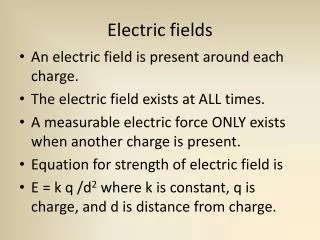
What is an Electric Field? • One charged object can influence another charged object without any direct contact. • We say a charged object is surrounded by an electric field, a region of influence. Any other charged object in that space will interact with that field and experience an electrical force.
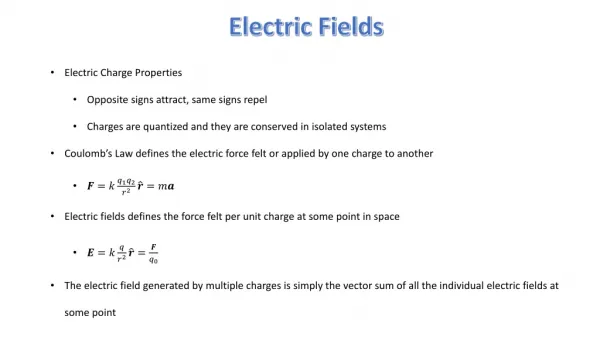
Electric Field Strength • The electric field strength at a given location is defined as the amount of force per unit of charge at that location. E = F / q (units: N/C)
Electric Field Strength • Consider a sphere with a charge of Q. A second charge q nearby would feel a force from the interaction with Q. From Coulombs Law… F = kQq / r2 E = F/q = kQq/r2 /q E = kQ/r2 q Q r
Electric field Strength • E is a vector quantity • The direction of E is defined as the direction of force that would be felt by a positive test charge at the location in question
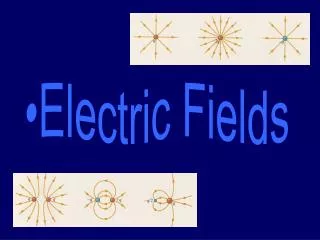
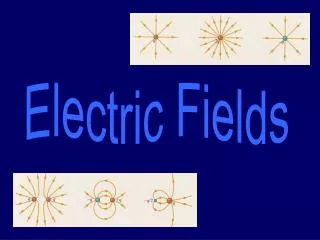
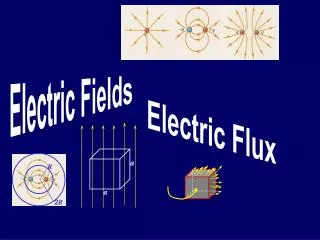
Electric Field Lines • In a diagram, the vector nature of E can be represented by arrows that represent “field lines”
Electric Field Lines • When drawing, or interpreting, electric field lines keep in mind the following… • Filed lines originate at + charge or infinity • Field lines terminate at – charge or infinity • Filed lines are always perpendicular to the surface of a charged object • Line density is an indicator of field strength • The number of lines leaving a + and terminating at a – is proportional to the magnitude of charge • Field lines NEVER cross each other (Why?)
Conductors in Electrostatic Equilibrium • The electric field is ZERO everywhere inside the conductor • Excess charge resides on the conductors outer surface • The electric field just outside the conductor is perpendicular to the conductor’s surface • For irregular shapes, charge tends to accumulate where radius of curvature is smaller (ie. sharp points)