Central Detector System Specifications
This document outlines the specifications for the Central Detector System discussed during the EDM Collaboration Meeting on May 25, 2006, in Oak Ridge, TN. Key questions addressed include the alignment of electric (E) and magnetic (B) fields and the requirements for uniformity of E to minimize vxE effects and motion-induced false EDM. It also examines mechanisms for non-zero velocities, non-uniform coatings, and energy-dependent loss rates, emphasizing the impact of these factors on neutron and 3He behavior. Additional requirements are specified for coating uniformity and alignment.

Central Detector System Specifications
E N D
Presentation Transcript
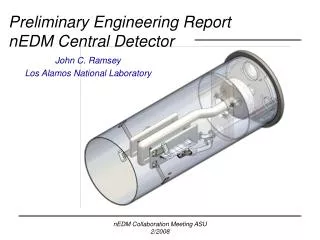
Central Detector System Specifications Takeyasu Ito Los Alamos National Laboratory EDM Collaboration Meeting May 25, 2006 Oak Ridge, TN
Question • How well should E and B be aligned? • What should the uniformity of E be?
Requirements from vxE effects • Motional field • False EDM due to motional field • Example • EB=1º, v=10-4 m/s gives dsys=10-28 e cm
Mechanisms for nonzero <v> • Non-uniform coating • Non-uniform UCN loss • Non-uniform depolarization of UCN and/or 3He • Energy dependent loss rate of UCN + gravity • Holes on the cell wall
Non-uniform coating — cont’d • We need for if • In order to guarantee , we need • Therefore we need • The same argument applies also to depolarization, which also applies to 3He atoms. • Note: this effect only appears in experiments where the precession is continuously monitored. Note: 3He mean free path at 0.3K is ~ 8 cm.
Energy dependent loss rate + gravity — cont’d h = 10 cm V = 165 neV
Holes on the cell wall 40m gap for a 1cm diameter valve on a 500cm2 wall
Summary Additional requirements from the liner vxB effect • E and B be parallel to 1o • Non-uniformity of the coating be such that • 10-5 (neutron loss/bounce) • <10-5 (3He depolarization/bounce)