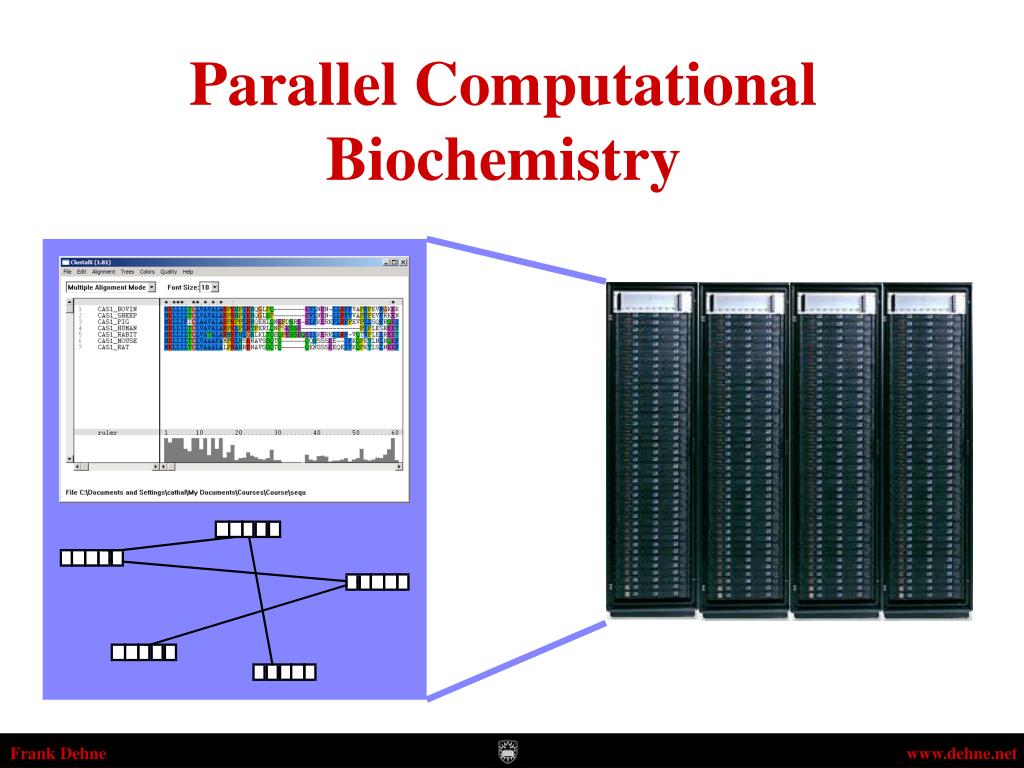
Parallel Computational Biochemistry. Proteins, DNA, etc. DNA encodes the information necessary to produce proteins. Proteins are the main molecular building blocks of life (for example, structural proteins, enzymes). Proteins, DNA, etc.
Une image / un lien ci-dessous est fourni (tel quel) pour télécharger la présentation
Politique de téléchargement : le contenu du site vous est fourni TEL QUEL pour votre information et votre usage personnel ; il ne peut être vendu, concédé sous licence ni partagé sur d’autres sites sans l’accord de son auteur.Le contenu vous est fourni TEL QUEL, pour votre information et votre usage personnel uniquement.Téléchargez la présentation en cliquant sur ce lien.Lors du téléchargement, si vous ne parvenez pas à télécharger une présentation, l’éditeur a peut-être supprimé le fichier de son serveur.Pendant le téléchargement, si vous ne parvenez pas à obtenir une présentation, le fichier a peut-être été supprimé par l’éditeur.
Proteins, DNA, etc. DNA encodes the information necessary to produce proteins Proteins are the main molecular building blocks of life (for example, structural proteins, enzymes)
Proteins, DNA, etc. • Proteins are formed from a chain of molecules called amino acids
Proteins, DNA, etc. • The DNA sequence encodes the amino acid sequence that constitutes the protein
Proteins, DNA, etc. • There are twenty amino acids found in proteins, denoted by A, C, D, E, F, G, H, I, ...
Our Contributions • Parallel min vertex cover for improved sequence alignments (to appear in Journal of Computer and System Sciences) • Parallel Clustal W (ICCSA 2003) • In progress: “Clustal XP” portal at http://cgm.dehne.net
Human Mouse Drosophila C.elegans S.cerevisiae Progressive Alignment 1. Do pairwise alignment of all sequences and calculate distance matrix Scerevisiae [1] Celegans [2] 0.640 Drosophia [3] 0.634 0.327 Human [4] 0.630 0.408 0.420 Mouse [5] 0.619 0.405 0.469 0.289 2. Create a guide tree based on this pairwise distance matrix 3. Align progressively following guide tree. • start by aligning most closely related pairs of sequences • at each step align two sequences or one to an existing subalignment
Parallel Clustal - Improvements • Optimization of input parameters • scoring matrices, gap penalties - requires many repetitive Clustal W calculations with various input parameters. • Minimum Vertex Cover • use minimum vertex cover to remove erroneous sequences, and identify clusters of highly similar sequences.
Conflict Graph vertex: sequence edge: conflict (e.g. alignment with very poor score) TASK: remove smallest number of gene sequences that eliminates all conflicts NP-complete Minimum Vertex Cover
Phase 1: Kernelization Reduce problem to size f(k) Phase 2: Bounded Tree Search Exhausive tree search; exponential in f(k) FPT Algorithms
Kernelization Buss's Algorithm for k-vertex cover • Let G=(V,E) and let S be the subset of vertices with degree k or more. • Remove S and all incident edges G->G’ k -> k'=k-|S|. • IF G' has more than k x k' edges THEN no k-vertex cover exists ELSE start bounded tree search on G'
Depth first search backtrack when k'=0 and G'<>0 ("dead end" )) stop when solution found (G'={}, k'>=0 ) Sequential Tree Search
Basic Idea: Build top log p levels of the search tree (T ') every proc. starts depth-first search at one leaf of T ' randomize depth-first search by selecting random child Parallel Tree Search
Analysis: Balls-in-bins sequential depth-first search path total length:L, #solutions: m expected sequential time (rand. distr.): L/(m+1) parallel search path expected parallel time (rand. distr.): p + L/(p(m+1)) expected speedup: p / (1 + (m+1)/L) if m << L then expected speedup = p
Implementation • test platform: • 32 node HPCVL Beowulf cluster • each node: dual 1.4 GHz Intel Xeon, 512 MB RAM, 60 GB disk • gcc and LAM/MPI on LINUX Redhat 7.2 • code-s: Sequential k-vertex cover • code-p: Parallel k-vertex cover
Test Data • Protein sequences • Same protein from several hundred species • Each protein sequence a few hundred amino acid residues in length • Obtained from the National Center for Biotechnology Information (http://www.ncbi.nlm.nih.gov/)
Test Data • Somatostatin • neuropeptide involved in the regulation of many functions in different organ systems • Clustal Threshold = 10, |V| = 559, |E| = 33652, k = 273, k' = 255
Test Data • WW • small protein domain that binds proline rich sequences in other proteins and is involved in cellular signaling • Clustal Threshold = 10, |V| = 425, |E| = 40182, k = 322, k' = 318
Test Data • Kinase • large family of enzymes involved in cellular regulation • Clustal Threshold = 16, |V| = 647, |E| = 113122, k = 497, k' = 397
Test Data • SH2 (src-homology domain 2) • involved in targeting proteins to specific sites in cells by binding to phosphor-tyrosine • Clustal Threshold = 10, |V| = 730, |E| = 95463, k = 461, k' = 397
Test Data • Thrombin • protease involved in the blood coagulation cascade and promotes blood clotting by converting fibrinogen to fibrin • Clustal Threshold = 15, |V| = 646, |E| = 62731, k = 413, k' = 413
Test Data • PHD (pleckstrin homology domain) • involved in cellular signaling • Clustal Threshold = 10, |V| = 670, |E| = 147054, k = 603, k' = 603
Test Data • Random Graph |V| = 220, |E| = 2155, k = 122, k' = 122 • Grid Graph |V| = 289, |E| = 544, k = 145, k' = 145