

SlideServe
Menu
Préférences
© SlideServe · v2026

Bayes ’ Life

cachez avatar
8 diapositives · 292 Views · Jul 25, 2014

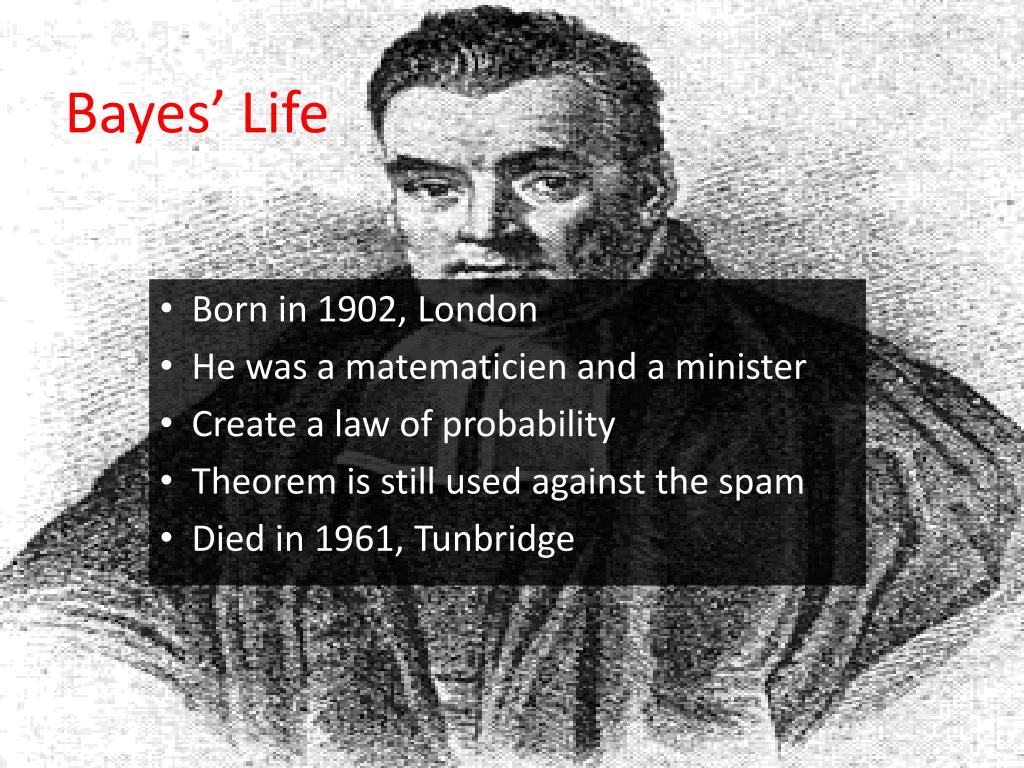
Bayes ’ Life. Born in 1902, London He was a matematicien and a minister Create a law of probability Theorem is still used against the spam Died in 1961, Tunbridge. The importance of the Theorem in the society.
Bayes ’ Life - slide 1
01 / 8Bayes ’ Life
1 / 17

Télécharger la présentation

Bayes ’ Life
Une image / un lien ci-dessous est fourni (tel quel) pour télécharger la présentation

Politique de téléchargement : le contenu du site vous est fourni TEL QUEL pour votre information et votre usage personnel ; il ne peut être vendu, concédé sous licence ni partagé sur d’autres sites sans l’accord de son auteur.Le contenu vous est fourni TEL QUEL, pour votre information et votre usage personnel uniquement. Téléchargez la présentation en cliquant sur ce lien. Lors du téléchargement, si vous ne parvenez pas à télécharger une présentation, l’éditeur a peut-être supprimé le fichier de son serveur.Pendant le téléchargement, si vous ne parvenez pas à obtenir une présentation, le fichier a peut-être été supprimé par l’éditeur.

F I N

Plus de contenu associé

Transcription de la présentation
  1. Bayes’ Life Born in 1902, London He was a matematicien and a minister Create a law of probability Theorem is stillusedagainstthespam Died in 1961, Tunbridge

  2. Theimportance of theTheorem in thesociety • ThisBayesianapproachisused by the centersanti-poison to detect as quickly as possible and with the maximum of precision the type of poisoningfromwhom a patient suffersprobably. • Thishavealso a inferencestatitical and also in the network.

  3. Theorem of Bayes • Suppliesthe relation betweenP (A¦ B) (probability of A knowing B) and P (B ¦ A) (probability of B knowingA) • Pr(A) and Pr(B) are the probabilities “a priori” of A and B • Pr(B|A) and Pr(A|B) are the probabilities “a posteriori” of B conditional to A and the A conditional to B respectively. • Bayes’ Theorem show us how change the probabilities “a priori” take into account new evidences of form to obtain probabilities “a posteriori”.

  4. Example • Let us imagine twoboxesfilledwithballs. The first one containsten ( 10 ) black balls and thirty ( 30 ) whites; the second has twenty ( 20 ) of it of every. We pull withoutparticularpreference one of the boxesatrandom and in thisbox, we pull a ballatrandom. The ballis white. • Whatis the probabilitythatwepulledthisball in the first boxknowingthatitis white?

  5. P(DlH1)=75% • H1 is thehypothesistotake a whiteball in thefirstbox. • P(DlH2)=50% • H2 is theprobabilitytotake a whiteball in thesecondbox

  6. Conclusion of theexample • P(H1lD)= = = 60% • Inthe final equationwe can calculatethehypothesis of take a whiteball in theboxes.

  7. Example (Monty Hall problem) • Suppose you're on a game show, and you're given the choice of three doors: Behind one door is a car; behind the others, goats. You pick a door, say No. 1 [but the door is not opened], and the host, who knows what's behind the doors, opens another door, say No. 3, which has a goat. He then says to you, "Do you want to pick door No. 2?" • Is it to your advantage to switch your choice?

  8. How tosolve it? This problem is one that shows us how the Bayes’ Theorem could be useful in our lives, because using the theorem we can know what is all the probabilities to win the car, though we have more probabilities to lose than win.