Understanding the Periodic Table: Mendeleev's Legacy and Atomic Structure
In 1867, Russian scientist Dmitri Mendeleev revolutionized chemistry by organizing elements into the Periodic Table based on properties like density, color, melting point, and boiling point. The table features atomic numbers that represent the number of protons and electrons in an atom, revealing the chemical similarities in vertical families and horizontal periods. This guide covers fundamental concepts such as electron arrangements, valence electrons, and the conservation of mass in chemical reactions. Explore the role of energy in reactions, including endothermic and exothermic processes.

Understanding the Periodic Table: Mendeleev's Legacy and Atomic Structure
E N D
Presentation Transcript
The Periodic Table Section 2.2
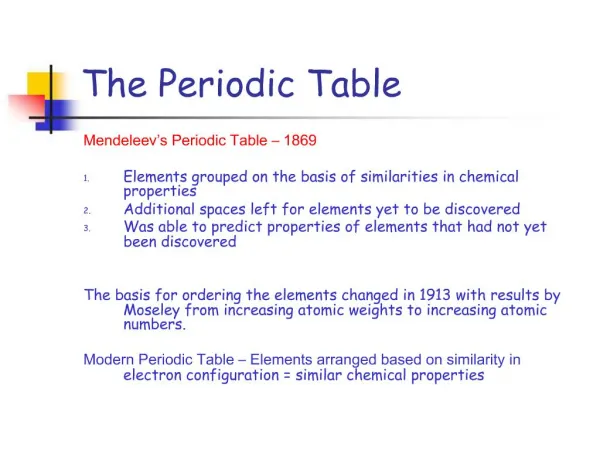
The Periodic Table • A Russian scientist, Dimitri Mendeleev, in 1867, organized the known elements into a table according to properties such as: -density -colour -melting point -boiling point
Today Mendeleev’s Table is known as the Periodic Table. • http://www.youtube.com/watch?v=JCfxJv83IvA&feature=related • http://www.youtube.com/watch?v=zGM-wSKFBpo&feature=related
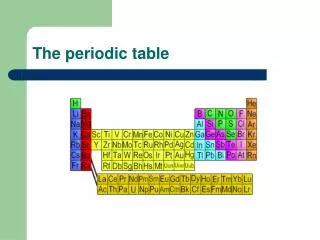
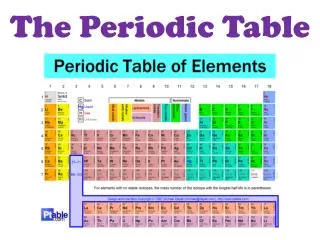
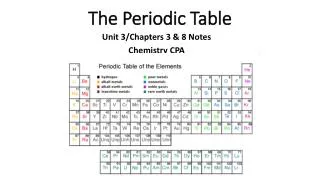
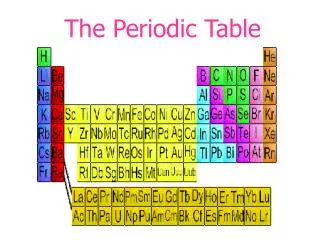
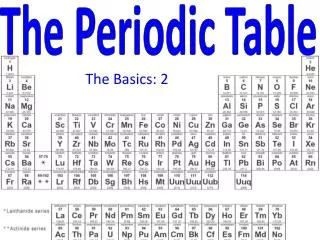
The periodic Table • Atomic number: the number of protons in the nucleus of the atoms of that element. The number of protons = # of electrons • Note: Atomic numbers increase as you read across each row of the periodic Table.
Periodic Table • The vertical lines of elements on the table are chemically similar. These vertical lines are called FAMILIES or GROUPS. • There are 18 families on the table.
Horizontal lines of elements are called PERIODS . • There are 7 periods in the table.
1. How many protons and elections are in the following atoms. • A) Beryllium (Be) • B) Neon (Ne) • C) Sodium (Na) • D) Carbon ( C ) • E) Sulphur ( S ) • Remember, Atomic Number = # of protons!!!!!
2. The following is a list of atomic numbers for different elements. Identify the elements: • A) 22 • B) 79 • C) 13 • D) 53 • E) 7
Complete Activity 2-2A pg. 49 • Remember the following... • #protons (p+) = atomic # • #electrons (e-)= #p+ • #neutrons = atomic mass -#p+
MODELS TO REPRESENT ATOMS • Atoms can be represented by electron diagrams which show how many protons and electrons there are in one atom. • They are arranged in “energy levels” or “orbitals”. • An atom can have at most 2 electronsin the first orbital, 8 electronsin the second, 8 electronsin the third orbital and 18 electrons in the fourth orbital.
Electrons in Orbitals • In an atom, the first orbital is filled (2 electrons) before the second orbital is filled. • Likewise, the second orbital is filled (8 electrons) before the third orbital. • This trend continues as the third is filled (8 electrons) before the fourth orbital is filled.
Valence Electrons • The electrons in the outer most shell or orbital are called VALENCE ELECTRONS. • This outer shell is called the valence shell. • Elements in the same family (column) have the same # of valence electrons. (Ex. Family 17 are Halogen gases that have seven valence electrons)
Atoms react with other atoms to fill their outer electron shell (sharing or “stealing” electrons). • A full valence shell gives an atom stability because it does not have to react to fill its outer valence shell. • Noble gases have full valence shells so they are unreactive for the most part.
Valence Electron #= group or family number. • # of energy levels= Period number
REACTANT AND PRODUCTS • Another term for chemical change is chemical reaction. In every chemical reaction there is something used up and there is something produced.
MASS AND CHEMICAL CHANGE • MASS AND CHEMICAL CHANGE • In a chemical reaction matter changes however the amount of matter does not.
The Law of Conservation of Mass states that : • In a chemical reaction, the total mass of the reactants is always equal to the total mass of the products Or • The number of atoms of each element on each side of the arrow must be equal. Or • During a chemical reaction, mass is neither created nor destroyed.
TOPIC 7: REACTIONS AS IDENTIFICATION TEST • Chemical Test: a special chemical reaction that allows you to identify an unknown substance.
Type 1:To test for oxygen: • oxygen is a clear, colourless gas • it promotes combustion (The chemical reaction in which oxygen in one reactant and heat is produced.
Type 2:To test for hydrogen • clear, colourless gas • it burns explosively • lighter than air • pop test
Type 3: To test for Carbon dioxide • -clear, colourless gas • -it does not burn • -does not allow other materials to burn • -heavier than oxygen • test review
Type 4: To test for water • -Clear, colourless liquid
Homework • COMPLETE QUESTIONS ON PAGE 39QUESTION 8 AND 10 ON PAGE 57
TOPIC 8: ENERGY IN A CHEMICAL REACTION • ENERGY IN A CHEMICAL REACTION • Energy: The ability to do work, to cause motion and to cause things to change
Examples of energy: • electrical energy • light or solar energy • gravitational energy • elastic energy • mechanical energy • sound energy • nuclear energy • chemical energy • endothermic vs exothermic
Potential Energy Versus Kinetic Energy • Potential Energy (PE) refers to stored energy • Example: Water held back behind a dam contains potential Energy • Kinetic Energy(KE): Energy in motion • Example: Water flowing through the dam causing turbines to turn to produce electricity.
Endothermic Reaction: a chemical reaction that absorbs energy • Example: • cooking an egg
TOPIC 9: CONTROLLING CHEMICAL REACTION • Reaction Rate - the speed of a chemical reaction
Corrosion a type of chemical reaction involving metals which react with other substances in the environment. (H2O, O2) • Eating away of metals • Metal- Elements that are shiny, hard, can corrode, can conduct electricity, and can be pulled into wires or pressed into sheets • Alloy: mixture formed from 2 or more metals • Brass => combination of zinc and copper
Internet Resource: • http://www.saskschools.ca/curr_content/science9/chemistry/lesson10.html
Questions • 1. List the conditions that favour the formation of rust • 2. Name 4 conditions that would slow down or prevent corrosion • 3. Which would corrode more quickly-steel wool or a steel nail? Why?. • 4. Which might become badly rusted- a bike in Gander or a bike in Harbour Main?