The Evolution of the Periodic Table: From Mendeleev to Modern Chemistry
80 likes | 214 Vues
The development of the Periodic Table transformed the understanding of chemical elements. In 1860, chemists convened in Karlsruhe, where Stanislao Cannizzaro presented a method for measuring atomic masses. Dmitri Mendeleev later organized these elements into the first periodic table, recognizing patterns in their properties when arranged by atomic mass. However, anomalies led to further insight, culminating in Henry Moseley's work, which established atomic number as the organizing principle. Today, the Periodic Table serves as a vital tool in chemistry, showcasing the periodic relationships between elements based on their atomic numbers.


The Evolution of the Periodic Table: From Mendeleev to Modern Chemistry
E N D
Presentation Transcript
Before the Table • In 1860 chemists assembled at the First International Congress of Chemists in Karlsruhe, Germany • Italian chemist StanislaoCannizzaro presented a convincing method for accurately measuring the relative masses of atoms.
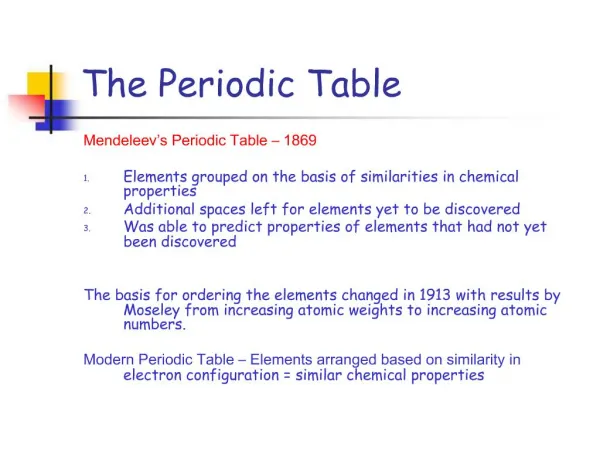
Mendeleev • Organized what became known as the first periodic table • Placed cards with the names, masses, and properties of the elements in order. • Noticed when ordered according to atomic mass properties appeared periodically • Published the first table in 1869
Two questions remained • Why could most of the elements be arranged in the order of increasing atomic mass but a few could not? • What was the reason for chemical periodicity?
Henry Moseley • Worked with Rutherford • The elements in the periodic table fit into patterns better when they were arranged in increasing order according to nuclear charge, or the number of protons in the nucleus. • He defined atomic number which is the basis for the organization of the modern periodic table
The Periodic Law • The physical and chemical properties of the elements are periodic functions of their atomic numbers. • When the elements are arranged in order of increasing atomic number, elements with similar properties appear at regular intervals.
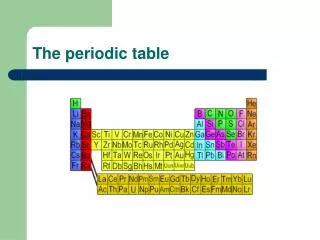
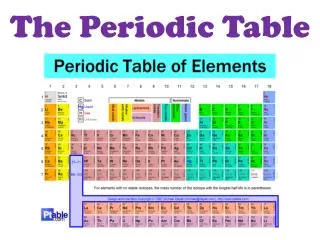
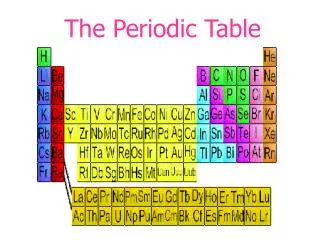
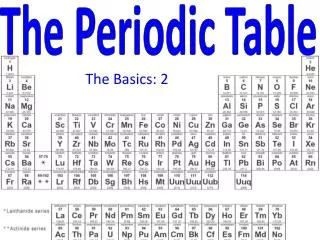
Modern Periodic Table • The periodic table is an arrangement of the elements in order of their atomic numbers so that elements with similar properties fall in the same column, or group. • Similar properties means?
Periodicity • Periodicity occurs due to the arrangement of the electrons around the nucleus