Understanding Series and Parallel Battery Circuits: Schematics and Power Analysis
This guide explores the differences between series and parallel battery configurations, providing detailed schematics for closed circuits that include one light and one fan powered by a compound battery. It discusses the advantages of using compound batteries in both series and parallel arrangements, highlighting their impact on performance. The document also covers essential electrical concepts such as volts, amps, and watts, with practical examples including ammeter and voltmeter connections in circuit diagrams. Learn how to effectively visualize and analyze your circuits.

Understanding Series and Parallel Battery Circuits: Schematics and Power Analysis
E N D
Presentation Transcript
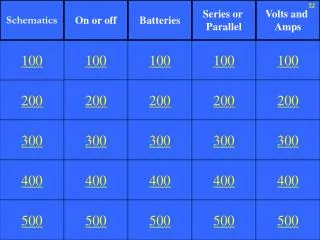
Schematics On or off Batteries Series or Parallel Volts and Amps FJ 100 100 100 100 100 200 200 200 200 200 300 300 300 300 300 400 400 400 400 400 500 500 500 500 500
Draw a schematic of an closed series circuit with one light and one fan. Make your power source be a compound battery in series.
2 light bulbs 1 ammeter 1 switch 1 battery 6 wires
Draw a new schematic to show how you would connect a voltmeter and an ammeter to the circuit right:
OFF (this is not a circuit)
Because the volt meter needs to be set across the device it is measuring.
Compound batteries in series will provide more power (the fan will spin faster and the light will be brighter).
Which schematic(s) is a series circuit with a compound battery
Which schematic(s) is a s parallel circuit with a compound battery in series?
What is the power rating if you have a 25 Amp saw that runs on 120 volt service ?
The power rating would be 3000 watts
A1=A2+A3 100=A2+50 A2=50