Understanding the Human Immune System: The Roles of B and T Cells
This lecture explores the specific immune system, focusing on the key functions of B cells and T cells in defending the body against pathogens and foreign substances. It covers the historical context of immune responses, the nature of antigens, and the development and proliferation of lymphocytes. You will learn about the mechanisms of cellular immunity, the production of antibodies by B lymphocytes, and the significance of immune memory. Gain insight into how the immune system distinguishes between self and non-self, and understand the processes involved in immune response.

Understanding the Human Immune System: The Roles of B and T Cells
E N D
Presentation Transcript
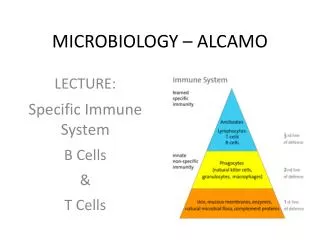
MICROBIOLOGY – ALCAMO LECTURE: Specific Immune System B Cells & T Cells
Specific Immune System • Late 1800’s: • not sure how body responded to ________ • knew there were certain ________ in blood involved (Bence Jones proteins) • 1922: • these ________ were unlike other serum ________
Specific Immune System • 1950’s: • post-war explosion in biological research • realized that ________ ________ applied to disease, organ transplant, allergies, resistance to cancer • 1960’s: • structure of ________ ________ • maturing of ________ as a key scientific discipline
Specific Immune System • Last ________ mechanism of the body • failure to beat the invader means death • “Man to Man” defense against ________ • Specific immune system cells: • Only ________ – type of WBC
Antigens • Substances capable of mobilizing the ________ ________ and provoking immune responses • Large ________ ________ not normally present in the body • They are anything ________ : Mo’s, Cells, Cells containing MO’s, or chemicals • ________ – small area of antigen that stimulates the immune response
Antigens • Exhibit 2 important properties: • _______________– ability to stimulate the proliferation of the immune system cells • ________ – ability to react with the products of the immune system cells or the immune system cells themselves
Antigens • ________ ________ ________– before birth, the proteins and polysaccharides of the body contact and inactivate immune system cells • These substances are now seen as “________” and will be tolerated by immune system
Origins of Immune System • General term for a complex series of cells, factors, and processes that provide a ________ ________ to antigens • ______________ – the cornerstone of the immune system: • Spread throughout the body • Small cells (10-20 um) with a large nucleus • Can be ____________ or ____________
Origins of Immune System • Immune system arises in a ________ ~ 2 months after conception • Lymphocytes arise from precursor cells in the bone marrow (________ ________) • Stem cells can be: • ______________ – become RBC’s • ______________ – become WBC’s
T Lymphocytes Original cells from ________ ________ • Memory programmed in ________ ________ • Circulate in blood, colonize lymph tissue • Interact directly with ________ marked cells and destroy them • ________ : Infected body cells, fungi, protozoa, cancer, transplants
T Lymphocytes 2 “T” cell types (total 4 “T” Cells) • ________ ________ ________ : • ________ T - worker • Delayed Sensitivity T - allergies • ________ ________ ________ : • ________ – don’t kill • ___________ – lower immune response • Active chemical: Lymphokines ( a group of glycoproteins)
T Lymphocytes Process • ________ ________ finds antigen in tissue (cell’s surface looks different if infected) • Brings it to lymph tissue containing ________ ________(spleen or lymph node) • May remember ________ • If “Yes” • If “No” • Cell ________ Immunity (CMI)
T Lymphocytes If “Yes” • ________ 2 Cell Types • ________ ________ and • ________ ________ which makes lymphokines • Lymphokines kill or inactivate ________ and ________phagocytosis Back
T Lymphocytes If “NO” • In ________, program ________ T cells for antigen memory • To ________ tissue in nearest war zone • Now: ________ ________ T and Killer T Back
B Lymphocytes Profile • Original cells from ________ ________ • Memory programmed in bone marrow • Circulate in blood and colonize ________ ________ • ________ : Bacteria, Viruses, Chemicals • Active chemical: ________
B Lymphocytes Process • ________ cell finds antigen in blood • Brings it to lymph tissue containing ________ ________ ________ • May remember ________ from before • We all have 1,000s of memory B cells • If “YES” • IF “NO”
B Lymphocytes • If “Yes”: • ________ 2 cell types • ________ ________ ll (so it won’t forget) and plasma cell to make ________ (2,000 molecules/sec/cell 4-5 days) • Antibodies kill or inactivate ________ and stimulate ______________ Back
B Lymphocytes • If “No”: • ________ ________ ________ in bone marrow program for antigen memory to lymph tissue nearest “war zone” • Now clone ________ and ________ cells Back
B Lymphocytes Process (continued) • ________ : Stimulate complement proteins to attack • ________ and ________ clean up • Antibody Mediated Immunity (AMI)
Antibodies • Edelman and Porter described the structure of antibodies (1972) • Basic ________ Protein: • Has 4 ________ chains • 2 identical heavy chains (400 AA) • 2 identical light chains (200 AA) • Joined together by disulfide bonds to form a “___” ________ ________ • Is called a ________ and has 2 identical halves (1 heavy and 1 light chain each)
Antibodies • Have ________ and ________ regions • Constant regions – ________ in all antibodies (AB) • Variable regions – ________among 100’s of thousands of different AB • Form a very specific, ________ ________ • Uniquely shaped to “fit” a ________ ________ • Each arm can bind an ________
Types of antibodies • Five Types – based on differences in heavy chain: • 1. ________ – five monomers joined to form a pentamer, First AB to appear after stimulation of ________ • 2. ________– monomer, the major AB in the blood that appears ________ ________ antigen appears, provides ________ ________ resistance, crosses placenta to give immunity to ________
Types of antibodies • Five Types – based on differences in heavy chain: • 3. ________ – dimer shaped AB that accumulates in ________ ________ in respiratory and GI tracts, in tears and saliva, and in the 1st milk secreted by a ________ ________ • 4. ________ – monomer that is involved in ________ reactions • 5. ________– monomer – function unknown
Antigen antibody Interaction • Neutralizing AB’s – react with viral capsids and ________ entry into cells • Antitoxins – ________ toxin molecules released by antigen • Agglutinins – ________ ________ of antigens and enhances phagocytosis • Precipitins – ________with dissolved antigens and ________ them to solids