Wireless Experimentation: Measurement Fundamentals and Coverage Mapping Techniques
This course covers the essentials of wireless measurements and experimentation, focusing on signal-to-noise ratio (SNR) analysis, performance mapping, and tools such as WiFiFoFum and Netstumbler. Students will participate in group measurements, both indoors and outdoors, to create coverage maps that analyze SNR variations and performance metrics. Key topics include equipment checkout procedures, potential experiment topics such as AP hunting and coverage planning, and insights into wireless tech heterogeneity. Join us to deepen your understanding of wireless networking phenomena!

Wireless Experimentation: Measurement Fundamentals and Coverage Mapping Techniques
E N D
Presentation Transcript
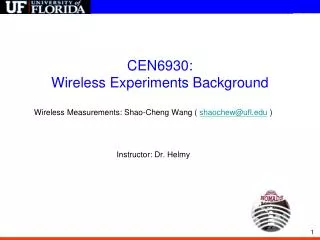
CEN6930: Wireless Experiments Background Wireless Measurements: Shao-Cheng Wang ( shaochew@ufl.edu ) Instructor: Dr. Helmy
Part I: Wireless MeasurementsAgenda • Introduction • Wireless measurement fundamentals • Tools/Procedures • Reference
http://www.ittc.ku.edu/wlan/images.shtml How does a coverage map look like?
Wireless fundamentals: SNR v.s. Performance SNR v.s. Delivery ratio (emulator) SNR v.s. Delivery ratio (real measurement) SNR v.s. TCP Tput (real measurement)
Tools (cont’d) • HP iPAQ: WiFiFoFum
Tools • Site-surveyer: Netstumbler (www.netstumbler.com) • Signal (in –dbm), SNR • AP MAC, SSID
Wireless coverage experiments Indoor measurements Outdoor measurements
Logistics • Exp: starts this week (?) • Form groups: 4~5 ppl • Equipment checkout: CSE401 • Bring your ID • 11am~6pm, no overnight checkout • Preparations • Materials • link: http://www.cise.ufl.edu/~sw0/cen6930/ • Software • Wififofum: pocket pc wifi scanner http://www.aspecto-software.com/rw/applications/wififofum/ • Knsgem: convert wifi scanner output to google earth kml • Google earth
Potential experiment topics • Coverage Map: • Create a coverage map of your choice: • SNR (enhanced with levels, dbm #’s) • SNR variations (weather, day/night) • Performance map • Find holes, additions, tech heterogeneity (11a/b/g/e/n) etc. (please coordinate between groups for the area of interest) • Reason about your choice and the implications of practicability • Observations/Surprises? • AP Hunting/Coverage/Handover • Locate APs in some specific areas/buildings • Create an AP-specific coverage map • AP-coverage/handover map for routes on campus • Observations and discussions about the AP planning (evaluation of planning, tradeoffs, applications, etc.)
Reference • Simon Byers and Dave Kormann, “802.11b access point mapping,” Communications of the ACM, May 2003. • Daniel Aguayo, John Bicket, Sanjit Biswas, Glenn Judd, Robert Morris, “Link-level Measurements from an 802.11b Mesh Network,” SIGCOMM 2004, August 2004 • Hiroto Aidal, Yosuke Tamura2, Yoshito Tobe2, Hideyuki Tokudal, “Wireless Packet Scheduling with Signal-to-Noise Ratio Monitoring,” LCN 2000