Download
1 / 41
410 likes | 525 Vues
In this lecture, we explore the fundamental principles of ionic and covalent bonding, focusing on how elements achieve stability by gaining or losing electrons to form ions. We discuss the formation of cations (positively charged ions) and anions (negatively charged ions), the octet rule, and how elements interact to share or transfer electrons. Additionally, we cover the types of bonds formed, including single, double, and triple covalent bonds, and delve into examples of ionic compounds. This lecture is essential for grasping the basics of chemical bonding and electron interactions.

E N D
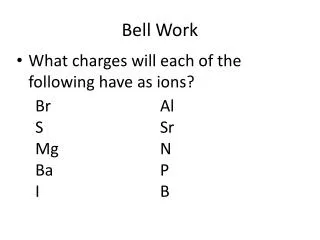
Bell Work • What charges will each of the following have as ions? Br S Mg Ba I Al Sr N P B
Physical Science – Lecture 39 Bonding
Octet Rule • All elements want 8 electrons in their outer shell. • They want 8 valence electrons to be complete. • Elements want valence electrons equal to noble gases (group 8A) • Only exception – Hydrogen and Helium only want 2.
Becoming a Noble Gas • Elements can lose or gain electrons to become “noble like”. • Loss of electrons = cation (+ charge) • Gain of electrons = anion (- charge)
Cations • Elements lose electrons to become positive • Positive charge comes from an abundance of protons. • For every electron lost, elements becomes +1.
Anions • Elements gain electrons to become negative • Negative charge comes from an abundance of electrons. • For every electron gained, elements becomes -1.
Two types of Bonding - 1 • Covalent – between two non-metals. They share electrons. • Two non-metals will share electrons to make them both think that they have a full outer shell.
Forming Covalent Compounds • When elements covalently bond, they are given special names to designate how many of each element is present.
Covalent Bonding • Formed between two non-metals. • Neither atom is "strong" enough to steal electrons from the other. • Instead, they share their electrons from outer molecular orbit with others to feel complete (8).
Covalent Bonding • Elements can form single bonds, double bonds, or triple bonds with other elements. • Bonds are represented with line drawn between two elements.
Single Bond • Two electrons are shared between elements
Double Bond • Four electrons are shared between elements
Triple Bond • Six electrons are shared between elements
Counting to 8 • Each pair of electrons (lone pair) counts as 2 electrons toward the total of 8 for the element they are attached to. • Each covalent bond (line) counts as 2 electrons for each element they are attached to. • Everyone still wants 8.
Types of Bonding - 2 • Ionic – between a metal and a non-metal or a cation and an anion. They steal or give away electrons to each other. • A metal will give its electrons to a non-metal to have a completed octet in the octet below its valence shell (becoming a cation). • A non-metal will take electrons from a metal to fulfill its outer valence shell (becoming an anion).
Lone Pairs • Electrons not involved in the bond are called “lone pairs”. • Lone pairs consist of two electrons.
Ionic Bonding • Ionic bond - type of bond formed between cations and anions. • Mostly formed between metals and non-metals. • Non-metals are more electronegative and steal the metals electrons.
Ionic Bonding • Na does not have 8 electrons in its outer shell, it has none. • It gave away electrons. It did not share.
Ionic Bonding • Metals NEVER keep their electrons! • They always give them away to non-metals. • They NEVER share!
Forming Ionic Compounds • Ionic compounds come from ions. • The charges cancel out • The cation (positive charged element) is written first in the formula. • The anion is always written second.
Examples • Ca2+ and SO42- • Br- and Na+ • K+ and O2-
Can 3 Cl form a Covalent bond with P? • What type of bond will they form? • Do they have enough electrons to make them each feel like they have 8?