
SlideServe
Menu
Préférences
© SlideServe · v2026

Evaluating the Impact of Chinese Medicine on Cardiovascular Stress in Daphnia Magna

chava avatar
3 diapositives · 143 Views · Jul 22, 2014

This experiment investigates the effectiveness of various Chinese herbal medicines, namely Ginseng and Ginger, in combating cardiovascular stress in Daphnia Magna. The study aims to determine whether these treatments can significantly influence heart rate under stress conditions compared to control groups. Results indicate that Chinese Ginseng can notably reduce heart rates, suggesting its potential therapeutic benefits against stress. The study highlights the differences in results between caffeinated and uncaffeinated groups and discusses implications for future research in herbal medicine.
Evaluating the Impact of Chinese Medicine on Cardiovascular Stress in Daphnia Magna - slide 1
01 / 3Evaluating the Impact of Chinese Medicine on Cardiovascular Stress in Daphnia Magna
1 / 17

Télécharger la présentation

Evaluating the Impact of Chinese Medicine on Cardiovascular Stress in Daphnia Magna
Une image / un lien ci-dessous est fourni (tel quel) pour télécharger la présentation

Politique de téléchargement : le contenu du site vous est fourni TEL QUEL pour votre information et votre usage personnel ; il ne peut être vendu, concédé sous licence ni partagé sur d’autres sites sans l’accord de son auteur.Le contenu vous est fourni TEL QUEL, pour votre information et votre usage personnel uniquement. Téléchargez la présentation en cliquant sur ce lien. Lors du téléchargement, si vous ne parvenez pas à télécharger une présentation, l’éditeur a peut-être supprimé le fichier de son serveur.Pendant le téléchargement, si vous ne parvenez pas à obtenir une présentation, le fichier a peut-être été supprimé par l’éditeur.

F I N

Plus de contenu associé

Transcription de la présentation
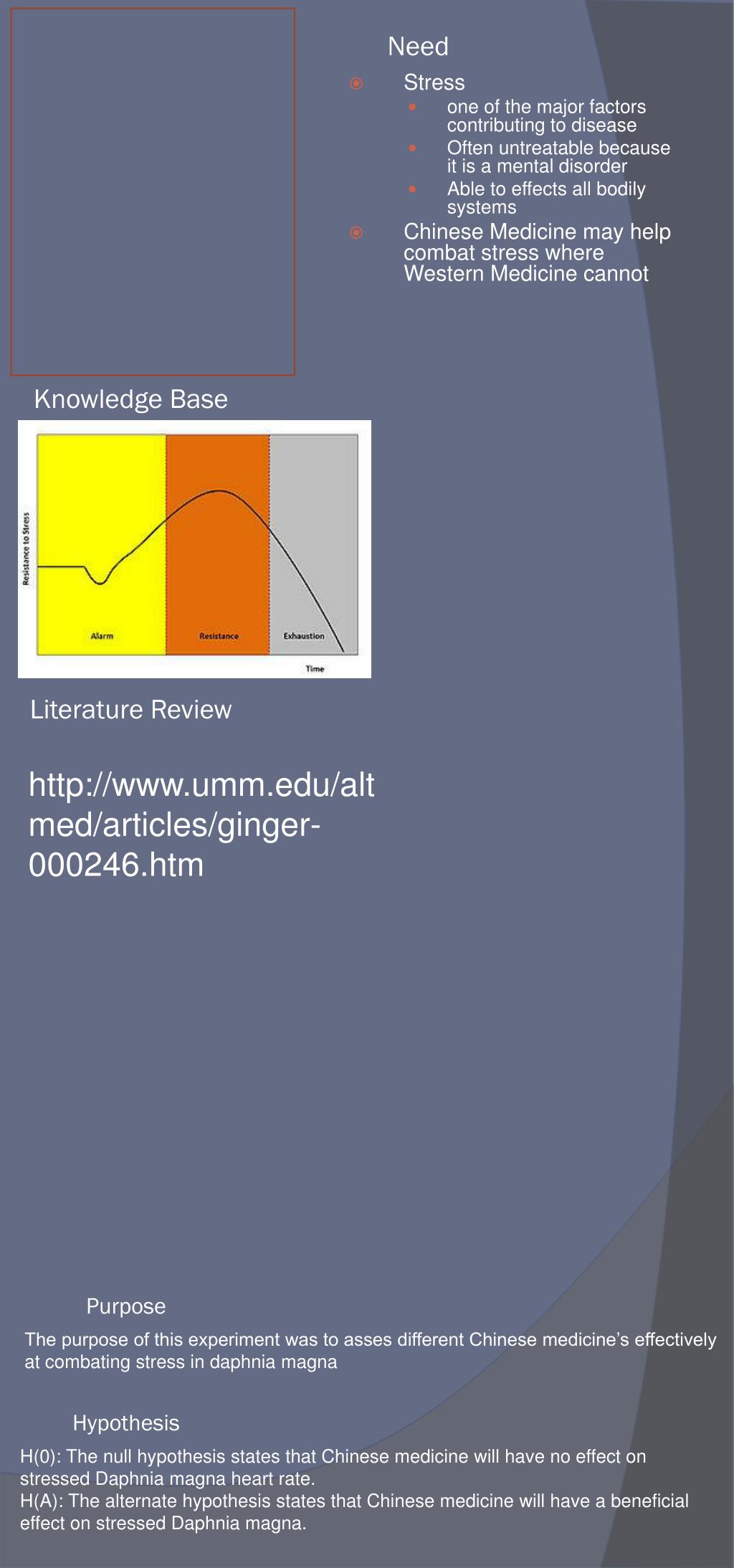
  1. Need Knowledge Base • Stress • one of the major factors contributing to disease • Often untreatable because it is a mental disorder • Able to effects all bodily systems • Chinese Medicine may help combat stress where Western Medicine cannot http://www.arltma.com/StressDoc.htm Literature Review http://www.umm.edu/altmed/articles/ginger-000246.htm Purpose The purpose of this experiment was to asses different Chinese medicine’s effectively at combating stress in daphnia magna Hypothesis H(0): The null hypothesis states that Chinese medicine will have no effect on stressed Daphnia magna heart rate. H(A): The alternate hypothesis states that Chinese medicine will have a beneficial effect on stressed Daphnia magna.

  2. N=10 Graph 1: Comparing the means of central tendency of the Non-Caffeinated groups. The heart rate ranges from 234 beats/min. in the negative control to 445 beats/min. in the Ginseng group. The largest standard deviation was 42 beats/min. in the Ginger group. The Effects of Chinese medicine on cardiovascular stress of Daphnia magna Variables N=30 Control N=30 Chinese Ginseng (Panax ginseng) N=10 Ginger (Zingiberofficinale) N=10 American Ginseng (Panaxquinquefolius) N=10 Control0 3 Herbal medicines N=10 Control Caffeine N=10 Control0 N=10 N=10 Measuring heart-rate using fluorescent Graph 1: Comparing the means of central tendency of the Non-Caffeinated groups. The heart rate ranges from 234 beats/min. in the negative control to 445 beats/min. in the Ginseng group. The largest standard deviation was 42 beats/min. in the Ginger group. Statistical analysis using SPSS and ANOVA (p˂.05) Statistical analysis using ANOVA followed by a Scheffe post-Hoc test at p<.05 revealed significant differences between each caffeinated group and their respective controls except for the Ginger groups where p=.59. In the rest of the groups,the largest p-value was 6 x 10⁻⁵ between the two American Ginseng groups. N=10 Graph 3: Comparison of Heart rates between Caffeinated and Uncaffeinated groups. The difference ranges from 317 to 354 beats/min. with a difference of 37 beats/min. and 234 and 408 beats/min. in the negative and positive control groups with a difference of 174 beats/min.

  3. Discussion Daphnia magna under 40xmagnification Heart Daphnia magna under 250x magnification Photos taken by authors • The purpose of this experiment was to observe the effect of Chinese herbal medicine (INSERT SCIENTIFIC NAMESSS) on the cardiovascular stress of Daphnia magna • The alternate hypothesis was supported in heart rate comparisons between each of the non-caffeinated variables and the negative control as well as between the caffeinated groups and the caffeine control with the exception of the Ginger groups • Results were comparable to _____________ • Chinese and American Ginseng extracts can decrease heart rate of Daphnia magna under cardiovascular stress induced through caffeine. • Limitation was the large sample size Future Studies • Using chemical compounds found in ginger and ginseng • Long term effects of extracts • Testing on higher mammals with systems relating more directly to humans Conclusion • Aside from the control the Chinese Ginseng group had the largest significant difference between its caffeinated and uncaffeinated group and the American Ginseng group had less of a significant difference between groups. • Chinese Ginseng, and American Ginseng extracts significantly lower the heart rate of Daphnia magna under cardiovascular stressin both caffeinated and uncaffeinated conditions. Bibliography