Download
1 / 14
140 likes | 266 Vues
This educational overview explores the history and structure of the Periodic Table, beginning with Dmitri Mendeleev's pioneering work in organizing elements by atomic mass, thereby predicting properties of yet-to-be-discovered elements. It discusses Henry Moseley's contribution, which established atomic number as the organizing principle. The Periodic Table is divided into groups and periods, emphasizing the number of energy levels and the similarities among elements in each group. Key groups such as Alkali Metals and Noble Gases are also highlighted.

E N D
The Periodic Table Unit II—Part 4 Adapted by NCDPI – Unit 2 Matter all around us
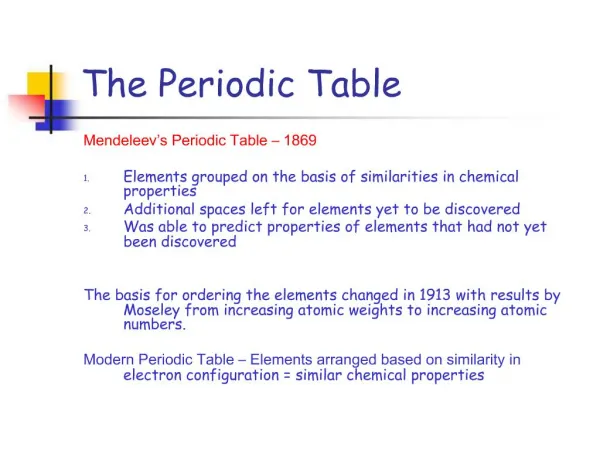
The Father of the Periodic Table—Dimitri Mendeleev • Mendeleev was the first scientist to notice the relationship between the elements • Arranged his periodic table by atomic mass • Said properties of unknown elements could be predicted by the properties of elements around the missing element Image taken from: http://jscms.jrn.columbia.edu/cns/2006-04-18/fido-luxuriantflowinghair/mendeleev
Henry Moseley • Moseley later discovered that the periodic nature of the elements was associated with atomic number, not atomic mass • Image taken from: • http://dewey.library.upenn.edu/sceti/smith/
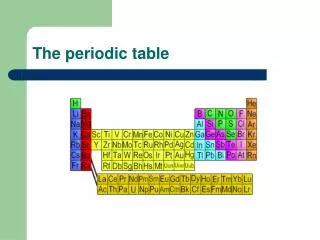
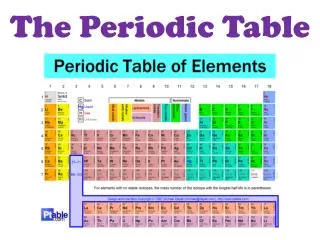
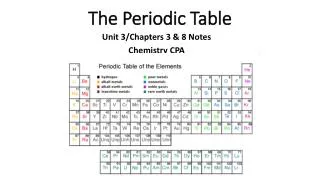
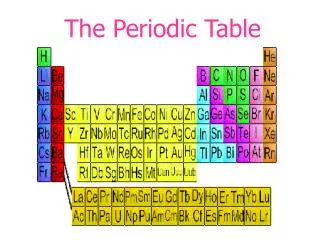
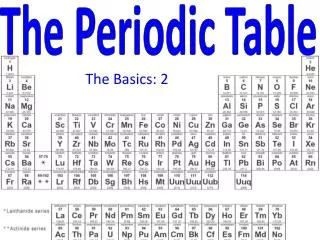
The Periodic Table Column = Group or Family 18 columns on the Periodic Table Row = Period 7 rows on the Periodic Table
Periods •Each row is called a “period” •The elements in each period have the same number of energy levels 1st Period = 1 E. Level 2nd Period = 2 E. Levels 3rd Period = 3 E. Levels 4th Period = 4 E. Levels 5th Period = 5 E. Levels 6th Period = 6 E. Levels 7th Period = 7 E. Levels Middle School Science Image: Chem4kids.com
Groups •Each column is called a “group” •Each element in a group has the same number of electrons in their outermost energy level (valence electrons) Except for He, it has 2 electrons Group 1 = 1 electron Group 2 = 2 electrons 4 Group 8 = 8 electrons Middle School Science Image: Chem4kids.com
Metals, Nonmetals, and Semi-metals Only nonmetal on the metal side Nonmetals are on the right of the stair-step Metals are to the left of the stair- step Semi-metals, “metalloids,” touch the stair-step
Special Rows on the PT Lanthanides Actinides
What does the information in the box tell me? 1 H 1.008 Atomic Number = # of protons Elemental Symbol Atomic Mass = # of protons plus neutrons
1 H 1.008 3 Li 6.941 + 11 Na 22.990 + + - 19 K 39.098 - - + 37 Rb 85.468 - - + + + + 55 Cs 132.905 + - - + + 87 Fr (223) - - - - The Groups of the Periodic Table • Group 1: The Alkali Metals • Most reactive metals on the PT • Rarely found free in nature • Charge of 1—1 valence electron
The Groups of the Periodic Table • Group 2: The Alkaline Earth Metals • Still quite reactive • Charge of 2—2 valence electrons Image: Chem4kids.com Image: http://wildeboer-fitch.wikispaces.com/2008fall+Calcium
T he Groups of the Periodic Table • Groups 3-12: Transition Metals • Found freely and in compounds in nature • Charge is usually 2 but can vary—usually 2 valence electrons • Group 13: Boron Family • Charge is 3—3 valence electrons https://encrypted-tbn1.gstatic.com/images?q=tbn:ANd9GcTOt9q27_Eou8z7JNLK7Q33g1oW5nLuZ468bup9AzxryqyuAaV_dA
The Groups of the Periodic Table • Group 14: The Carbon Family • Contains elements that can form unusual bonds (carbon and silicon) • Charge is +4 or -4—contains 4 valence electrons • Group 15: The Nitrogen Family • Charge is -3—contains 5 valence electrons
The Groups of the Periodic Table • Group 16: The Oxygen Family • Also known as the chalcogens • Charge is -2 has 6 valence electrons • Group 17: The Halogens • Most reactive nonmetals • charge is -1 has 7 valence electrons • Group 18: The Noble Gases (The Inert Gases) • Nonreactive • Charge is 0—2 or 8 valence electrons • https://www.google.come/search?q=valence+electrons+periodic+table