
SlideServe
Menu
Préférences
© SlideServe · v2026

Microscopy and Classification: Exploring the World of Cells

christiescott avatar
12 diapositives · 181 Views · Oct 24, 2019

This chapter delves into the principles of microscopy, staining techniques, and taxonomic characteristics of cells, covering topics such as lens properties, resolution, magnification, and the advancements in light microscopy. It also discusses the key advances in microscopy, including fluorescence and electron microscopy, as well as the classification of biological taxa and the characteristics of different domains of life.
Microscopy and Classification: Exploring the World of Cells - slide 1
01 / 12Microscopy and Classification: Exploring the World of Cells
1 / 17

Télécharger la présentation

Microscopy and Classification: Exploring the World of Cells
Une image / un lien ci-dessous est fourni (tel quel) pour télécharger la présentation

Politique de téléchargement : le contenu du site vous est fourni TEL QUEL pour votre information et votre usage personnel ; il ne peut être vendu, concédé sous licence ni partagé sur d’autres sites sans l’accord de son auteur.Le contenu vous est fourni TEL QUEL, pour votre information et votre usage personnel uniquement. Téléchargez la présentation en cliquant sur ce lien. Lors du téléchargement, si vous ne parvenez pas à télécharger une présentation, l’éditeur a peut-être supprimé le fichier de son serveur.Pendant le téléchargement, si vous ne parvenez pas à obtenir une présentation, le fichier a peut-être été supprimé par l’éditeur.

F I N

Plus de contenu associé

Transcription de la présentation
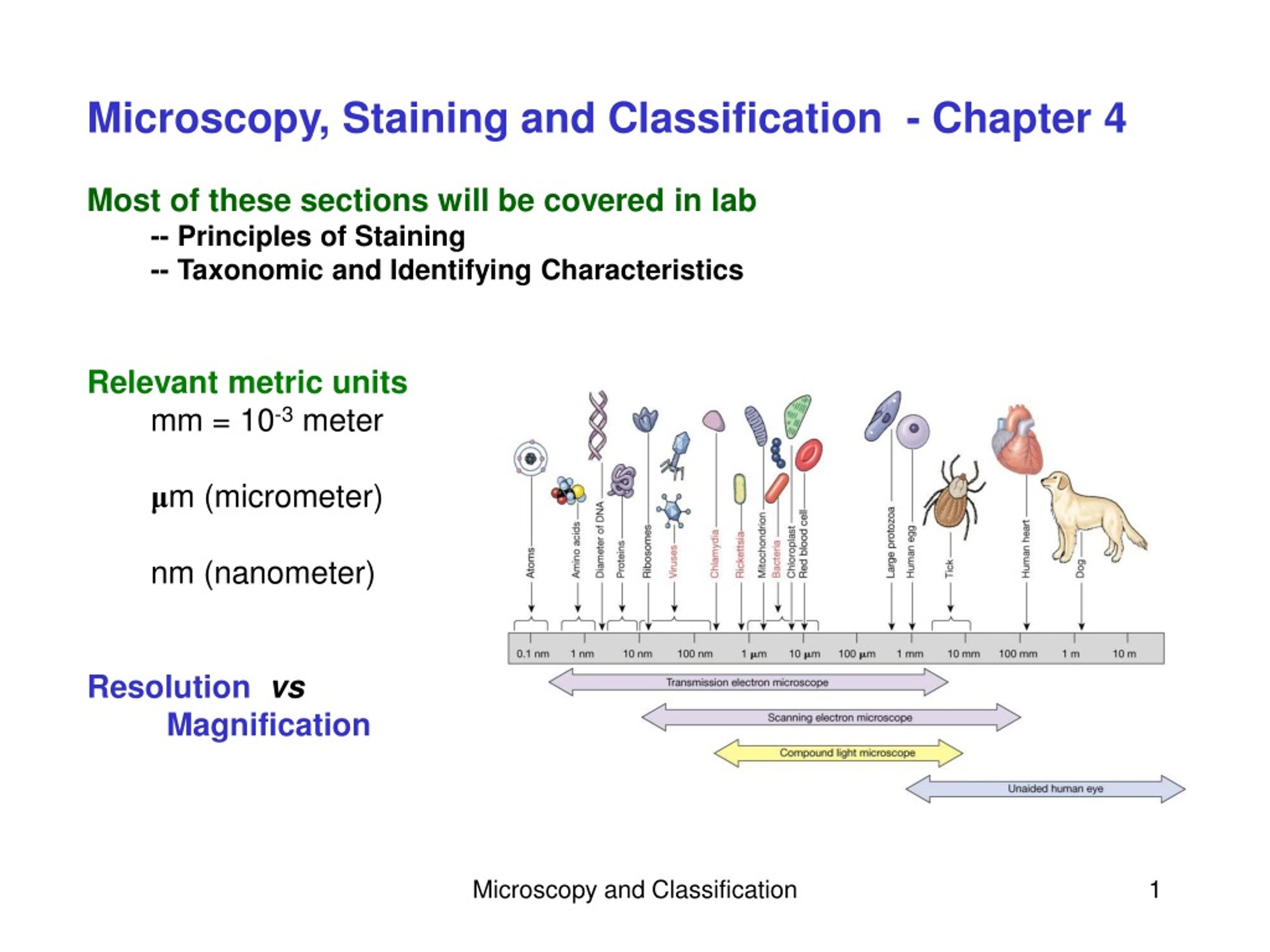
  1. Microscopy, Staining and Classification - Chapter 4 Most of these sections will be covered in lab -- Principles of Staining -- Taxonomic and Identifying Characteristics Relevant metric units mm = 10-3 meter μm (micrometer) nm (nanometer) Resolution vs Magnification Microscopy and Classification

  2. Microscopy How does a lens work? Optical properties refraction magnification resolution distortion, e.g., - spherical - chromatic Limitations of a single lens magnification illumination aberration Wikipedia link http://en.wikipedia.org/wiki/Lens_%28optics%29 Microscopy and Classification

  3. Some principles of a compound microscope Ocular lens Objective lens Condenser lens How is magnification calculated? Limitations to a compound microscope Microscopy and Classification

  4. What were the key advances • in light microscopy? • Oil immersion lens • Fused lenses • Advanced optics • How do oil immersion and • fused lenses improve resolution? • Refractive index = • Borosilicate glass = 1.52 • Air = 1.00 • Water = 1.33 • Immersion oil = 1.52 • Fused lenses combine different types of glass • -- compensate for aberrations Speed of light in vacuum Speed of light in medium Microscopy and Classification

  5. Advanced optics only improve contrast Theoretical limit of resolution = 0.2 uM Dark field manipulates the path of light Phase contrast and DIC manipulate phase of light Dark field Bright field DIC Microscopy and Classification

  6. Fluorescence Microscopy allows precise staining of cells and cellular components Standard fluorescence manipulates the path of light Confocal -- puts everything in focus Standard Fluorescence vs Confocal image of Tetrahymena Microscopy and Classification

  7. How does electron microscopy yield higher resolution? Resolution - Eye ~ 0.2 mm - LM ~ 0.2 uM - EM ~ 0.2 nM (0.0002 uM) Wavelengths of … of electrons ~ 0.005 nm … visible light ~ 550 nm Microscopy and Classification

  8. What are types of electron microscopy? Scanning vs Transmission STM is different Driscoll et al. 1990. Nature, 346, 6281 Microscopy and Classification

  9. Biological classification Biological taxa -- Muddled in the middle -- Blurry at the bottom Binomial naming Writing conventions Staphylococcus aureus Staphylococcusaureus S. aureus Common names and strains Pneumoncoccus E. coli O157 H7 Domain: Bacteria Kingdom: Eubacteria Phylum: Firmicutes Class: Bacilli Order: Bacillales Family: Staphylococcaceae Genus: Staphylococcus Species: aureus The Antiquity of Microbes Adam Had ‘em -- Strickland Gillilan Microscopy and Classification

  10. What are the 3 domains of life? Eukarya – Archaea – Bacteria What traits do Archaea and Bacteria share? -- prokaryotic cell structure -- circular chromosome What traits do Archaea and Eukarya share? -- Nucleosomes -- Multiple RNA Polymerases -- Ribosome structure Some Archaea have unique properties -- Genetically distinctive -- Cell membrane -- Cell wall structure New 2016 Tree of Life Hug, et al. 2016. Nature Microbiology Article #16048 Microscopy and Classification

  11. What are the characteristics of Eukaryotes vs Prokaryotes? -- all “cellular organisms” Basic similarities? membrane genetic information biochemistry Distinctive properties of eukaryotes • ‘ eu’ = true ‘karyo’ = nucleus • size • organelles mitochondria, chloroplasts, etc • chromosomes …vs prokaryotes ‘pre-nucleus’ Microscopy and Classification

  12. Archaea Extremophiles -- some notable ones… Pyrolobus fumarii -- “Fire lobe of the chimney” Hyper-thermophile -- 90OC – 113OC (106OC) hydrothermal vents Strain 121: http://www.genomenewsnetwork.org/articles/08_03/hottest.shtml Picrophilus spp. Extreme acidophiles -- pH <4 (opt 0.7) Volcanic steam vents Halobacterium spp. Extreme halophiles -- 3 – 5 M salt Dead sea; great salt lake; Salted foods Microscopy and Classification