Understanding Parent Functions and Their Characteristics in Pre-Calculus
130 likes | 258 Vues
In today's Pre-Calculus lesson, students will explore parent functions, including linear, quadratic, cubic, absolute value, and others. The objectives are to sketch graphs of these functions, define their domains and ranges, and graph functions using calculators. Key features of each function type will be highlighted, such as the constant value of absolute functions and the parabolic shape of quadratic functions. Students will also discuss transformations like roots and exponents, preparing them for complex applications in real-world scenarios.


Understanding Parent Functions and Their Characteristics in Pre-Calculus
E N D
Presentation Transcript
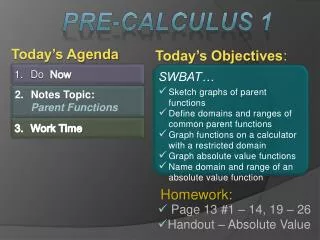
Pre-Calculus 1 Do Now Today’s Agenda Today’s Objectives: • SWBAT… • Sketch graphs of parent functions • Define domains and ranges of common parent functions • Graph functions on a calculator with a restricted domain • Graph absolute value functions • Name domain and range of an absolute value function Work Time 2. Notes Topic: Parent Functions Homework: • Page 13 #1 – 14, 19 – 26 • Handout – Absolute Value
Constant Functionf(x) = c • Domain • {x x } • read as “x such that x belongs to the set of all real numbers.” • Range • {y y = c} • read as “y such that y is equal to the constant value.” Features: A straight line gragh where y does not change as x changes.
LinearFunctionf(x) = mx + b • Domain • {x x } • Range • {y y } Features: A straight line graph where f(x) changes at a constant rate as x changes.
QuadraticFunctionf(x) = x2 • Domain • {x x } • Range • {y y 0} Features: Graph is shape of parabola. The graph changes direction at its one vertex.
Square Root Functionf(x) = • Domain • {x x 0} • Range • {y y 0} Features: The inverse of a quadratic function where the range is restricted.
Cubic Functionf(x) = x3 • Domain • {x x } • Range • {y y } Features: The graph crosses the x-axis up to 3 times and has up to 2 vertices
Cube Root Functionf(x) = • Domain • {x x } • Range • {y y } Features: The inverse of a cubic function
Power Functionf(x) = • Domain • {x x } • Range • {y y } Features: The graph contains the origin if b is positive. In most real-world applications, the domain is nonnegative real numbers if b is positive and positive real numbers if b is negative.
ExponentialFunctionf(x) = abx • Domain • {x x } • Range • {y y >0} Features:The graph crosses the y-axis at y = a and has the x-axis as an asymptote
LogarithmicFunctionf(x) = loga x • Domain • {x x > 0} • Range • {y y } Features:The graph crosses the x-axis at 1 and has the y-axis as an asymptote.
Absolute ValueFunctionf(x) = • Domain • {x x } • Range • {y y 0} Features: The graph has two halves that reflect across a line of symmetry. Each half is a linear graph.
Homework: • Page 13 #1 – 14, 19 – 26 • Handout – Absolute Value
Polynomial Function • http://zonalandeducation.com/mmts/functionInstitute/polynomialFunctions/graphs/polynomialFunctionGraphs.html • *zero degree • *first Degree • *second degree • *third degree • Fourth degree