
Municipal Solid Waste Disposal: Past, Present, and Future
E N D
Presentation Transcript
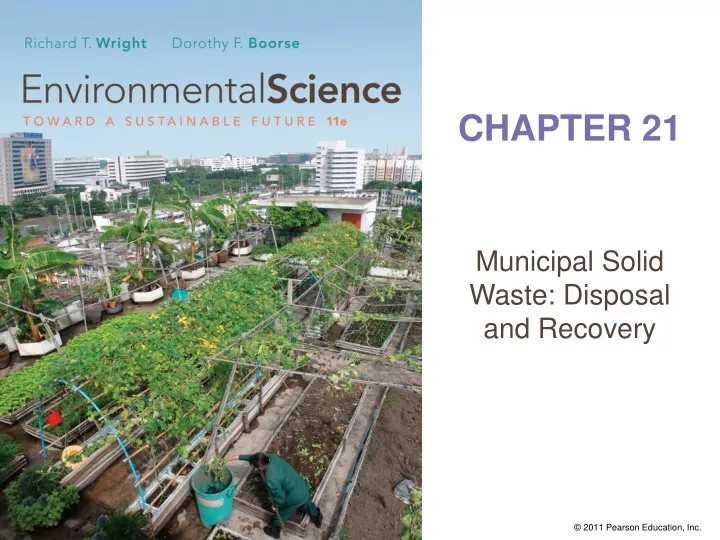
CHAPTER 21 Municipal SolidWaste: Disposaland Recovery
An introduction to municipal solid waste • Danehy Park is in North Cambridge, Massachusetts • Its 50 acres hosts thousands of people • A red light in the bathroom warns if methane has built up • The park is built on an old landfill that was once a blight on the neighborhood • In the 1970s and 1980s, closing old landfills created a “solid waste crisis” that turned out to be temporary • Many have been converted to parks, golf courses, and nature preserves • We are running out of space to put all of our garbage
Solid wastes: landfills and combustions • Municipal solid waste (MSW): total of all materials (trash, refuse, garbage) thrown away from homes and small businesses • It is collected by local governments • It is different from hazardous waste and nonhazardous industrial waste • Nonhazardous industrial waste: generated by industries • Demolition and construction wastes, agricultural and mining wastes, sewage sludge, industrial wastes • States, not the EPA, oversee these wastes
Disposal of municipal solid waste • The amount of MSW generated in the U.S. is increasing • More people, changing lifestyles, excessive packaging • In 1960, the average MSW was 2.7 lbs/person/day • In 2007: 4.6 lbs/person/day • In 2007, the U.S. generated enough garbage to fill 96,000 garbage trucks/day • We generate huge amounts of MSW and it is harder to dispose of in an environmentally sound and healthy way • MSW varies depending on the generator, neighborhood, and time of year
Whose job? • Many local governments are responsible for collecting and disposing of MSW • They own trucks and hire workers • Or contract with a private firm • Who pays for the cost of waste pickup? • Taxes • Pay-as-you-throw: charges by the amount of trash • Collectors bill households • State and federal regulations begin to apply at disposal
Past sins • Until the 1960s MSW was burned and buried in dumps • Smoldering dumps smelled and attracted flies and rats • Incineration (combustion facilities): burn waste completely • May cause air pollution • Open dumps and incinerators were phased out • Public pressure and air pollution laws • Replaced by landfills • In the last 10 years, landfills and combustion have declined • Recycling has increased • Patterns of disposal differ in countries
Landfills • Landfill: waste is put on or in the ground and covered with earth • Minimizing air pollution and vermin • But managers did not understand ecology, the water cycle, or products of decomposition • They did not have regulations to guide them • So landfills were put on any cheap land outside of town • Natural gullies, abandoned quarries, wetlands, old dumps
Problems of landfills: leachate and groundwater pollution • Leaching: chemicals dissolve in and are transported by water • Leachate: water with various pollutants • A “witches brew” of pollutants • Organic matter, heavy metals, chemicals • Can enter groundwater aquifers • All states have, or will have, landfills contaminating groundwater • Florida has 145 sites on the Superfund list (sites where groundwater contamination threatens human health)
Problems of landfills: methane • Buried wastes undergo anaerobic decomposition • Producing biogas (methane, CO2 and hydrogen) • Biogas is highly flammable • Seeping horizontally through soil, it can enter homes and cause explosions • Seeping to the surface, it kills vegetation • Biogas can be captured, purified, and used as fuel • In 2008, commercial landfill gas produced electricity and gas for 1.4 million homes • Reducing greenhouse gas emissions and fossil fuel use
Problems of landfills: incomplete decomposition • Plastics in MSW resist decomposition • Petroleum-based polymers resist microbial digestion • Biodegradable plastic polymers have been developed • Using cornstarch, cellulose, lactic acid, soybeans • They are more expensive • They are used by organic manufacturing companies • Even biodegradable materials degrade very slowly • Newspapers buried 30 years ago are still readable • Decomposition requires water • But water produces toxic leachates
Problems of landfills: settling • Waste settles as it compacts and decomposes • Buildings have never been put on landfills • Where landfills have been converted to playgrounds and golf courses, shallow depressions or deep holes are created • Monitoring the facility and using fill to restore a level surface solve the problem
Improving landfills • The EPA upgraded siting and construction requirements • New landfills are sited on high, stable ground above the water table, away from airports • Water drains into a leachate-collection system • Tile, plastic liners, and compacted soil collect leachate • The fill is built up in the shape of a pyramid and capped with earthen material and soil and reseeded • The site is surrounded by groundwater monitors • Abandoned landfills can become recreational facilities • Attractive golf courses and wildlife preserves
Siting new landfills • Between 1988 and 2007, landfills decreased from 8,000 to 1,754 • The EPA does not think capacity is a problem • But people don’t want landfills near them • It is hard to find areas to build new landfills • Any potential site is met with protests and lawsuits • LULU (locally unwanted land use); NIMBY (not in my backyard); NIMTOO (not in my term of office) • BANANA (build absolutely nothing anywhere near anything)
Outsourcing • Undesirable consequences of the siting problem • Drives up costs of waste disposal • Inefficient and objectionable transfer to private landfills • Transfer of waste may occur across state or national lines • Resentment and opposition from citizens • 11 U.S. states export > 1 million tons/year (#1: New York) • 13 states import > 1 million tons/year (#1: Pennsylvania) • Desirable consequences of siting problems: it encourages recycling and stimulates combustion of MSW
Advantages of combustion • 89 U.S. facilities burn 32 million tons/year of MSW • A waste reduction process, not disposal • Ash must still be disposed of • Combustion reduces weight of trash by 70% and volume by 90% • Fly ash contains most of the toxic substances • It is landfilled • Bottom ash: is used as fill in construction or roadbeds • Converted to concrete
More advantages of combustion • No changes are needed in collection or people’s behavior • Two-thirds of combustion facilities are waste-to-energy (WTE) • Untreated MSW releases 35% as much energy as coal when burned • Producing electricity for 2.3 million homes • Wasted energy going to landfills equals 9.4 billion gallons of diesel oil/year • Many facilities add resource recovery • Separating and recycling materials before and after burning
Drawbacks of combustion • Air pollution: has decreased through strict regulations • Odor pollution: plants are isolated from residential areas • Facilities are expensive to build • Siting: facilities are located in industrial areas • Toxic ash must be disposed of in secure landfills • The facility must have a continuous supply of MSW • Agreements with municipalities decreases flexibility in waste management options • The process wastes energy and materials • Combine burning with recycling and recovery
An operating facility • A facility serving 1 million gets 3,000 tons of MSW/day • Waste comes in by rail and truck • Communities pay $65/ton tipping fees • Waste processing is efficient: 80% is burned for energy • 12% is recovered; 8% is landfilled • If 1 million tons of MSW are processed • 40,000 tons of metals are recycled • Electricity for 65,000 homes is generated • Opponents cite air pollution, traffic, and property values as concerns against WTE facilities
The WTE process • Incoming waste is inspected and recyclables are removed • Shredders reduce waste particles to 6 inches or less • Magnets remove metals for recycling • Waste is blown into boilers for burning • Water circulating through the boilers produces steam for electricity • Metals are separated from bottom ash • Combustion gases are treated to reduce emissions • Fly ash and bottom ash are taken to landfills
Costs of municipal solid-waste disposal • Costs of disposing of MSW are increasing • Design features of landfills • Expenses in acquiring sites and transportation • Tipping fees average $42/ton (but New York City’s is $263/ton—$1 billion/year!) • One consequence: illegal dumping • Some towns charge $5/bag for MSW, $1/tire, etc. • Wastes are appearing in many areas • Buildings put padlocks on dumpsters • Many states track down midnight dumpers
Better solutions: source reduction • Source reduction: reducing waste at its source • The best solution for domestic wastes • Designing, manufacturing, purchasing, or using materials to reduce the amount/toxicity of trash • U.S. waste has leveled off at 4.5 lbs/person • Due to lifestyle changes • Measured by measuring consumer spending, which reflects goods and products that become trash • In 2000, 55 million tons did not go into the waste stream
Examples • Reducing the weight of items • Steel cans are 60% lighter than they used to be • Reducing paper waste via electronic communication, data transfer, the Internet • Reusing durable goods: reselling items • eBay, Craigslist, Freecycle Network • Designing products to last longer and be easier to repair • Staying off of bulk mailing lists • Composting yard wastes
The recycling solution • More than 75% of MSW is recyclable • Primary recycling: the waste is recycled into the same material • Recycling newspapers into newspapers • Secondary recycling: waste is made into different products that may or may not be recyclable • Recycling newspapers into cardboard
Benefits of recycling • Recycling saves energy and resources • One ton of recycled steel saves 2,500 pounds of iron ore, 1,000 lbs of coal, 5,400 BTUs of energy • Recycling decreases pollution • Making recycled paper uses 64% less energy, creates 74% less air, and 35% less pollution • A recycling program that processes 1 ton of waste eliminates 620 lbs of CO2, 30 lbs of methane, 5 lbs of CO, 2.5 lbs of particulates
What gets recycled? • Paper (47%): paper, cardboard, insulation, or is composted • Glass (28%): new containers, fiberglass or used in highway construction (glassphalt) • Plastic (12%): carpet, clothes, irrigation drainage tiles, building materials, sheet plastic • Metals: recycling aluminum (39%) saves 90% of the energy to make cans from ore • Saves energy, creates jobs, reduces the trade deficit • Yard wastes (64%) are composted
Other items that are recycled • Textiles (17%): strengthen recycled paper products • Old tires (35%): incorporated into highway asphalt • Over 1 million tires/year are burned in combustion plants • People recycle out of environmental and economic motivations • The Global Recycling Network is an information exchange promoting recycling and ecofriendly products
Municipal recycling • Recycling is the most direct and obvious way to become involved in environmental issues • Almost every state has recycling goals, with varying degrees of success • 33.4% of MSW was recycled in 2007 • There is great diversity in recycling programs • Recycling centers, curbside recycling, incentives, etc.
Successful recycling programs • Have a strong incentive to recycle • PAYT charges, but no charges for recycling • Have mandatory regulations, with warnings or sanctions for violators • Offer curbside residential recycling • 60% of people in the U.S. have curbside programs • Have drop-off sites for large items (e.g., sofas) • Have ambitious, yet clear and feasible, recycling goals • Involve local industries • Have an experienced, committed recycling coordinator
Economics of recycling • Cities have different recycling rates • New York City, 16%; San Francisco, 70% • Recycling costs are often higher than alternatives • Markets fluctuate wildly; low tipping fees • Recycling critics say that recycling must pay for itself • Environmental assessments should compare energy costs of recycling with costs of landfill or combustion • Life cycle analysis: comparing energy costs of making products from recycled goods vs. from scratch
Recycling has taken a hit • The 2008–2009 recession caused demand for recyclable products to plummet • Berkeley, California received $200/ton for recyclables in 2008, but it got $35/ton in 2009 • But support for recycling is strong • Two-thirds of households will participate in curbside recycling • Even more recycle if a PAYT program exists or participants are rewarded • Dover, New Hampshire’s MSW went from 6 lbs/person (1991) to 2.3 lbs/person (1997)
Paper recycling • Newspapers: the most important item that is recycled • 78% of newspaper is recycled • What is meant by “recycled paper”? • Recycled paper: routinely recovered and rerouted back into processing • Postconsumer recycled paper is what’s important • It is almost impossible to tell recycled from virgin paper • The market is a critical factor in recycled paper • Is there a demand?
The market for recycled paper • The market for recycled paper fluctuates widely • During the late 1980s, municipalities had to pay to get rid of paper • In 1995, at $160/ton, paper was being stolen! • In 1996, the market collapsed • Cities had to pay to have paper hauled away • But it is still less expensive than paying tipping fees • There is a lively international trade in used paper • Forest-poor countries buy wastepaper
Glass recycling and bottle laws • Most MSW glass: containers for beverages • The U.S. drinks 28 billion gallons/year • Most drinks come in single-serve containers that are thrown away • Glass = 5.3% of MSW, but 50% of nonburnable MSW • Mining and manufacturing create pollution • Hidden problems: litter, injuries, flat tires, etc. • Bottle laws: require a deposit on all beverage containers • Retailers must accept used containers and pass them on for reuse or recycling
Bottle laws • Are fiercely opposed by beverage and container industries • Cite lost jobs and higher costs of beverages • Well-financed lobbying has defeated bottle laws • 11 states have adopted bottle laws • Jobs are gained and costs have not risen • A high percentage of bottles is returned • There is a marked reduction in litter • A national bottling law has been unsuccessful • It would increase recycling • It would employ tens of thousands
Plastics recovery • Plastics have a bad reputation • They have a rapid throughput (packaging, diapers, etc.) • The are conspicuous in MSW and litter • They do not decompose in landfills • Bottled water: the number one “new” drink • 8.9 billion gallons were sold in the U.S. in 2007 • Only two states with bottle laws include bottled water • People pay 10,000 times more than for tap water • Only 1 in 6 bottles is recycled • But there is a real market demand for plastic
PETE and HDPE • Numbers and letters on the bottom of plastic bottles tell the type of plastic polymer in the bottle • PETE (polyethylene terephthalate): code 1 • Recycled into carpets, jackets, film, strapping, new PETE bottles • HDPE (high-density polyethylene): code 2 • Recycled into irrigation drainage tiles, sheet plastic, recycling bins • Recycling plastic makes economic and environmental sense
Plastic bags • Plastic bags are everywhere: hanging from trees, blowing along highways, clogging sewers, in oceans • Killing thousands of marine animals and turtles yearly • Each year, the U.S. uses 100 billion (world: 1 trillion!) • Hard to recycle and almost indestructible • China has banned ultrathin bags • San Francisco banned plastic bags in 2007 • The plastic industry is fighting back with lawsuits • Use cloth, paper bags, or thicker plastic bags