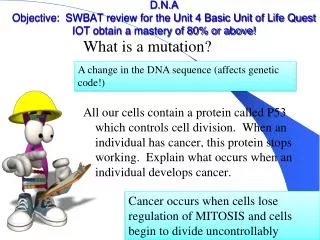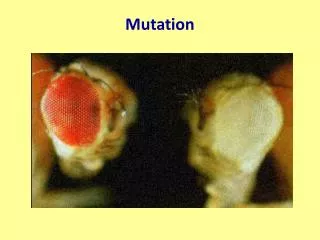
What is a mutation???
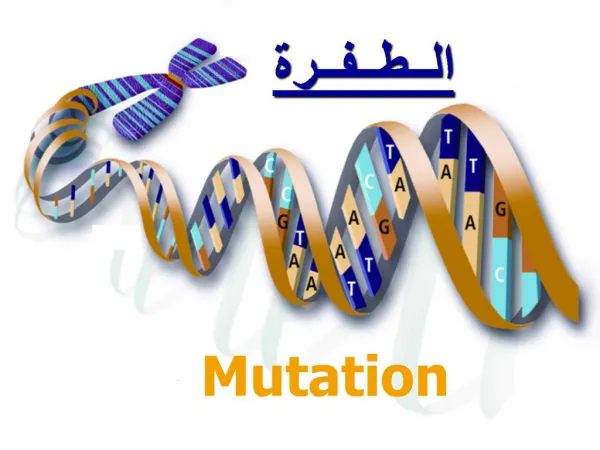
Genetic mutations are errors that occur in DNA, leading to changes in genetic information. These can be classified into point mutations, which involve the substitution, addition, or deletion of a single DNA base, and frameshift mutations that result from the addition or deletion of bases, altering the entire genetic sequence. Examples include sickle cell anemia from point mutations and muscular dystrophy from frameshift mutations. Other mutation types, affecting entire chromosomes, include deletions, inversions, duplications, and translocations. Understanding these mutations is crucial for recognizing their impact on health and development.

What is a mutation???
E N D
Presentation Transcript
GENETIC MUTATIONS MISTAKES IN DNA
A MISTAKE CAN BE: 1. A point mutation – substitution, addition, or removal of a single DNA base. 2. A frameshift mutation – a point mutation due to an addition or deletion of a DNA base that causes a major change in the genetic code.
Sickle cell anemia is caused by a point mutation - substitution Val-his-leu-thr-pro-glu-glu Val-his-leu-thr-pro-val-glu-
CHANGE THE W TO A T: THE CAT SAT THE DOG CHANGE THE D TO AN H THE CAT SAW THE HOG
MAJOR MISSENSE: REMOVE THE “C” THE ATS AWT HED OG This type of mutation causes a protein to be non-functional. It is a severe problem and can be lethal.
MAJOR MISSENCE: INSERT AN “M” after the first “The”. THE MCA TSA WTH EDO G The body cannot make sense out of the incorrect protein, just as the sentence no longer makes sense to you.
Nonsense • When a point mutation codes for a STOP in the middle of a sequence. Could be due to any of the point mutations. Nonfunctional dystrophin, the protein that helps attach your skeletal muscle to its surroundings.
Some mutations involve whole chromosomes: 1. Deletion: A piece of a chromosome is lost because of breakage during cell division Cri du chat
Inversion: A piece of a chromosome breaks off and reattaches backwards. The effect can belethal.
Duplication: A portion of the chromosome is copied and placed in the same chromosome.
Translocation: a piece of a chromosomes breaks off and reattaches to a non-homologous chromosome
Non-disjunction: A chromosome fails to separate from its homologue during meiosis