Chapter 28 Urinary System
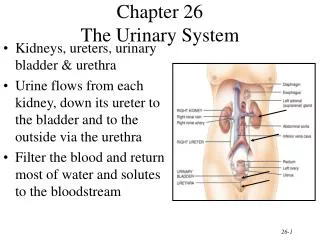
Chapter 28 Urinary System. Overview of the Urinary System. Kidneys— principal organs of the urinary system accessory organs are ureters, urinary bladder, and urethra

Chapter 28 Urinary System
E N D
Presentation Transcript
Chapter 28Urinary System Slide
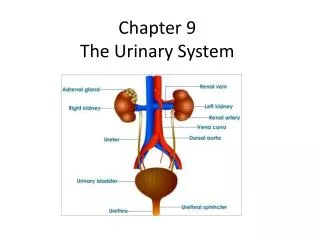
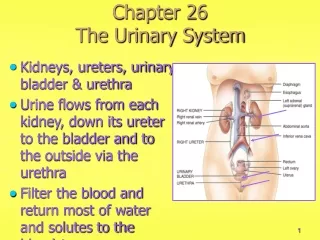
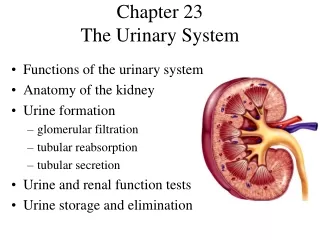
Overview of the Urinary System • Kidneys— principal organs of the urinary system • accessory organs are ureters, urinary bladder, and urethra • Urinary system— regulates the content of blood plasma to maintain homeostasis of the internal fluid environment within normal limits • “blood plasma balancer” Slide
Mink Slide
Human Slide
Gross structure • Kidneys (two) • Roughly oval with a medial indentation • Left kidney often larger than right • Right kidney is a little lower • Lie on either side of the vertebral column between T12 and L3 • Heavy cushion of fat surrounds each kidney Slide
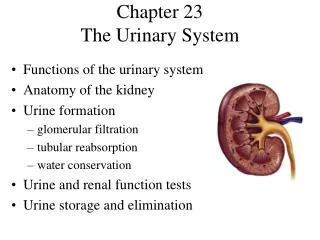
Internal structures of kidney • Cortex and medulla • Renal pyramids comprise much of the medullary tissue • Renal columns— where cortical tissue dips into the medulla between the pyramids • Calyx (KAY liks)— cuplike structure at each renal papilla to collect urine • join together to form renal pelvis • Renal pelvis narrows as it exits kidney to become ureter Slide
Gross structure • Renal artery— large branch of abdominal aorta; brings blood into each kidney • Kidneys are HIGHLY vascular • Every minute 1,200 mL blood flows through them • 1/5 of all blood pumped by heart goes to the kidneys Slide
Gross structure FYI: Pattern of blood flow through kidneys—abdominal aorta → renal artery → segmental arteries → lobar arteries → interlobar arteries → arcuate arteries → interlobular artery → afferent arteriole → glomerulus (glomerular capillaries) → efferent arteriole → peritubular capillaries (vasa recta) → interlobular veins → arcuate veins → interlobar veins → lobar veins → segmental veins → renal vein → inferior vena cava (Figure 28-3, Page 831) Slide
Gross structure Juxtaglomerular apparatus (juks-tah-glo-MER-yoo-lar) • located near the glomerulus • Helps regulate blood pressure by secreting renin when blood pressure in afferent arteriole drops Ureter • tube running from each kidney to urinary bladder • composed of three layers • mucous lining • muscular middle layer • fibrous outer layer Slide
Gross structure • Urinary bladder • collapsible bag located behind the symphysis pubis made mostly of smooth muscle tissue • can distend considerably • Functions • Reservoir for urine before it leaves the body • Aided by the urethra, expels urine from the body • Mechanism for voiding • Voluntary relaxation of external sphincter muscle • Regions of the detrusor muscle contract reflexively • Urine is forced out of the bladder and through the urethra Slide
Gross structure Urethra • Small mucous membrane–lined tube • In females • lies posterior to symphysis pubis and anterior to vagina • approximately 3 cm long • In males • after leaving the bladder, passes through prostate gland where it is joined by two ejaculatory ducts • from prostate, extends to base of penis and then through center of penis, and ends as urinary meatus • approximately 20 cm long • male urethra is part of the urinary system, as well as part of the reproductive system Slide
Nephrons • Nephrons, the microscopic functional units, make up the bulk of the kidney • those located in renal cortex called cortical nephrons • those near junction of cortical and medullary layers called juxtamedullary nephrons Slide
Structure of the Nephron Renal corpuscle • Bowman’s capsule— cup-shaped mouth of nephron • Glomerulus— network of fine capillaries in Bowman’s capsule • together called renal corpuscle • located in cortex of kidney • Glomerular-capsular membrane • function is filtration Slide
Structure of the Nephron • Proximal tubule • first part of renal tubule nearest to Bowman’s capsule • also known as proximal convoluted tubule Loop of Henle • Consists of a thin descending limb, a sharp turning, and a thick ascending limb Cortical nephron • a nephron with a loop of Henle that does not dip into the medulla but remains almost entirely within the cortex • constitute about 85% of total nephron numbers Slide
Structure of the Nephron Distal tubule • convoluted tubule beyond the loop of Henle • also known as distal convoluted tubule Collecting duct • Straight tubule joined by the distal tubules of several nephrons • Joins larger ducts • larger collecting ducts of one renal pyramid converge to form one tube that opens at a renal papilla into a calyx Slide
Kidney Function • Chief functions of kidney are to process blood and form urine • Basic functional unit of kidney is nephron • Forms urine through three processes • Filtration— movement of water and protein-free solutes from plasma in glomerulus into space of Bowman’s capsule • Tubular reabsorption— movement of molecules out of tubule and into peritubular blood • Tubular secretion— movement of molecules out of peritubular blood and into tubule for excretion Slide
1: Filtration • Filtration— 1st step in blood processing that occurs in the renal corpuscles • From blood in the glomerular capillaries, about 180 liters of water and solutes filter into Bowman’s capsule each day • takes place through the glomerular-capsular membrane • Filtration occurs as a result of existence of a pressure gradient • Glomerular capillary filtration occurs rapidly as a result of the increased number of fenestrations (openings) • Glomerular pressure and filtration are directly related to systemic blood pressure Slide
2: Reabsorption • Reabsorption- 2nd step • occurs as a result of passive and active transport mechanisms from all parts of the renal tubules • major portion of reabsorption occurs in proximal tubules • Reabsorption in proximal tubule: most water and solutes are recovered by the blood, leaving only a small volume of tubule fluid to move on to the loop of Henle Slide
2: Reabsorption Reabsorption in proximal tubule • Sodium— actively transported out of tubule fluid and into blood • Glucose and amino acids— passively transported out of tubule fluid by means of the sodium cotransport mechanism • Chloride, phosphate, and bicarbonate ions passively move into blood because of an imbalance of electrical charge • Water— movement of sodium and chloride into blood causes an osmotic imbalance, moving water passively into blood • Urea— approximately one half of urea passively moves out of tubule with the remaining urea moving on to the loop of Henle Slide
2: Reabsorption Reabsorption in the loop of Henle • Water is reabsorbed from the tubule fluid • urea is picked up from the interstitial fluid in the descending limb • Sodium and chloride are reabsorbed from the filtrate in the ascending limb, where the reabsorption of salt makes the tubule fluid dilute and creates and maintains a high osmotic pressure of the medulla’s interstitial fluid • Go to this Great Website! Slide
2: Reabsorption • Reabsorption in the distal tubules and collecting ducts • Distal tubule reabsorbs sodium by active transport but in smaller amounts than in the proximal tubule • ADH is secreted by the posterior pituitary and targets the cells of distal tubules and collecting ducts to make them more permeable to water • With the reabsorption of water in the collecting duct, [urea] of tubule fluid increases urea to diffuse out of collecting duct into medullary interstitial fluid • Urea participates in a countercurrent multiplier mechanism that, along with countercurrent mechanisms of the loop of Henle and vasa recta, maintains the high osmotic pressure needed to form concentrated urine and avoid dehydration Slide
3: Secretion • H +, K+ and NH3 are actively transported out of the blood into filtrate to be excreted. This increase in concentration increases the activity of the Na+/K+ pump in the distal and collecting tubule. Slide
3: Secretion • Tubular secretion— the movement of substances out of blood and into tubular fluid • Descending limb of loop of Henle secretes urea via diffusion • Distal and collecting tubules secrete potassium, hydrogen, and ammonium ions • Aldosterone— hormone that targets the cells of distal and collecting tubule cells, causes increased activity of sodium-potassium pumps increasing [Na+] • Secretion of hydrogen ions increases with decreases blood [H+] Slide
Regulation of urine volume • Antidiuretic hormone (ADH) influences water reabsorption • as water is reabsorbed, total volume of urine is reduced by amount of water removed by tubules • ADH reduces water loss • Aldosterone • secreted by adrenal cortex • increases distal tubule absorption of sodium, raising [Na+] of blood • thus promoting reabsorption of water • Atrial natriuretic hormone (ANH) • secreted by specialized atrial muscle fibers (in atria) • promotes loss of sodium via urine • opposes aldosterone, causing the kidneys to reabsorb less water • thereby produce more urine • This reduces blood pressure by reducing the amount of water in blood Slide
Regulation of urine volume • Tubuloglomerular feedback mechanism maintains constant glomerular filtration rate (GFR) by regulating resistance in afferent arterioles • protects kidney GFR function from rapid blood pressure variations • dependent on juxtaglomerular apparatus • Myogenic mechanism— rapid and effective regulation of GFR via changes in afferent arteriole smooth muscle contraction and relaxation • Urine volume— also related to total amount of solutes other than sodium excreted in the urine • generally, the more solutes, the more urine Slide
Urine Composition • approximately 95% water with several substances dissolved in it • the most important are the following: • Nitrogenous wastes— result of protein metabolism • urea, uric acid, ammonia, and creatinine • Electrolytes • sodium, potassium, ammonium, chloride, bicarbonate, phosphate, and sulfate • amounts and kinds of minerals vary with diet and other factors • Toxins— during disease, bacterial poisons leave the body in urine • Pigments— especially urochromes (make it yellow) • Hormones— high hormone levels may spill into the filtrate • Abnormal constituents— such as blood, glucose, albumin, protein, WBC Slide
Urine dip stick Slide
The Big Picture: Urinary System and the Whole Body • Homeostasis of water and electrolytes in body fluids relies on proper functioning of the kidneys • Nephrons process blood to adjust its content to maintain a relatively constant internal environment • Urinary and cardiovascular systems are interdependent • Endocrine and nervous systems must operate properly to ensure efficient kidney function Slide