Download
1 / 19
190 likes | 312 Vues
This work explores the challenges and methods associated with earthquake prediction, focusing on statistical probabilities, physical measurements, geochemical observations, and animal behavior. The study analyzes historical seismicity data from regions such as Parkfield and Wrightwood in California to assess recurrence times and predict future events. Despite observed patterns, the inherent unpredictability of earthquakes remains a significant hurdle, compounded by the complexities of fault physics and insufficient precursor observations. Ongoing research aims to enhance predictive models.

E N D
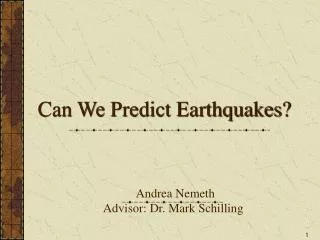
Can We Predict Earthquakes? AndreaNemeth Advisor: Dr. Mark Schilling
Earthquake Prediction • location • time • magnitude • probability of occurrence • reliable • accurate The collapse of part of Jefferson Junior High School in Long Beach in 1933.(Photo: Portland Cement Association)
Methods Employed In Earthquake Prediction • statistical probability • physical measurements • geochemical observations • observations of animal behavior Seismicity of California (USGS)
Popular media statements “the Big One is overdue” “the longer it waits, the bigger it will be” (USGS)
Statistical Models • time-independent • Poisson (exponential) model • time-dependent • Gaussian • gamma • log-normal • Weibull distributions • Brownian Passage Time
Magnitudes of EQs and the time intervals between EQs are each assumed to be independently distributed. memoryless The probability of rupture is a function of the accumulated strain. Poisson Model Weibull Model
Parkfield and Wrightwood • Parkfield area medium-sized EQs occur here fairly regularly • Wrightwood area long term data is available LA (USGS)
The Experiment • 1857, 1881, 1901, 1922, 1934, 1966 • USGS prediction: an earthquake of ~M6 would occur in Parkfield between 1983 and 1993
So how regular are the recurrence times of these earthquakes? The intervals between these EQs: 24, 20, 21, 12, 32, 38 Mean: 24.5 years Standard deviation: 9.25 years.
Can we rule out the possibility that even EQs at Parkfield are random in time? Result:8.8% of all simulated interval sequences had standard deviation less than 9.25. Conclusion: Thissequence is somewhat regular, but not extremely unusual.
Wrightwood 534, 634, 697, 722, 781, 850, 1016, 1116, 1263, 1360, 1470, 1536, 1610, 1690, 1812, 1857
The Recurrence Times of the EQs at Wrightwood The time intervals between successive EQs: 100, 63, 25, 59, 69, 166, 100, 147, 97, 110, 66, 74, 80, 122, and 45 years. mean: 88.2 years standard deviation: 37.8 years.
Simulation for the Wrightwood area Result: Only 1.5% of all simulated interval sequences had standard deviation less than 37.8 years. Conclusion: This sequence of 16 EQs at Wrightwood is more regular than the Parkfield sequence.
Summary Several factors make EQ prediction difficult: • the cycle of EQs is long • the fundamental physics of EQ faulting is not yet understood • no clearly recognizable precursor has been observed • EQ history is short for most faults
Potential Future Work • Further investigation of the Wrightwood data • Analysis of other data sets from the San Andreas Fault • Study of other statistical models with our data
Acknowledgments • This project was sponsored by the NASA/JPL PAIR program. • I thank Dr. Carol Shubin for her continuous support, interest and encouragement. • I’m very grateful to Dr. Mark Schilling, my advisor, for his comments on the data analysis and preparation, for his valuable insights andobservations.







![The signs of the times(2) [earthquakes]](https://cdn1.slideserve.com/2296340/the-signs-of-the-times-2-earthquakes-dt.jpg)