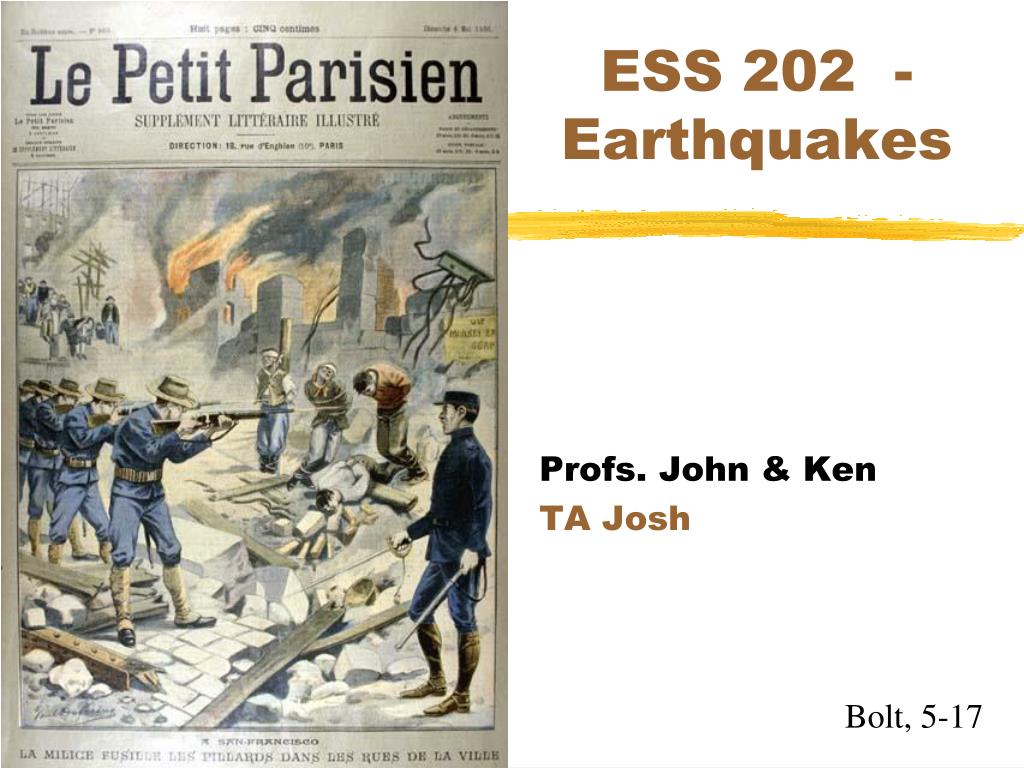
ESS 202 - Earthquakes. Profs. John & Ken TA Josh. Bolt, 5-17. Overall outline. Plate tectonics Earthquakes Structure of the the Earth Measuring intensity Seismometers, magnitude Where are west coast faults? Some famous quakes More Tsunamis Rest of quarter - Hazards of quakes.
Une image / un lien ci-dessous est fourni (tel quel) pour télécharger la présentation
Politique de téléchargement : le contenu du site vous est fourni TEL QUEL pour votre information et votre usage personnel ; il ne peut être vendu, concédé sous licence ni partagé sur d’autres sites sans l’accord de son auteur.Le contenu vous est fourni TEL QUEL, pour votre information et votre usage personnel uniquement.Téléchargez la présentation en cliquant sur ce lien.Lors du téléchargement, si vous ne parvenez pas à télécharger une présentation, l’éditeur a peut-être supprimé le fichier de son serveur.Pendant le téléchargement, si vous ne parvenez pas à obtenir une présentation, le fichier a peut-être été supprimé par l’éditeur.
Overall outline • Plate tectonics • Earthquakes • Structure of the the Earth • Measuring intensity • Seismometers, magnitude • Where are west coast faults? • Some famous quakes • More Tsunamis • Rest of quarter - Hazards of quakes Light at the end of the tunnel
You are here Pacific and North American plates are main players Press, 20-12
Where are faults, exactly? • We’ll swing down the coast • Alaska • British Columbia, Oregon, Washington • California • Wasatch Fault Zone • Utah, Idaho, Montana, Wyoming (Yanev,Appendix A)
Subduction under Alaska & Aleutian Is. • 8 cm/yr of plate convergence • almost strike-slip in Aleutian Is. • Site of large underthrusting earthquakes • 1964 Alaska Earthquake MW=9.2 • Volcanic arc & eruptions
Alaska • Most dangerous faults in US • 8 quakes over M=8 in last 100 years • Sparsely populated • Main fault is subduction thrust • Only surfaces on ocean floor • Many secondary faults • Also has volcanoes, tsunamis
1899-1979 Alaska quakes 6.7 & 8 quakes in 2002 Stars - M > 7.5 Triangles - 6.5 to 7.5 Yanev, p. 175
Tectonic Settingof N. America • Old stable interior • East coast “passive margin” • West coast “active margin” • Pacific - N. Am. plate interactions • Transform motion at SAF • Subduction under Alaska & Aleutian Is. • Juan de Fuca - N. Am. interactions • Subduction under Northern California, Oregon, Washington, and British Columbia
USA seismicity • Notice that all the action is in the West • most dramatic topography in the West • Yosemite, Cascade Mts., Big Sur coast, etc. • few earthquakes in the East • Some faults as far east as Yellowstone • No action to west in Pacific plate either • Hawaii is special case - hot spot volcano
Geology of western US - Fabric related to deformation
Western boundary of North American Plate • Type of boundary depends on orientation • Plate boundaries move and change in time • Past 30 My saw major changes & development of San Andreas Fault • From 80 to 30 My Farallon plate subducted under west coast. • Juan de Fuca & Cocos plates are remnants of Farallon plate
Details: US and Mexico coast • Three little plates subducting offshore Oregon, Washington, and B. Columbia • Juan de Fuca Plate • Gorda Plate • Explorer Plate • Spreading ridge splitting Gulf of California • Separating Baja from N. America • Oblique because ridges are combined with transform faults • Cocos Plate subducting to the south
Exotic terrains Western N. Am (Cordillera) assembled from small pieces over past 200 My
Changes in west coast • A mid-ocean ridge subducted • Before that, just subduction on coast • First hit near LA 25 Mya • San Andreas fault system started then • As ridge is subducting, two triple junctions are moving apart on coast • Mendocino Triple Junction moving north • NA-Pacific-Juan de Fuca junction • NA-Pacific-Rivera junction off Baja California
Oregon-Washington • M 9 every 1000 years, last in 1700 • Recent quakes • M 7.0 in 2000, 6.5 in 1965 in Seattle • M 7.1 in 1949 in Olympia • Main fault is subduction zone • Also volcanoes (like Mt. St. Helens) • Not adequately prepared • We’ve looked at these faults before • But biggest surface offshore
Subduction under Pacific Northwest • 4 cm/yr of plate convergence • like small convection cell - up at ridge down at subduction zone • Site of great underthrusting earthquakes • None in historic record • But evidence for magnitude 9 quake in 1700 • Tsunami sands in buried marsh • Tsunami in Japan in 1700 • Volcanic arc & eruptions • Mt. St. Helens, Mt. Rainier, Mt. Shasta
Quakes in California • The highest concentration is near the big faults; San Andreas, Cape Mendocino • Other areas also have many little quakes • Mammoth Mts. - 1000’s of quakes per year • Coso Hot Springs - geothermal activity • Probably no area in California is safe from occasional little quakes
California • Last 150 years, 2-3 quakes of M8 • Main fault is strike-slip, on land • San Andreas fault zone • Easy to map in detail • Many secondary faults • Some offshore, most farther East
Northern California • San Andreas • Runs through Point Arena, Point Reyes, San Francisco, San Jose, Watsonville • East Bay Faults • Calaveras-Hayward-Rodger’s Creek • Some farther east • Offshorefaults?
Connexion au compte
Connectez-vous pour publier votre contenu sur SlideServe.