Understanding Cell Structure and Function: Exploring the Basics of Life
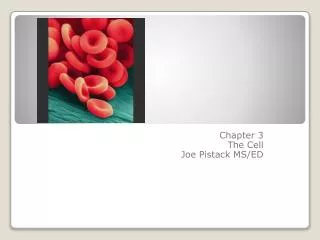
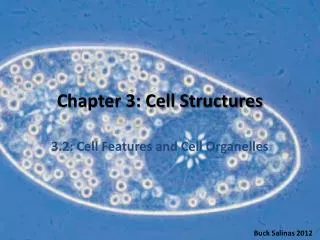
This chapter delves into the fundamental aspects of cells, enhancing our understanding as microscope technology advanced. It introduces cell theory, which posits that all living organisms are composed of cells, and that all existing cells arise from pre-existing cells. The text elaborates on the characteristics of prokaryotic and eukaryotic cells, their internal structures including the cytoskeleton, nucleus, and organelles like mitochondria and lysosomes. It also discusses cell membrane functions and the processes of transport, both passive and active, emphasizing the complex interactions that sustain cellular life.

Understanding Cell Structure and Function: Exploring the Basics of Life
E N D
Presentation Transcript
3.1 • Our understanding of the cell grew as microscope quality improved.
Cell Theory • Mainly Schleiden, Schwann, Virchow • All organisms are made of cells • All existing cells are produced by other cells • The cell is the most basic unit of life.
General Cell Characteristics • Tend to be microscopic • Enclosed in a membrane • Filled with cytoplasm
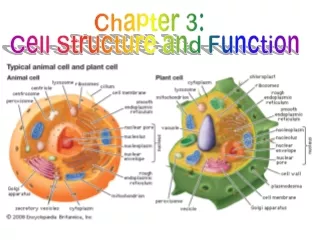
Types of cells • Prokaryotic • No nucleus • No membrane bound organelles • Like bacteria • Eukaryotic • Nucleus • Membrane bound organelles • Like not bacteria
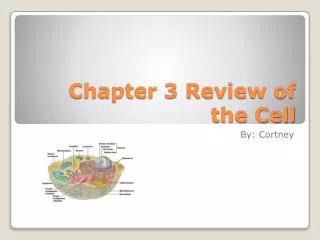
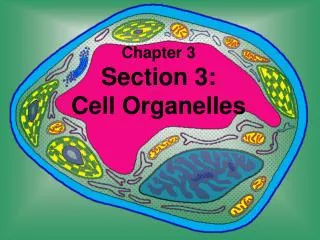
3.2 • Cells have an internal structure
Cytoskeleton • Support and shape • Position and transport organelles • Strength • Assists in cell division • Cell movement
Nucleus • Stores genetic information • Control center of the cell
Endoplasmic Reticulum • Transport • Rough: has ribosomes for processing proteins • Smooth: no ribosomes, process lipids and carbohydrates
Ribosomes • Made of rRNA • Form proteins
Golgi apparatus • Golgi bodies • Packaging and shipping
Vesicles • Membrane bound sacks • Storage
Mitochondria • Energy
Vacuoles • Like little warehouses • Storage
Lysosomes • Waste disposal • Digest material
Centrioles • Tubes in centrosomes • Help in mitosis • Form cilia and flagella
Plant cell parts • Chloroplasts: where photosynthesis occurs • Have a cell wall of cellulose for support
3.3 • Cell membrane
Functions • Enclose cell like a fence does • Controls passage of stuff like a fence does
Structure • Phospholipidbilayer • Proteins, carbohydrates, and lipids may be imbedded in the membrane • The fluid mosaic model
Selectively permeable • Lets some stuff in, keeps other stuff out. Kinda like a fence does
Receptors • A substance can bind to its receptor • Causes an action on the other side of the membrane
3.4 • Stuff can move across cell membranes
Transport • Passive: just happens • Active: requires energy
Passive transport • Diffusion: stuff diffuses from regions of high concentration to regions of low concentration • Osmosis: diffusion of water
Three types of solutions • Hypotonic: • Lower concentration • Water moves out of cell • Hypertonic • Higher concentration • Water moves out of cell • Isotonic • Same concentration • No net movement of water
Facilitated diffusion • Some molecules can only diffuse through transport proteins. • Facilitated diffusion is diffusion through transport proteins. • Revolving door
3.5 • Some transport requires energy
Active transport • Requires energy • Goes against a gradient
Types • Pumps • Endocytosis: takes material into the cell • Pinocytosis: cell drinking • Phagocytosis: cell eating • Exocytosis: expels material from the cell