
SlideServe
Menu
Préférences
© SlideServe · v2026

Friction, Conduction and Induction

cwen avatar
18 diapositives · 3.5K Views · Jul 23, 2014

Friction, Conduction and Induction. How do you charge an object?. There are three ways to charge an object: 1. Charge by Friction 2. Charge by Conduction 3. Charge by Induction. How do you measure “charge”.
Friction, Conduction and Induction - slide 1
01 / 18Friction, Conduction and Induction
1 / 17

Télécharger la présentation

Friction, Conduction and Induction
Une image / un lien ci-dessous est fourni (tel quel) pour télécharger la présentation

Politique de téléchargement : le contenu du site vous est fourni TEL QUEL pour votre information et votre usage personnel ; il ne peut être vendu, concédé sous licence ni partagé sur d’autres sites sans l’accord de son auteur.Le contenu vous est fourni TEL QUEL, pour votre information et votre usage personnel uniquement. Téléchargez la présentation en cliquant sur ce lien. Lors du téléchargement, si vous ne parvenez pas à télécharger une présentation, l’éditeur a peut-être supprimé le fichier de son serveur.Pendant le téléchargement, si vous ne parvenez pas à obtenir une présentation, le fichier a peut-être été supprimé par l’éditeur.

F I N

Plus de contenu associé

Transcription de la présentation
  1. Friction, Conduction and Induction

  2. How do you charge an object? • There are three ways to charge an object: 1. Charge by Friction 2. Charge by Conduction 3. Charge by Induction

  3. How do you measure “charge” • The unit of measure for electrical charge is the Coulomb (C). In equations it is symbolized by a “q” • Eg: q = 900C • One Coulomb is equal to the charge of 6.25 X 10¹⁸ electrons (-) or protons (+). • That is to say, one Coulomb has 6.25 X 10¹⁸ electrons.

  4. Charging Objects • Most objects start out electrically neutral, but by CHARGING an object you create an imbalance in the number of electrons and protons; the object is then charged and is either positive or negative. • You can charge an object through: • Friction – the transfer of electrons from one object to the other • Conduction – by having two objects TOUCH each other and transfer electrons from one object to the next. • Induction – By inducing electrons to move from one object to the other.

  5. Charging by Friction • When two neutral objects are rubbed against each other, one object may pull electrons away from the other creating one positive object and one negative object.

  6. Electrostatic Series: • All objects begin neutral & can become positively or negatively charged • A positively charged object has more positives than negatives • A negatively charged object has more negatives than positives

  7. Electrostatic Series: • Electrostatic seriesis a list that ranks objects’ ability to take negative charges Rubber Items at top take negatives Ebonite Polyethylene Cotton Silk Wool Items at bottom lose negatives Glass Acetate Fur / Hair

  8. Items at top take negatives Ex #1 Your cat rubs against a rubber balloon. What will be the charge on the balloon? Your cat’s fur? Rubber balloon becomes negative Rubber Rubber Ebonite Polyethylene Cotton Silk Wool Glass Acetate Fur / Hair Cat’s fur becomes positive Fur / Hair Negatives

  9. Items at top take negatives Ex #2 In a lab, you take a piece of neutral wool & neutral polyethylene & rub them together. What will be their charges? Polyethylene balloon becomes negative Rubber Ebonite Polyethylene Cotton Silk Wool Glass Acetate Fur / Hair Polyethylene Negatives Wool Wool becomes positive

  10. Ex #3 In a lab, you rub a piece of cotton & ebonite together. Then you rub a piece of silk & wool together. You then bring the charged piece of cotton& the charged piece ofsilktogether. What will happen? Rubber Ebonite Polyethylene Cotton Silk Wool Glass Acetate Fur / Hair - Cotton is + Silk is - + - They wouldATTRACT +

  11. Ex #4 You rub your hair with a balloon. Explain using words & pictures, why your hair “sticks up”. 1st Hair & balloon are both neutral _ + _ _ + + 2nd Rubber balloon takes negative charges from the hair. So, balloon becomes negatively charged & hair becomes positively charged + _ + _ 3rd Since hair is positive & like charges repel, hair sticks up!!!

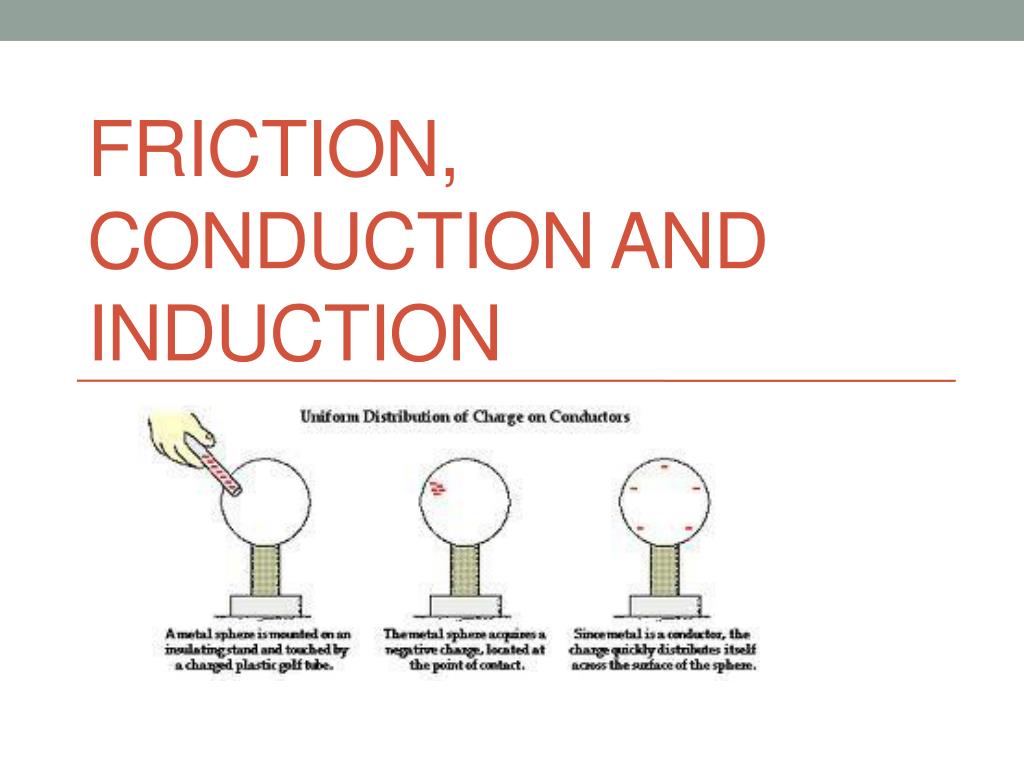
  12. Charging by Conduction • An object can be charged by touching it with another object that already has a charge. The resulting object will then have the same charge but weaker in strength than the original object.

  13. Charging by Conduction • This image shows how a positive charged object alters the charge on the globe via conduction.

  14. Charging by Conduction • This image shows how a negative charged object alters the charge on the globe via conduction

  15. Charging by Induction • Objects do not touch (one is charged, one is neutral) • Proximity of the charged object causes (induces) the charges in the neutral object to separate.

  16. Charging by Induction • This image shows how a negative charged object alters the charge on the globe via induction.

  17. Charging by Induction • This image shows how a positive charged object alters the charge on the globe via induction.

  18. Key Points to Remember • Two types of charges – positive(+) & negative (-) • “Opposites Attract” • “Like Repel” • Items at the top of the electrostatic series list take negative charges • Only negative charges move • Three methods to charge an object: friction, conduction, induction. These three methods are what cause static electricity.