
SlideServe
Menu
Préférences
© SlideServe · v2026

Number of Media Stories on Internet Problems by Year

cybil avatar
1 diapositives · 243 Views · Sep 27, 2014

Media Portrayal of MySpace and Internet Dangers: An Archival Study By: Larry Rosen, Ph.D., Scott Mariano, Helen Gutierrez, and Saira Rab. Are Teens Really in Danger on the Internet? 8% to 15% of teens report unwanted sexual solicitation (Rosen et al., 2008; Wolak et al.,
Number of Media Stories on Internet Problems by Year - slide 1
01 / 1Number of Media Stories on Internet Problems by Year
1 / 17

Télécharger la présentation

Number of Media Stories on Internet Problems by Year
Une image / un lien ci-dessous est fourni (tel quel) pour télécharger la présentation

Politique de téléchargement : le contenu du site vous est fourni TEL QUEL pour votre information et votre usage personnel ; il ne peut être vendu, concédé sous licence ni partagé sur d’autres sites sans l’accord de son auteur.Le contenu vous est fourni TEL QUEL, pour votre information et votre usage personnel uniquement. Téléchargez la présentation en cliquant sur ce lien. Lors du téléchargement, si vous ne parvenez pas à télécharger une présentation, l’éditeur a peut-être supprimé le fichier de son serveur.Pendant le téléchargement, si vous ne parvenez pas à obtenir une présentation, le fichier a peut-être été supprimé par l’éditeur.

F I N

Plus de contenu associé

Transcription de la présentation
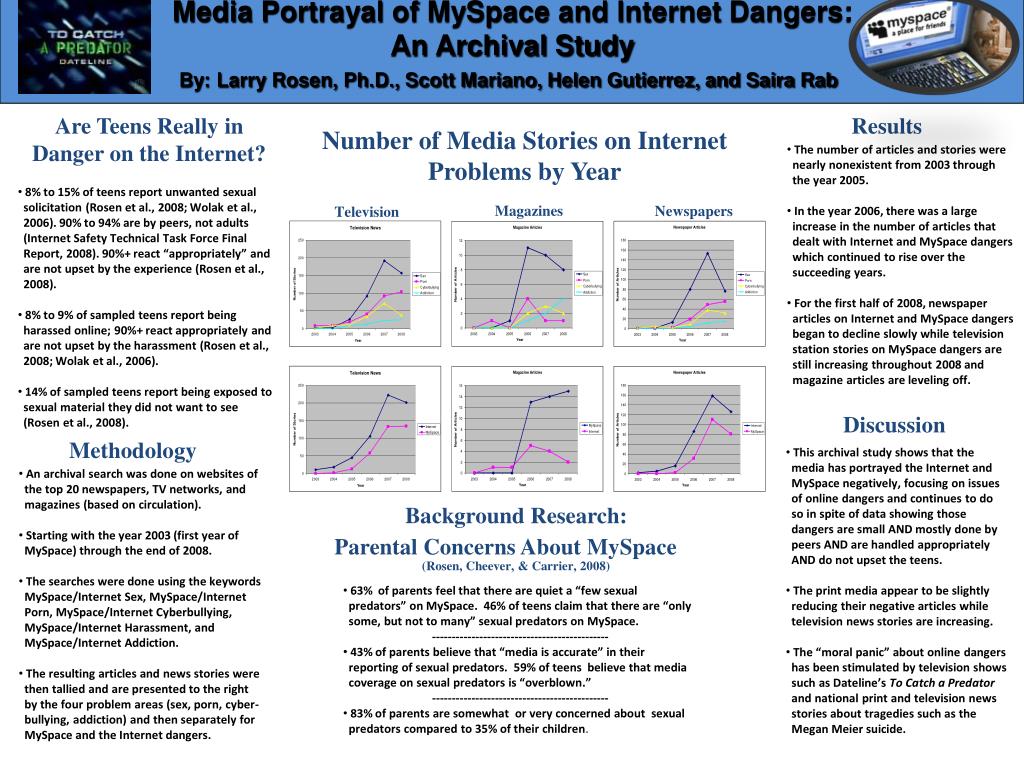
  1. Media Portrayal of MySpace and Internet Dangers: An Archival Study By: Larry Rosen, Ph.D., Scott Mariano, Helen Gutierrez, and Saira Rab • Are Teens Really in Danger on the Internet? • 8% to 15% of teens report unwanted sexual • solicitation (Rosen et al., 2008; Wolak et al., • 2006). 90% to 94% are by peers, not adults • (Internet Safety Technical Task Force Final • Report, 2008). 90%+ react “appropriately” and • are not upset by the experience (Rosen et al., • 2008). • 8% to 9% of sampled teens report being • harassed online; 90%+ react appropriately and • are not upset by the harassment (Rosen et al., • 2008; Wolak et al., 2006). • 14% of sampled teens report being exposed to • sexual material they did not want to see • (Rosen et al., 2008). Results Number of Media Stories on Internet Problems by Year • The number of articles and stories were • nearly nonexistent from 2003 through • the year 2005. • In the year 2006, there was a large • increase in the number of articles that • dealt with Internet and MySpace dangers • which continued to rise over the • succeeding years. • For the first half of 2008, newspaper • articles on Internet and MySpace dangers • began to decline slowly while television • station stories on MySpace dangers are • still increasing throughout 2008 and • magazine articles are leveling off. Magazines Newspapers Television Discussion Methodology • This archival study shows that the • media has portrayed the Internet and • MySpace negatively, focusing on issues • of online dangers and continues to do • so in spite of data showing those • dangers are small AND mostly done by • peers AND are handled appropriately • AND do not upset the teens. • The print media appear to be slightly • reducing their negative articles while • television news stories are increasing. • The “moral panic” about online dangers • has been stimulated by television shows • such as Dateline’s To Catch a Predator • and national print and television news • stories about tragedies such as the • Megan Meier suicide. • An archival search was done on websites of • the top 20 newspapers, TV networks, and • magazines (based on circulation). • Starting with the year 2003 (first year of • MySpace) through the end of 2008. • The searches were done using the keywords • MySpace/Internet Sex, MySpace/Internet • Porn, MySpace/Internet Cyberbullying, • MySpace/Internet Harassment, and • MySpace/Internet Addiction. • The resulting articles and news stories were • then tallied and are presented to the right • by the four problem areas (sex, porn, cyber- • bullying, addiction) and then separately for • MySpace and the Internet dangers. Background Research: Parental Concerns About MySpace (Rosen, Cheever, & Carrier, 2008) • 63% of parents feel that there are quiet a “few sexual • predators” on MySpace. 46% of teens claim that there are “only • some, but not to many” sexual predators on MySpace. • --------------------------------------------- • 43% of parents believe that “media is accurate” in their • reporting of sexual predators. 59% of teens believe that media • coverage on sexual predators is “overblown.” • --------------------------------------------- • 83% of parents are somewhat or very concerned about sexual • predators compared to 35% of their children.