Download
1 / 10
100 likes | 226 Vues
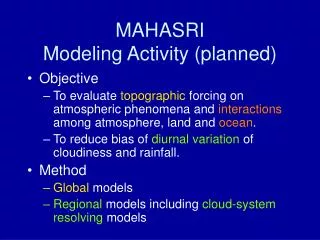
This research aims to improve seasonal weather predictions by evaluating the topographic forcing on atmospheric phenomena and their interactions with land and ocean. Key objectives include reducing biases in diurnal variations of cloudiness and rainfall, assessing aerosol impacts on monsoons, and understanding urban pollution effects on local precipitation. We utilize advanced global and regional models, including cloud-system resolving models, and conduct coordinated research with CLIVAR/AAMP. Findings will address critical issues like rainfall variability and improve forecasting accuracy.

E N D
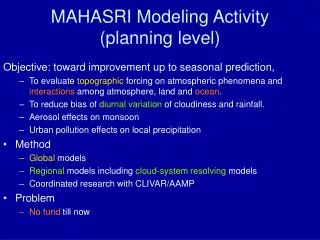
MAHASRI Modeling Activity (planning level) Objective: toward improvement up to seasonal prediction, • To evaluate topographic forcing on atmospheric phenomena and interactions among atmosphere, land and ocean. • To reduce bias of diurnal variation of cloudiness and rainfall. • Aerosol effects on monsoon • Urban pollution effects on local precipitation • Method • Global models • Regional models including cloud-system resolving models • Coordinated research with CLIVAR/AAMP • Problem • Nofund till now
Problem of topographic effects TRMM (rainy season average) Xie et al. 2006 Effects of narrow topographic latent heating
Issues of rainfall diurnal variation • 20km AGCM captures spatial distribution of diurnal rainfall peak time over both land and the ocean within a few hours • Few difference between 20km and 120km AGCMs Arakawa & Kitoh
Surface & COADS T42L26 + 1degL40 Dai & Trenberth (2004)
MJJ Satomura (2000) Oct Okumura et al. (2003)
23 LT 16th 01 LT 17th 03 LT 05 LT 07 LT 09LT 1 hour precipitation in the case of Bangladesh
Shinoda (2005) Issues of rainfall diurnal variation • MRI GCM vs other GCMs • Large scale hydrostatic systems vs mesoscale non-hydrostatic systems • Precise evaluation of long time effects of diurnal variation error on land Nakata & Satomura (2007)
Expectation • Data which help resolve the issues itemized at the beginning • Modeling objective: toward improvement up to seasonal prediction, • To evaluate topographic forcing on atmospheric phenomena and interactions among atmosphere, land and ocean. • To reduce bias of diurnal variation of cloudiness and rainfall.
One of targets: Multi-Scale Interrelation Slingo2006: THORPEX/WCRP Workshop report from Wang
JMA LRF Model Replacement(Plan) • 1 months prediction • 2007: Improve initial data for ensemble fcst • 2008~: dx=120km --> 60km • 3 months prediction • 2007 : SST ensemble • El-Nino prediction • 2007: Increase resolution: • T42L40, 2.5°L40 --> T95L40, 1°L50 • 2008~ : develop unified 3-months & El-Nino prediction model with T159L60, 0.5°L60