Overview of 8255 Programmable Peripheral Interface and Its Modes
The 8255 Programmable Peripheral Interface (PPI) features three I/O ports: Port A (8 bits), Port B (8 bits), and Port C (4 bits upper, 4 bits lower). Functionality is controlled via pins such as CS (Chip Select), RD (Read), and WR (Write), enabling bidirectional data transmission. The device operates in two primary modes: I/O mode (further divided into Mode 0 - Basic I/O, Mode 1 - Strobe I/O, and Mode 2 - Bi-Conditional Bus) and BSR mode. Each port can be configured as input or output based on the control bytes provided.


Overview of 8255 Programmable Peripheral Interface and Its Modes
E N D
Presentation Transcript
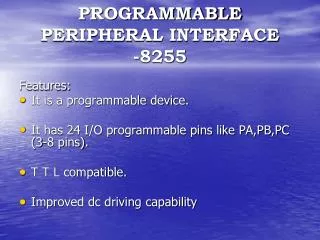
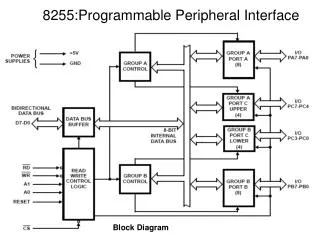
8255 • It is a programmable peripheral Interface with three i/o ports • A 8 bits • B 8 bits • C 4 bits upper and 4 bits lower
8 bit i/o ports PA, PB, PC (Port A,B,C) CS (Chip Select) A low signal at this pin enables the chip RD (Read) Read enable WR (Write) Write enable Bi-directional data lines D0-D7 (Data Bus) A0,A1 (Address) Address select
8255 • The 8255 can work in 2 modes that are I/O mode and BSR mode • i/o mode is further divided in to 1. Mode 0 (Basic I/O) 2. Mode 1 (Strobe I/O) 3. Mode 2 (Bi - Conditional Bus)
D7 D4 D3 D1 D0 D6 D5 D2 1 Control Bytes for I/O mode Group B Port C (lower) 1 = input 0 = output Port B 1 = input 0 = output Mode selection 00 = mode 0 01 = mode 1 1x = mode 2 Group A Port C (upper) 1 = input 0 = output Port A 1 = input 0 = output Mode selection 00 = mode 0 01 = mode 1 1x = mode 2