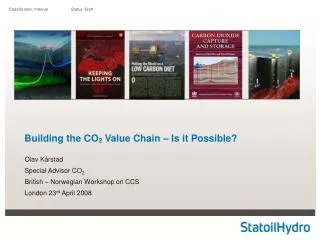
Building the CO2 Value Chain: Opportunities and Challenges in Carbon Capture and Storage
210 likes | 352 Vues
This workshop focuses on the potential for building a CO2 value chain as a means to address climate change through Carbon Capture and Storage (CCS). With rising CO2 emissions from various sectors, including petrochemical refineries, cement, and power generation, CCS is vital for meeting emission reduction targets. The discussion will cover successful projects, economic viability, technology development, and the necessary policy frameworks to enhance CCS adoption. Key insights on reducing carbon footprints while maximizing value creation in industrial processes will also be explored.


Building the CO2 Value Chain: Opportunities and Challenges in Carbon Capture and Storage
E N D
Presentation Transcript
Building the CO2 Value Chain – Is it Possible? Olav Kårstad Special Advisor CO2 British – Norwegian Workshop on CCS London 23rd April 2008
Build new international growth platforms Maximise value creation from the NCS Norway Global prod. avg. Re-fining LNG Extra heavy oil GTL Extra heavy oil incl. upgrad. StatoilHydro’s growth challenge is a climate gas emission challenge More CO2 intensive production in the pipeline – CCS necessary to reach targets CO2 emission [kg/tonne product]
Large Stationary Sources of CO2 – Global View Greater than 100 kt CO2/yr per facility Petrochemical Refineries Iron/steel Cement Oil power Coal power Gas power Data source: IPCC SRCCS (2005) and IPIECA
This is about 56% of fossil fuel related CO2 Number of sources or millions of tonnes/year * Larger than 0,1 million tonnes of CO2/yr from one source Data source: IPCC Special Report on CO2-capture and -storage
StatoilHydro’s CCS projectsPart-owner of 3 of 4* large-scale CCS project * The 4th project is Weyburn – Midale in Canada
Sleipner – 11 years of large scale CCS demo • Started in 1996 • CO2 from natural gas (Approx. 1 mill. tons CO2 annually) • Stored in saline aquifer – sandstone formation with water • Driver: CO2-tax (340 NOK/ton – $60/ton), corporate environmental strategy • Learning and confidence building through a series of large EU-wide R&D programmes
The In Salah gas processing plant with CO2-capture facilities
What does it take?Simple economic rules will decide speed and volume of CCS roll-out Cost Cost of emitting • Low hanging fruits • Direct governm. investment • Technology development • CO2-EOR • Kyoto mechanisms Cost of removing/injecting • Environmental taxes • Under-supply of credits • Emission limitation Time
LNG production Ammonia plants Coal gasification plants Hydrogen production CCS low-hanging fruits – “cheap”, already concentrated CO2 more than 200 sites globally with CO2 > 100 000 tonnes/yr Natural gas purification
Snøhvit LNG Sleipner In Norway two low-hanging fruits has passed the point of profitability due to the high CO2 tax on petroleum activity • Low hanging fruits • Direct governm. investment • Technology development • CO2-EOR • Kyoto mechanisms • Environmental taxes • Under-supply of credits • Emission limitation
Mongstad Kårstø And two “high hanging” CCS-fruits (in connection with gas fired power plants) are planned to be built with state funding • Low hanging fruits • Direct governm. investment • Technology development • CO2-EOR • Kyoto mechanisms • Environmental taxes • Under-supply of credits • Emission limitation
CO2-EOR – profits from CO2 injection • Income from extra oil production to pay for CO2 infrastructure • Onshore applications to happen first • Free up natural gas resources by using CO2 as injection gas • Coexistence with storage necessary • Sensible natural resource exploitation CO2 EOR Graphics : EnCana
Regulation and acceptance – perception of riskWhat does it all come down to? TODAY – certain emission TOMORROW – safe storage
Summary: Building the CO2 Value Chain – Is it Possible? • Climate change is happening – CCS one of five important solutions • Making CCS happen is difficult under any circumstances, but in particular in today’s high cost construction market and uncertain long term cost of emitting CO2 to the atmosphere • Low-hanging CCS fruits are there to be picked useful to prove storage and CO2-EOR as well as for gaining public enthusiasm • Power plant CO2-capture A number of demo-projects must proceed to avoid delay in 2. and 3. generation deployment (technology lock-in of long life plants) • In the shorter time frame carrot and stick incentives are necessary to initiate industrial scale projects without which technology and frameworks will not develop