Modeling Subsurface Oil Flow Fields
Understanding the movement of underground oil flows is crucial for efficient resource management. One effective computational method for predicting these flows is 3D seismic waveform inversion. This technique involves generating numerous forward-projecting model estimates and comparing them with observed data. By minimizing discrepancies between these two sets, the accuracy of the predictive models is enhanced. This paper discusses the modeled results as they relate to observed flow fields and offers insights into improving oil extraction and management strategies.

Modeling Subsurface Oil Flow Fields
E N D
Presentation Transcript
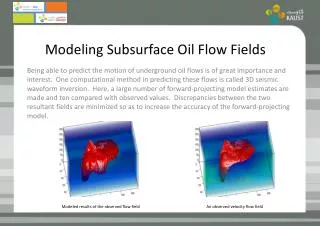
Modeling Subsurface Oil Flow Fields Being able to predict the motion of underground oil flows is of great importance and interest. One computational method in predicting these flows is called 3D seismic waveform inversion. Here, a large number of forward-projecting model estimates are made and ten compared with observed values. Discrepancies between the two resultant fields are minimized so as to increase the accuracy of the forward-projecting model. Modeled results of the observed flow field An observed velocity flow field