
Ecosystems
E N D
Presentation Transcript
Ecosystems Výukový materiál EK 01 - 16 Tvůrce: Ing. Marie Jiráková Tvůrce anglické verze: Mgr. Milan Smejkal Projekt: S anglickým jazykem do dalších předmětů Registrační číslo: CZ.1.07/1.1.36/03.0005 Tento projekt je spolufinancován ESF a SR ČR
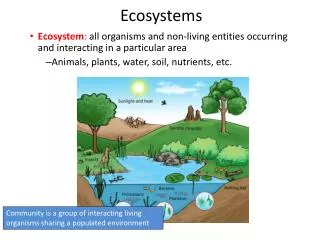
Ecosystem • Definition I. Ecosystemis a summary of living and non-living parts to form a stablesystem that occursat certain times and in certain space and includetheflowofenergy via food - chainsandfood-websandthecyclingofnutrientsbiogoechemically.
Ekosystem • Definition II. Ecosystemiscreated by the community of organisms together with the abiotic environment.
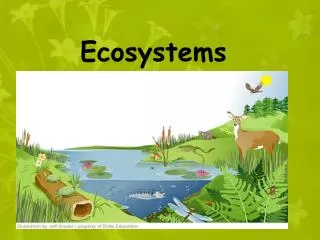
Ekosystems are divided • water – a pond, a rever, theseaetc. • land – a forest, a meadow, fieldsetc..
Structure and function of ecosystems Thereare different abiotic conditions in various ecosystems. Biotic conditions are created by the organisms and the relationships between them. There is a different function of organisms in an ecosystem : producers, consumers, decomposers
Ecosystemandlife • In everyecosystemthereis a conversionand transfer ofenergyandothersubstances. • Ecosystems are restored. • Ecosystemsevolve.
ecosystem • Each ecosystem reaches a balance under certain conditions. • Thereis a disruptionof balance whenchangingabioticorbioticcomponents. • The balance of the ecosystem isoftenruinedby human activity.
Ecosystemis A discretefunctional unit ofnature.
Ecosystems are dividedinto : • natural constant composition of plant and animal communitiesatcertainabioticconditions • artificial man-made, additionalenergy
Themainecosystems • tundra • taiga • steppe • deciduousforests • scrubbyforests • desertsandsemi-deserts • tropical deciduous forests and savannas • tropicalrainforests
Changes in ecosystems • Large areas of the original natural ecosystems have been altered by human activities.
worksheets - revision • Whatisecosystem? • Give an example of human activities that negatively affects some ecosystems. • What are thebiotic conditions madeupof? • Give examples of natural and artificial ecosystems. • How the man puts his supplemental energy into the artificial ecosystem of wheat and why.?
source • BRANIŠ, Martin. Základy ekologie a ochrany životního prostředí. 2. vyd. Praha: Informatorium, 1999. ISBN 80-86073-52-1. • PAPÁČEK, Miroslav a kol. Zoologie. Praha: pedagogické nakladatelství, 2000, ISBN 80-7183-203-0. • KVASNIČKOVÁ, Danuše. Základy ekologie. Praha: Scientia,spol.sr.o., 1994, ISBN 80-85827-84-0