Molecules Cause Pressure
The Kinetic Molecular Theory explains the behavior of gases based on the motion of particles. It states that particles are always in motion, with negligible volume, and that collisions with container walls exert pressure. Key aspects include the relationship between average kinetic energy and gas temperature, as all gases exhibit the same kinetic energy at identical temperatures. Additionally, the theory outlines diffusion and effusion processes, including Graham’s Law, while correcting for the behavior of real gases under high pressure and low temperature conditions, where attractive forces become significant.
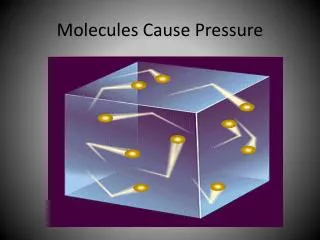

Molecules Cause Pressure
E N D
Presentation Transcript
Kinetic Molecular Theory • Particles of matter are ALWAYS in motion • Volume of individual particles is zero. • Collisions of particles with container walls cause pressure exerted by gas. • Particles exert no forces on each other. • Average kinetic energy µ Kelvin temperature of a gas.
Kinetic Energy of Gas Particles At the same conditions of temperature, all gases have the same average kinetic energy.
Distribution of Molecular Speeds • Maxwell’s equation relates molecular mass, average speed, and temperature together.
Diffusion Diffusion: describes the mixing of gases. Therateof diffusion is the rate of gas mixing.
Effusion Effusion: describes the passage of gas into an evacuated chamber.
Graham’s LawRates of Effusion and Diffusion Effusion: Diffusion:
Real Gases Must correct ideal gas behavior when at high pressure(smaller volume) and low temperature(attractive forces become important). corrected pressure corrected volume Videal Pideal