Understanding Enzymes: Catalysts of Life and Their Influences on Metabolic Reactions
Enzymes are large biological molecules that act as highly selective catalysts, accelerating metabolic processes essential for life. They decrease the energy needed for reactions while being highly specific to their substrates. Enzymes, primarily proteins but also including some RNA, catalyze around 4,000 biochemical reactions. Their activity is influenced by various factors, including pH, temperature, substrate concentration, and inhibitors. Learning about enzyme behavior can provide valuable insights into biological functions and the impact of environmental conditions on metabolic reactions.

Understanding Enzymes: Catalysts of Life and Their Influences on Metabolic Reactions
E N D
Presentation Transcript
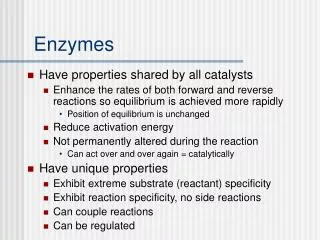
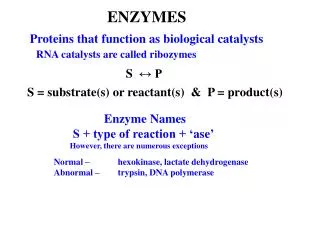
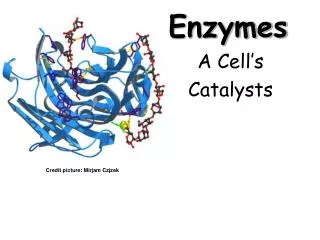
Enzymes are large biological molecules that are responsible for the thousands of metabolic processes that sustain life. • They are: • highly selective catalysts • greatly accelerating rate of metabolic reactions • greatly decrease the energy needed for a reaction • Mostly proteins, although some catalytic RNA molecules have been identified.
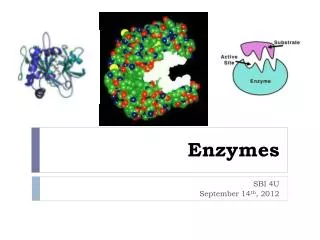
Structure • Enzymes are a 3-D structure that are highly complex. • Their structure is very important because they are specific to their substrates. • Enzyme origins: • Listen, will be important when we get to genetics.
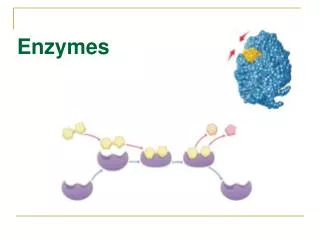
Lock and Key Model • Enzyme, Substrate, Product
Amylase • Foods with Maltose • Sweet potatoes • Grain Cereals • Pears • McDonald Hotcakes • Catsup [Ketchup] • Tootsies rolls Lock and Key
Energy savers • Like all catalysts, enzymes work by lowering the activation energy • this dramatically increasing the rate of the reaction. • Most enzyme reaction rates are millions of times faster than those of comparable un-catalyzed reactions. • As with all catalysts, enzymes are not consumed by the reactions they catalyze • However, enzymes do differ from most other catalysts in that they are highly specific for their substrates. • Enzymes are known to catalyze about 4,000 biochemical reactions.
Enzyme activity can be affected by: • Other molecules • Inhibitors • Activators • Many drugs and poisons are enzyme inhibitors • Temperature • Pressure • Chemical environment (pH) • Concentration of substrate
Pressure • How could pressure effect enzymes? • Under pressure, dun dundundadi dun dum!
The experiment • What’s the enzyme? • What’s the substrate? • What’s the product?
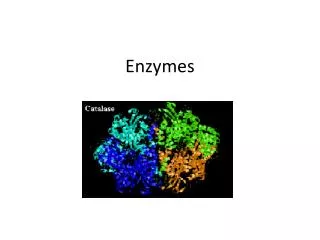
The experiment • What’s the enzyme? • Catalase • What’s the substrate? • H2O2 • What’s the product? • H20 + O2
The Experiment • Basic Idea???? • How would you test pH’s affect on catalase? • How would you test temperatures effect on catalase? • How would you test for different amounts of substrate?
The Experiment • Test for pH • Keep the concentration of yeast the same but make a range of pH to test. • Test for temperature • Keep the concentration of yeast the same but make a range of temperatures. • Substrate concentration • Change the concentration of the substrate.