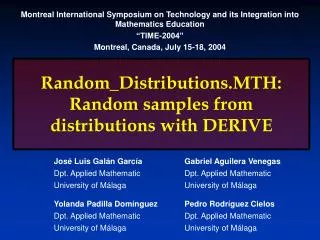
Random_Distributions.MTH: Random samples from distributions with DERIVE
120 likes | 244 Vues
This document presents a comprehensive study on random number generation in the context of mathematics education, showcased at the TIME-2004 symposium in Montreal. It explores various algorithms including the Ran2 and Mzran13 methods, alongside different approaches such as the Inverse Transform and Acceptance-Rejection methods for generating random samples from both continuous and discrete distributions. The contributions from researchers at the University of Málaga emphasize the importance of integrating technology into mathematics learning while providing practical examples and techniques beneficial for educators and students alike.


Random_Distributions.MTH: Random samples from distributions with DERIVE
E N D
Presentation Transcript
Random_Distributions.MTH: Random samples from distributions with DERIVE Montreal International Symposium on Technology and its Integration into Mathematics Education “TIME-2004” Montreal, Canada, July 15-18, 2004 José Luis Galán García Dpt. Applied Mathematic University of Málaga Gabriel Aguilera Venegas Dpt. Applied Mathematic University of Málaga Yolanda Padilla Domínguez Dpt. Applied Mathematic University of Málaga Pedro Rodríguez Cielos Dpt. Applied Mathematic University of Málaga
INDEX • Random number generation • Derive’s random function • Ran2 algorithm • Mzran13 algorithm
INDEX • Random number generation • Different methods for random generation • Inverse Transform Method • Composition Method • Acceptance-rejection Method • Inverse Transform Method for discrete distributions
INDEX • Random number generation • Different methods for random generation • Continuous distributions • Discrete distributions • Approximative algorithms
Random number generationMixed congruential generators Congruential methods are based on a fundamental congruence relationship, which may be expressed as: Xi+1 = a Xi + c (mod m) Random numbers in [0,1) can be obtained by: Ui = Xi / m
Random number generationMixed congruential generators Full period if: • c is relative prime to m • a is congruent with 1 modulus g for every prime factor g of m • a is congruent with 1 modulus 4 if m is a multiple of 4
Random number generationMultiplicative and Fibonacci generators Xi+1 = a Xi (mod m) Xi+1 = a1 Xi + a2 Xi-1 + ... + ak Xi-k+1 + c (mod m) Xi+1 = a Xi Xi-1 ... Xi-k+1 + c (mod m)
Derive’s random generatorMixed congruential generator Xi+1 = 2.654.435.721 Xi + 1 (mod 232) It is a full period generator. Thus, its period is: 232 = 4.294.967.296
ran2 generatorL'Ecuyer This algorithm merges the following two multiplicative generators: Xi+1 = 40014 Xi (mod 231 - 85) Yi+1 = 40692 Yi (mod 231 - 249) Period: 2.3 1018 = 2.300.000.000.000.000.000 535.510.480 times longer than Derive’s period
mzran13 generatorG. Marsaglia and A. Zaman This algorithm merges the following two generators: Xi+1 = 69069 Xi + 1.013.904.243 (mod 232) Yi+1 = Yi – Yi-1 + “c” (mod 232 - 18) Period: 294 = 19.807.040.628.566.084.398.385.987.584 8.611.756.795 times longer than ran2’s period 4.611.686.018.427.387.904 than Derive’s
Random_Distributions.MTH: Random samples from distributions with DERIVE Montreal International Symposium on Technology and its Integration into Mathematics Education “TIME-2004” Montreal, Canada, July 15-18, 2004 José Luis Galán García Dpt. Applied Mathematic University of Málaga Gabriel Aguilera Venegas Dpt. Applied Mathematic University of Málaga Yolanda Padilla Domínguez Dpt. Applied Mathematic University of Málaga Pedro Rodríguez Cielos Dpt. Applied Mathematic University of Málaga