The Rise and Governance of Islam: From Caliphate to Golden Age
This overview explores the foundational elements of Islam, tracing its growth from the era of Muhammad to its governance under the Umayyad and Abbasid dynasties. It discusses key concepts such as Caliphate, Jihad, and the role of women in Islamic society. The information delves into the political dynamics, including the succession of leadership and the spread of Islam across regions. The Golden Age of Islam is highlighted, showcasing advancements in science, trade, and culture, along with the decline marked by corruption and division among Muslim states.

The Rise and Governance of Islam: From Caliphate to Golden Age
E N D
Presentation Transcript
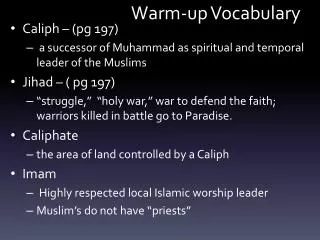
Warm-up Vocabulary • Caliph – (pg 197) • a successor of Muhammad as spiritual and temporal leader of the Muslims • Jihad – ( pg 197) • “struggle,”“holy war,” war to defend the faith; warriors killed in battle go to Paradise. • Caliphate • the area of land controlled by a Caliph • Imam • Highly respected local Islamic worship leader • Muslim’s do not have “priests”
Role of Women in Islam • Quran granted spiritual and social equality • Women could inherit property • Men were still dominant • Every woman had a male guardian • Men could have more than one wife, but not more than four, but most could only afford one due to the dowry
Spread of Islam Umayyads and Abbasids
A quick review • Mohammed (570-632) founded Islam • Based on the messages he heard from Allah • Same God as the Jews and Christians • Quran – Muslim Holy Book • Teaches respect for Jews, Jesus and “the Book” [ the Bible] • 5 Pillars • Sets up a theocracy - Religion, gov’t, & army are combined • Followed by the first 4 Caliphs • called “Rightly Guided” • Strictly adhered to Quran
Muslim conquest • Under the first 4 caliphs, Islam spreads across Persia and into north Africa (632-661) • Take Jerusalem in 638 • Jihad – “struggle,”“holy war,” war to defend the faith. • Warriors killed in battle will go to Paradise • Arabs are tolerant of other religions • But other religions pay high taxes • So it is cheaper to convert to Islam
Umayyad Dynasty (661- 750) • 661 – 4th Caliph ((Mohammed's cousin) is assassinated • The Umayyad family takes over as caliph • Sets up succession by inheritance (dynasty) • Moves the capital from Medina, Arabia (the Prophet’s home) to Damascus, Syria • Builds the Dome of the Rock Mosque • On the site of the Jewish Temple
A split occurs (680) • Some unhappy about Umayyad takeover • Mohammad's grandson, Hussein, leads a revolt • Revolt fails, but leads to a split among Muslims
A split occurs (680) Sunni Shiite Believe only descendants of Mohammed can lead the Islamic community Umayyads were usurpers Dominant - Iraq and Iran 10% of modern Muslims • Accept the caliphs chosen by the Islamic community at large. • 90% of modern Muslims
Umayyad expansion • After the Shiite revolt fails, Umayyad continue to expand East (Indus) and West (North Africa & Spain) • Spanish Muslims - Moors • But support for Umayyad family weakens • Non-Arabs resent favoritism for Arabs • Leaders are becoming corrupt
Abbasid Dynasty (750-1258) • 750 –the Abbasid family takes over • Emphasis is on trade, gov’t, rather than war • Moves the capital to Baghdad • Tigris river goes south to the Red Sea • It is on the Silk Road. • Less prejudice against non-Arabs • All Muslims can hold office • Freedom to marry across racial/national lines
Umayyad Abbasid Mohammad
Golden Age (800’s ) • Greek works are translated and saved • Muslims are studying science • The empire becomes wealthy controlling the silk road
Decline and Division • Wealth, corruption, in-fighting for control • Non-Arabs rise to ruling class • Generals, civil servants • Local gov’ts start to break away • By 973,capital cities in Spain, Egypt and Baghdad all control a part of the divided empire.