Comprehensive Overview of Computer Networking Standards and Protocols
This revision document covers essential topics in computer networks, including standards like OSI and TCP/IP, LANs, MANs, and WANs. It delves into wireless LAN technologies, data compression methods, error detection and correction techniques, routing, and network management. Additionally, it highlights the OSI reference model's seven-layer structure, functions of each layer, and the relationship with various networking standards. Key protocols, including IEEE802.x and ATM, are discussed, alongside modern networking technologies like GPS and 3G systems. This resource is vital for understanding the complexities of contemporary networking.

Comprehensive Overview of Computer Networking Standards and Protocols
E N D
Presentation Transcript
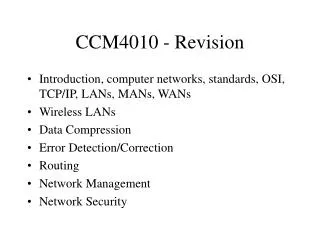
CCM4010 - Revision • Introduction, computer networks, standards, OSI, TCP/IP, LANs, MANs, WANs • Wireless LANs • Data Compression • Error Detection/Correction • Routing • Network Management • Network Security
OSI Reference Model • Seven layered structure • Application • Presentation • Session • Transport • Network • Data Link • Physical
OSIRM • Functions of each layer • Relationships between various networking standards and the OSIRM • LAN standards • IEEE802.x • FDDI • DQDB • ATM • etc.
Protocols Protocol is the set of rules that make communication more efficient.
LANs/MANs/WANs • IEEE802.11 – wireless LAN • HiperLAN - wireless LAN (Europe) • IEEE802.x – LANs • 10Base2/10Base5/10Base T/100Base T etc. • ATM • DQDB • FDDI – SAS/DAS • SDH/SONET • Selection criteria
LANs/MANs/WANs • Topologies • LAN • Bus • Token ring • Star • Extended star
Wireless LANs and Mobile Systems • Infrastructure • Ad-hoc • WAP • i-mode • UMTS • Location technology: • Global Positioning System (GPS)
Transmission Media and supporting technologies • ISDN • ADSL • PSTN • Satellite link • Data link using mobile telephony • Microwave • The Internet
Delay calculations • Propagation time = distance/speed • Transmission time = Number of bits in a frame/bit rate • Total time = outward propagation time + outward transmission time + inward propagation time + inward transmission time
Bridges/Routers • Use of bridges • Routing • Routing tables • Adaptive routing • Non-adaptive routing
Data Compression • Packed decimal • Relative encoding • Character suppression • Huffman coding • Static • dynamic • Limpel-Zev coding
Huffman coding • Statistical encoding • Analyse the characters to be transmitted • Determine character types and their relative frequency • Create an unbalanced tree (Huffman code tree/ binary tree) • Obtain codeword for each character • Calculate the number of bits needed to transmit these characters • Calculate the average number of bits per codeword needed to transmit these characters
Huffman coding • Example: • “AGAIN AND AGAIN AND AGAIN” • Determine character types and their relative frequency A 8; N 5; Sp 4; G 3; I 3; D 2. Total 25 • Create an unbalanced tree (Huffman code tree/ binary tree) • Obtain codeword for each character A 00; N 11; Sp 010; G 011; I 100; D 101 • Calculate the number of bits needed to transmit these characters Total bits 62 • Calculate the average number of bits per codeword needed to transmit these characters 62/25 = 2.48 b/character
Limpel-Zev Coding • Example: • “AGAIN AND AGAIN AND AGAIN” • Ad a space to make the number of characters even (26) • “AGAIN AND AGAIN AND AGAIN ” • Take pair of characters together and determine their frequency AG 3; AI 3; NSp 3; AN 2; DSp 2; Total 13 • Create binary tree • Obtain codeword for each character AG 11; AI 00; NSp 01; AN 100; DSp 101 • Calculate the number of bits needed to transmit these characters Total bits 30
Compression • A very simple stratagem applied to the string could reduce the number of bits needed for transmission of the string still further. Suggest and validate, a suitable stratagem • Answer Put the extra space at the beginning of the string. There are now only four pairs and the total number of bits is 26. SpA; GA; IN; ND;
Huffman - decoding • A code table must be available • Read data as received, compare to known codes, • if it is a match, identify code, • if not keep reading and concatenating bits received
Huffman - decoding • Example 001101000000010110011010011010001 Character coding: E = 1; T = 01; G = 001; C = 0000; A = 0001 001 1 01 0000 0001 01 1 001 1 01 001 1 01 0001 G E T C A T E G E T G E T A
Error control • ASCII • Parity bit: additional bit added to each character • Even parity • Total number of bits (inclusive) in a digital word is even; e.g. 10110111 • Odd parity • Total number of bits (inclusive) in a digital word is odd; e.g. 10110110
Error control • Hamming distance: The Hamming distance of the code is the minimum number of bit positions in which two valid codewords differ. 00000000 00000011 00000101 00000110 Hamming distance? Odd/even parity?
Hamming Codes • The parity bits are inserted into the positions which numerically are the powers of 2 (i.e. 1,2,4,8,16 etc.) • Parity bit 1 covers bits 1,3,5,7,9,… • Parity bit 2 covers bits 2,3,6,7,10,11,14,15,.. • Parity bit 4 covers bits 4,5,6,7,12,13,14,15,20,21,22,23,… • Parity bit 8 covers bits 8,9,10,11,12,13,14,15,24,25,26,27,28,29,30,31,…
Network Management • Functions • Fault management • Performance management • Security • Accounting • etc. • Characteristics of network managers • Other network management topics
Network Security • Terminology/definitions • Solutions