Download
1 / 15
150 likes | 267 Vues
This study investigates two ethnically distinct rural communities within the Cotacachi-Cayapas Ecological Reserve, focusing on their unique settlement patterns and agricultural practices. It highlights the livelihoods of the Chachi and Negro communities, emphasizing their subsistence agriculture, forest extraction, and distinct cultural roles in hunting and fishing. Key findings reveal significant spatial differences in settlement and agricultural plot locations, as well as variations in forest product usage between genders. Understanding these differences is crucial for developing culturally appropriate conservation strategies.

E N D
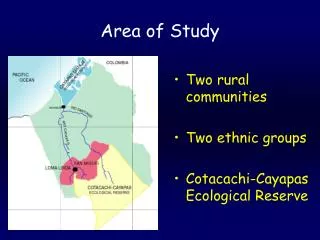
Area of Study • Two rural communities • Two ethnic groups • Cotacachi-Cayapas Ecological Reserve
Diversity at the Community Level • Ethnically distinct • Geographically distinct settlement patterns
San Miguel • Descendents of shipwrecked slaves • Nuclear community • Travel some distance to fields
Loma Linda • Households geographically isolated • Agricultural fields & forest plots located directly behind households
Livelihood Systems • Slash & mulch • Subsistence agriculture • Forest extraction
Chachi Basketry Negro Basketry
CHACHI Men Women Hunting Rampira Fishing Plantain Cacao Chickens Café Cassava Pigs Timber NEGRO Men Women Hunting Canoeras Fishing Fishing Cacao Plantain Café Cassava Cassava Rampira Pigs Plantain Production Systems
Findings • Spatial differences in settlement patterns and agricultural plot locations • Cultural & gender distinct agricultural and forest extraction activities • Differences within gender groups regarding the use of forest products • Cultural & gender differences may influence the adoption of proposed conservation activities
Household Composition, Stress & Strategies in West African Farming Systems Amy J. Sullivan