Understanding Enzymes: Catalysts of Life and Their Role in Chemical Reactions
Enzymes are biological proteins that act as catalysts, accelerating chemical reactions by lowering activation energy. They enable reactants, or substrates, to transform into products within living cells. The specific shape of enzymes is crucial for their function, adhering to the lock-and-key model, where only perfectly fitting substrates can bind. Factors like pH, temperature, and enzyme concentration affect their activity, and inhibitors can interfere with their function. Understanding enzymes is key to grasping biological processes and reactions essential for life.


Understanding Enzymes: Catalysts of Life and Their Role in Chemical Reactions
E N D
Presentation Transcript
Enzymes Catalysts of Life
Review of Chemical Reactions • A chemical reaction is a process that changes, or transforms, one set of chemicals into another • Reactants are elements or compounds that enter into a chemical reaction • Products are the elements or compounds produced by a chemical reaction • Chemical reactions usually require energy to get started • Activation energy is the energy that is needed to get a reaction started
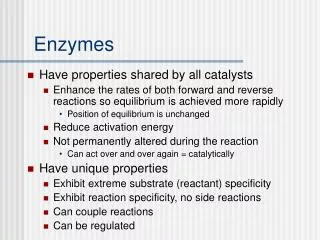
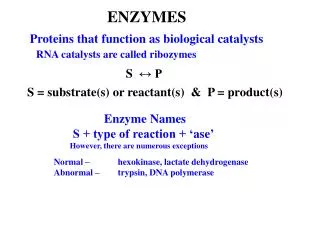
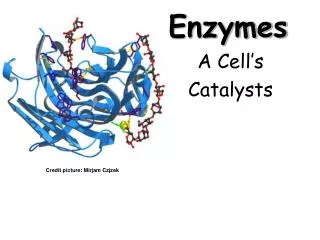
What are enzymes? • Enzymes are proteins that hasten, or speed up, chemical reactions • A catalyst is a substance that speeds up the rate of a chemical reaction • Enzymes are biological catalysts • Enzymes speed up the reactions that take place in cells
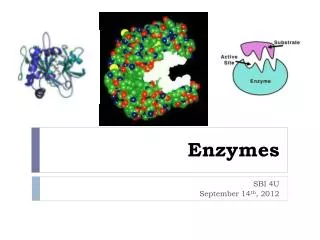
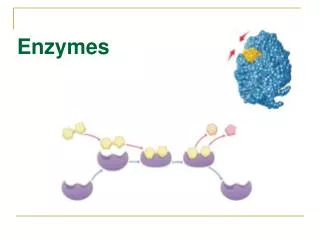
How do enzymes work? • The molecule that an enzyme binds with or acts upon is called the substrate • The spot on an enzyme where the enzyme and substrate bind together is called the active site. • The active site is made of deep folds created by the folding of amino acid chains • Enzymes can be used over and over again after a reaction is complete
How do enzymes work? • Enzymes have a specific shape • Substrates also have a specific shape • In order for an enzyme and substrate to bind together and react, their shapes MUST fit together • This is called the lock-and-key model
How do enzymes work? • If an enzyme shape does not match with a substrate, there is no reaction • An enzyme’s shape can be changed if conditions are not right • If an enzyme’s shape is changed due to changing conditions, then the enzyme has been denatured • No reaction can occur if an enzyme’s shape is denatured • Factors that affect enzyme shape • pH – too acidic or too basic • Temperature – too hot or too cold • Enzyme concentration – how many enzymes are there?
How do enzymes work? • Web Link: • http://www.lew-port.com/10712041113402793/lib/10712041113402793/Animations/Enzyme_activity.html
Other factors affecting enzymes • Competitive inhibitors are molecules that are similar to the substrate’s shape • Competitive inhibitors get stuck in the active site and prevent the enzyme from binding with the substrate • Noncompetitive inhibitors are molecules that bind near, but not at, the active site • Noncompetitive inhibitors change the shape of the active site and prevent the enzyme from binding with the substrate