Understanding Cardiac Output and Blood Flow Regulation in Exercise Physiology
360 likes | 584 Vues
Explore the intricacies of cardiac output and blood flow regulation during exercise, including the Frank-Starling Law, components of blood, Fick Equation, heat exchange mechanisms, and effects of dehydration on cardiovascular parameters. Learn how to optimize hydration for optimal exercise performance.


Understanding Cardiac Output and Blood Flow Regulation in Exercise Physiology
E N D
Presentation Transcript
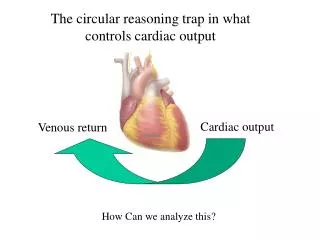
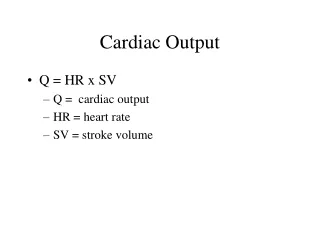
Q = HR x SV Q = cardiac output HR = heart rate SV = stroke volume Cardiac Output
end diastolic volume (EDV) - volume of blood in ventricles at the end of diastole Frank-Starling Law increase in contractility increases volume pumped per beat venous return average aortic blood pressure strength of ventricular contraction Regulation of Stroke Volume
Components of Blood • Plasma • Liquid portion of blood • Contains ions, proteins, hormones • Cells • Red blood cells • Contain hemoglobin to carry oxygen • White blood cells • Platelets • Important in blood clotting • Hematocrit • Percent of blood composed of cells
hematocrit is the percentage of whole blood which is composed of solid material cells, platelets etc the blood is composed primarily of water (~55 %) called plasma the hematocrit would be 45 can vary between 40 and 50
Cardiac Output during Exercise • Q increases in direct proportion to the metabolic rate required to perform task • linear relationship between Q and VO2 • remember... Q = HR x SV
Stroke Volume and Heart Rate during Exercise • in untrained or moderately trained individuals stroke volume plateaus ~ 40% VO2 max • at work rates > 40% VO2 max, Q increases by HR alone • See fig 9.17
The Fick Equation • VO2 = Q x (a-vO2 diff) • VO2 is equal to the product of cardiac output and arterial-mixed venous difference • an increase in either Q or a-vO2 difference will result in an increase in VO2max
Redistribution of Blood Flow • Increased blood flow to working skeletal muscle • Reduced blood flow to less active organs • Liver, kidneys, GI tract
Prolonged Exercise • Cardiac output is maintained • Gradual decrease in stroke volume • Gradual increase in heart rate • Cardiovascular drift • Due to dehydration and increased skin blood flow (rising body temperature) .
Increases in Temperature • Receptors on skin first sense changes • receptors also located in spinal cord and hypothalamus respond to core temp changes • Stimulates sweat glands - increases evaporation • Increases skin blood flow - vasodilation
Take Home Message • During exercise, evaporation is the most important method of heat loss • Heat production must be matched with heat dissipation or hyperthermia will ensue
Metabolic heat production increases in proportion to the exercise intensity • Convective and radiative heat loss do not increase with intensity as temp gradient between body and environment does not change significantly
Hyperthermia • Increased core temperature to the point that physiological functions are impaired • Contributing factors • dehydration • electrolyte loss • failure of cooling mechanisms to match heat production
Other factors related to hydration • Water as a solvent • Ionic concentration • Neuro-muscular coordination • Contractile function • Reactions • Macronutrient formation • Glycogen • Proper digestion and waste removal
Amount of fluids ingested • Small amounts of fluid ingestion do not entirely attenuate • Elevation in core temperature • Elevation in heart rate • Rating of perceived exertion
Moderate and Large fluid intake resulted in significantly different responses than No or Small fluid intake Small = 300 ml/hr Moderate=700 ml/hr Large=1200 ml/hr From Coyle SSE #50 GSSI
Effects of dehydration on cardiovascular parameters versus % body weight loss From Coyle SSE #50 GSSI
Recommendations • Drink as much as can be tolerated up to 1250 ml/h for 68 kg/150 lb individual • Drink should contain 4-8 % CHO to optimize absorption • Adjust volume per body weight as ratio of 68 kg • E.g. 50 kg> 50/68 * 1250 = 925 ml/hr