Download
1 / 1
10 likes | 154 Vues
In this lab, students will explore the principles of motion by collecting data on the speed of a ball. By measuring how long it takes for a ball to travel between set distances, students will observe variations in movement speed. The experiment involves timing the ball as it rolls, graphing the data, and analyzing the results to understand motion dynamics. Students will work in groups to ensure accurate timing and data collection, culminating in a graphical representation that reflects their findings.

E N D
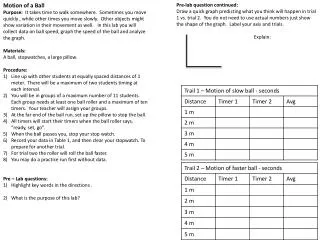
Motion of a Ball Purpose: It takes time to walk somewhere. Sometimes you move quickly , while other times you move slowly. Other objects might show variation in their movement as well. In this lab you will collect data on ball speed, graph the speed of the ball and analyze the graph. Materials: A ball, stopwatches, a large pillow. Procedure: Line up with other students at equally spaced distances of 1 meter. There will be a maximum of two students timing at each interval. You will be in groups of a maximum number of 11 students. Each group needs at least one ball roller and a maximum of ten timers. Your teacher will assign your groups. At the far end of the ball run, set up the pillow to stop the ball. All timers will start their timers when the ball roller says, “ready, set, go”. When the ball passes you, stop your stop watch. Record your data in Table 1, and then clear your stopwatch. To prepare for another trial. For trial two the roller will roll the ball faster. You may do a practice run first without data. Pre – Lab questions: Highlight key words in the directions . What is the purpose of this lab? Pre-lab question continued: Draw a quick graph predicting what you think will happen in trial 1 vs. trial 2. You do not need to use actual numbers just show the shape of the graph. Label your axis and trials. Explain: