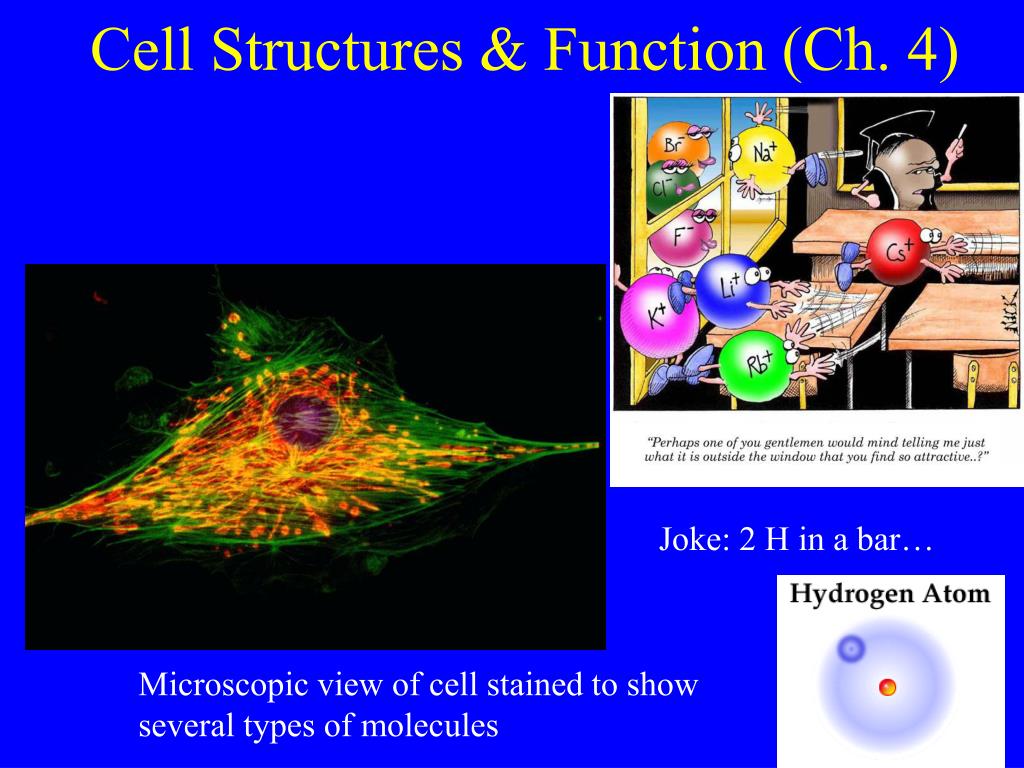
Cell Structures & Function (Ch. 4). Joke: 2 H in a bar…. Microscopic view of cell stained to show several types of molecules. Cell structures and functions. Animal Cell. Cell structures and functions. 2. cytoplasm. 3. nucleus. 1. plasma membrane. Animal Cell.
Une image / un lien ci-dessous est fourni (tel quel) pour télécharger la présentation
Politique de téléchargement : le contenu du site vous est fourni TEL QUEL pour votre information et votre usage personnel ; il ne peut être vendu, concédé sous licence ni partagé sur d’autres sites sans l’accord de son auteur.Le contenu vous est fourni TEL QUEL, pour votre information et votre usage personnel uniquement.Téléchargez la présentation en cliquant sur ce lien.Lors du téléchargement, si vous ne parvenez pas à télécharger une présentation, l’éditeur a peut-être supprimé le fichier de son serveur.Pendant le téléchargement, si vous ne parvenez pas à obtenir une présentation, le fichier a peut-être été supprimé par l’éditeur.
Cell structures and functions • 5) Endoplasmic reticulum (ER): Membrane sacs & channels transport materials (“freeway system”). • 6) Ribosomes: Granules used in making proteins (“protein factories”)
ER • Rough ER: has ribosomes (making proteins) • Smooth ER: no ribosomes. Make lipids & others. • Liver: enzymes on smooth ER “Detox centers” (break down drugs)
Golgi apparatus • 7) Golgi apparatus: Sorting, processing, shipping center
Golgi apparatus • 7) Golgi apparatus: Sorting, processing, shipping center
Lysosome storage diseases • Pompe’s disease: glycogen not broken down by liver • Tay-Sachs disease: lipids not broken down (damages nerve cells in brain)
Cell structures and functions Clusters protein tubules Function: cell division (covered later….) 9) Centrioles Animal Cell
PLANT CELL Golgi body central vacuole vesicle rough ER) microfilaments (components of cytoskeleton) ribosomes (attached to rough ER) ribosomes in cytoplasm smooth ER mitochondrion DNA + nucleoplasm chloroplast nucleolus NUCLEUS nuclear envelope plasma membrane microtubules (components of cytoplasm) cell wall
Vacuoles • Large membrane “bags” • Most plant cells: huge “central vacuole” (storage) Plant cell TEM micrograph Centralvacuole Cell walls Nucleus
Nucleus Contractilevacuoles Other Vacuoles • Some unicellular organisms: “contractile vacuoles” (expel water)
Cytoskeleton • Protein tubes: Cell shape, hold organelles • Some cells: “ameboid movement” • Change cytoskeleton (change cell shape) • Projections: “pseudopods” Direction movement Amoeba movie Pseudopods
Archaea and Bacteria cells • Mostly unicellular • Cells very small, simple (1/10 size other cells) • Prokaryotes: Cell wall, plasma membrane, ribosomes, DNA. If flagella, differ from other flagella. • NO nucleus, mitochondria, chloroplasts, ER
Prokaryotic cell DNA plasma membrane bacterial flagellum capsule ribosomes in cytoplasm pilus cell wall cytoplasm
Prokaryote example TEM micrograph • Bacterial cell (rod-shaped) Bacillus infernus: The “bacillus from Hell” From rock 3 km deep!
Protists • 2 main groups • 1) Algae: photosynthetic protists (chloroplasts) • 2) Protozoans: eat other organisms • Ex: Paramecium, Amoeba Volvox Giant kelp
Fungi • Have: cell walls, nuclei, mitochondria, ribosomes • No chloroplasts, usually no flagella • Molds, yeasts, mushrooms
Plants • Have: cell walls, chloroplasts, central vacuole • Also nuclei, ER, mitochondria, ribosomes, golgi apparatus • Most lack flagella/cilia, centrioles Federally endangered AL plants!
Animals • No cell walls, chloroplasts, central vacuoles • Have: lysosomes, centrioles, flagella, etc.